


Dark
Light
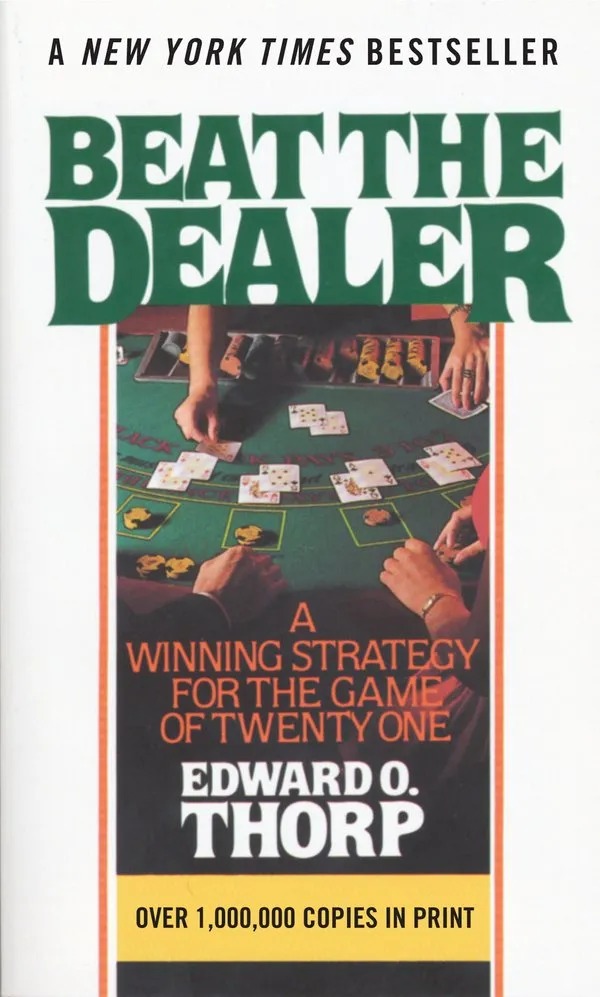
Edward O. Thorp, a mathematician and hedge fund pioneer, revolutionized the world of gambling with his groundbreaking book Beat the Dealer in 1962. Using probability theory and computer simulations, Thorp proved that blackjack could be beaten with a strategic approach. His Ten-Count System gave players a statistical edge over the house, transforming blackjack from a game of chance into a game of skill.
The Origins of the Ten-Count System
The birth of card counting began with a simple question: Could mathematics beat the casino? Collaborating with Claude Shannon, the father of information theory, Thorp used the IBM 704 computer to simulate thousands of blackjack hands. His analysis revealed that the ratio of tens (10, J, Q, K) to non-tens in the deck had a significant influence on the game’s outcome. When more tens remained, the player had a higher chance of winning.

Understanding the Ten-Count System
Card Values
| Card | Value |
|---|---|
| A–9 | +4 |
| 10 | -9 |
The Ten-Count System assigns values to cards based on their impact on the game. Non-tens (A through 9) are counted as +4, while tens (10, J, Q, K) are counted as -9. Players maintain a running count by adding or subtracting these values as cards are revealed.
Calculating the True Count
To determine the true count, divide the running count by the number of decks remaining. This helps adjust for multi-deck games and provides a more accurate measure of the player’s advantage.
Example:
- Cards seen: 2, 3, 5, 7, 10, J, Q
- Running Count: +4 (2) +4 (3) +4 (5) +4 (7) -9 (10) -9 (J) -9 (Q) = -7
- Decks remaining: 1
- True Count = -7 / 1 = -7 → Bet minimum
How Thorp Tested His System
Thorp didn’t stop at simulations. He took his system to the casinos of Reno, Lake Tahoe, and Las Vegas. Using his Ten-Count strategy, he began consistently winning at blackjack, prompting casinos to change their rules, introducing frequent shuffling and limiting deck penetration. Thorp’s success proved that mathematical strategy could outperform intuition and luck.
Strategic Advantages of the Ten-Count System
- Predicts Dealer Busts: High true counts indicate a higher proportion of tens in the deck, thereby increasing the likelihood of dealer busts.
- Informs Player Decisions: Helps determine when to hit, stand, double down, or split.
- Optimizes Bet Sizing: Players can increase bets during favorable counts to maximize profits.
- Reduces House Edge: With perfect execution, the house edge can drop below zero.
Comparing the Ten-Count to Modern Systems
| System | Simplicity | Accuracy | Deck Adaptability |
|---|---|---|---|
| Ten-Count | Moderate | High | Best for single deck |
| Hi-Lo | Easy | Moderate | Multi-deck friendly |
| Omega II | Complex | High | Advanced players only |
While the Ten-Count System is less common today due to its complexity and the prevalence of multi-deck games, it remains a valuable tool for understanding the mathematics behind card counting.
Practicing the Ten-Count System
Training Techniques
- Flash Card Drills: Practice assigning values quickly to each card.
- Deck Walkthroughs: Count through a full deck to verify the total equals zero.
- Simulated Play: Use apps or software to mimic real casino conditions.
- True Count Estimation: Practice dividing the running count by decks left.
Tips for Success
- Start with single-deck games to simplify deck estimation.
- Use a timer to simulate the pace of a casino.
- Track accuracy and speed over time.
Using a Card Counting System in Real Casinos
Preparation
- Dress inconspicuously to avoid attention.
- Understand the casino’s shuffle and deck penetration habits.
- Build mental stamina for long sessions.
Execution
- Flat bet during neutral counts.
- Increase bets when the true count is high.
- Apply basic strategy deviations based on the count.
Risk Management
- Set win/loss limits.
- Vary bet sizes subtly to avoid detection.
- Consider team plays for camouflage and efficiency.
Psychological and Ethical Considerations
Card counting is legal, but it is frowned upon by casinos. Players must maintain discipline, focus, and emotional control at all times. Thorp emphasized intellectual curiosity and strategic thinking over greed, advocating for a respectful and calculated approach to advantage play.
Thorp’s Legacy Beyond Blackjack
Edward Thorp’s influence extends far beyond the casino floor. His hedge fund, Princeton/Newport Partners, applied similar statistical models to financial markets. Thorp’s work laid the foundation for quantitative finance, and Beat the Dealer remains a seminal text in the fields of gambling and probability theory.
Beat the Dealer
Beat the Dealer
5
5
0
1
The Book That Made Las Vegas Change the Rules. Over 1,000,000 Copies in Print.
Edward O. Thorp is the father of card counting, and in this classic guide he shares the revolutionary point system that has been used successfully by professional and amateur card players for generations.
Edward O. Thorp is the father of card counting, and in this classic guide he shares the revolutionary point system that has been used successfully by professional and amateur card players for generations.
The Book That Made Las Vegas Change the Rules. Over 1,000,000 Copies in Print.
Edward O. Thorp is the father of card counting, and in this classic guide he shares the revolutionary point system that has been used successfully by professional and amateur card players for generations.
Edward O. Thorp is the father of card counting, and in this classic guide he shares the revolutionary point system that has been used successfully by professional and amateur card players for generations.
5/5
Total Score
iAudiobook: A Winning Strategy for the Game of Twenty-One. Edward O. Thorp (Author), Marc Cashman (Read by)
Amazing
Final Thoughts
The Edward O. Thorp Ten-Count System is a masterclass in applied mathematics. Though complex, it offers deep insight into probability and strategic thinking. With practice and discipline, players can transform blackjack from a game of chance into a calculated opportunity for success.
Frequently Asked Questions
Is Edward Thorp’s Ten-Count System still relevant today?
Yes, especially for single-deck games. While modern systems like Hi-Lo are more common, Thorp’s method remains a foundational strategy.
Is card counting legal in casinos?
Card counting is legal, but casinos reserve the right to refuse service or ban players suspected of using it.
How did Thorp develop his system?
Thorp used IBM 704 computer simulations and probability theory to analyze blackjack outcomes and devise his Ten-Count strategy.
What’s the difference between Ten-Count and Hi-Lo systems?
Ten-Count is more complex and accurate for single-deck games, while Hi-Lo is simpler and better suited for multi-deck play.
Can beginners learn the Ten-Count System?
Yes, with dedication and practice. Begin with flashcard drills and simulated play to develop speed and accuracy.


Sign Up for Our Newsletters
Be the first to know when new content is created.Related Posts

How to Create a Simple Random Number Generator in Excel
Random number generators (RNGs) are systems that produce unpredictable values used in computing, gaming, and cryptography. They ensure fairness, simulate chance, and power secure algorithms. By generating sequences without discernible patterns, RNGs replicate randomness found in nature, making them essential for online gambling, simulations, and digital security applications.

Improve Your Blackjack: 5 Things You Need to Do Right Now
Want to know how to improve at blackjack? Forget lucky streaks, hunches and supposedly unbeatable betting systems. The best blackjack tips are based on mathematics, good decision-making and understanding the game you are playing. Here are five things you need to learn if you want to become a better blackjack player.

Hi-Lo Card Counting Strategy: How the Blackjack Counting System Works
The Hi-Lo Card Counting Strategy is one of the best-known systems used to track the changing composition of a blackjack deck or shoe. Rather than trying to predict individual cards, the Hi-Lo Counting System assigns simple values to different card ranks and maintains a running count as cards are revealed. The system was introduced by Harvey Dubner in 1963 and remains one of the most widely discussed blackjack card counting methods.

Chinese Sports Betting Syndicates: How They Operate and Their Role in Global Sports Betting
Chinese sports betting syndicates are best understood as organised groups of bettors, analysts, intermediaries and financial participants who coordinate sports wagering across markets. Their activities can range from sophisticated legal betting strategies to illegal gambling and, in documented cases, match manipulation. The term does not describe one organisation or all Chinese bettors.