


Dark
Light
Chinese sports betting syndicates are best understood as organised groups of bettors, analysts, intermediaries and financial participants who coordinate sports wagering across markets. Their activities can range from sophisticated legal betting strategies to illegal gambling and, in documented cases, match manipulation. The term does not describe one organisation or all Chinese bettors.
Why the Term “Chinese Syndicate” Needs Care
There is a significant difference between describing a documented network of individuals and attributing suspicious betting to Chinese people as a group. While I have used the term ‘Chinese Betting Syndicates’ for this article, a more accurate description may be ‘Asian Betting Syndicates’.
The overall purpose of this article is to provide information; it should not be inferred that Chinese syndicates are more likely to engage in criminal activity.
China has a huge population, a large sporting audience, and substantial international connections. Chinese nationals participate legitimately in sport, investment and betting-related businesses around the world.
What Are Chinese Sports Betting Syndicates?
The phrase Chinese sports betting syndicates is often used loosely in media and gambling discussions. It is important to distinguish between a formal syndicate, a network of professional bettors, illegal gambling operations, and a group involved in match manipulation.
A betting syndicate generally involves several people pooling capital, information, analytical expertise, or betting access. One participant might analyse statistics, another may identify pricing opportunities, while others place wagers through different betting accounts or channels.
The basic economic principle is similar to professional sports betting elsewhere: identify situations in which the perceived probability of an outcome differs from the price offered by bookmakers or betting exchanges.
That does not, by itself, constitute match fixing.
Match fixing is fundamentally different because it involves deliberately altering a sporting contest or event for an improper purpose. INTERPOL identifies match fixing as one of the forms of corruption in sport that can be exploited by organised criminal networks for profit and money laundering.
Consequently, an article about Chinese betting syndicates must avoid treating ordinary professional betting, illegal gambling and sports corruption as interchangeable concepts.

How Chinese Betting Syndicates Operate
A sophisticated sports betting syndicate can resemble a small trading operation.
Potential roles include:
- betting analysts
- statisticians
- sports specialists
- market traders
- account managers
- bankroll providers
- information gatherers
- intermediaries
- bettors operating across different jurisdictions
The division of labour can provide advantages over an individual bettor. A specialist football analyst, for example, may concentrate entirely on Asian leagues, while another member studies European football and another monitors market movements.
The important point is that syndicate organisation does not necessarily mean criminality.
The distinction becomes critical when a network moves from attempting to predict an uncertain sporting event to attempting to control the event itself.

The Importance of Asian Handicap Betting
One of the most important concepts when researching Asian sports betting syndicates is the Asian handicap.
Asian handicap markets attempt to reduce the significance of unequal teams by applying a virtual advantage or disadvantage. Instead of simply betting on which team wins, the bettor wagers on whether a team will overcome an assigned handicap.
For example, a stronger football team might be priced at a -1 handicap against an underdog. The market therefore incorporates the expected difference between the teams.
Asian handicap markets became particularly important in international football betting because they can provide highly liquid markets and more granular pricing than simple win-draw-win betting.
For professional bettors, the attraction is not that Asian handicap betting guarantees a profit. Rather, it provides a framework in which probabilities, prices and expected returns can be analysed systematically.
This is also why betting-market surveillance is important. Large or unusual changes in prices can potentially provide information about betting activity, although an unusual market movement is not automatically evidence of match fixing.
Data and Information Networks
Modern Chinese sports betting networks operate in an environment where information is increasingly valuable.
A professional betting group may monitor:
- historical performance
- injuries and suspensions
- team selection
- player availability
- travel schedules
- weather
- tactical changes
- statistical trends
- bookmaker prices
- betting-market movements
- live-event data
The emergence of real-time data has transformed sports betting. Instead of relying solely on newspapers, television or personal knowledge, sophisticated operators can analyse enormous amounts of information.
Sports integrity organisations use similar data from the opposite perspective.
FIFA says its partnership with Sportradar includes a Fraud Detection System that monitors football matches and betting markets for suspicious betting behaviour and patterns. The system covers FIFA competitions, confederation competitions and a wide range of domestic competitions.
The same underlying market data that can be used by bettors to make decisions can therefore also help regulators and sports bodies identify unusual activity.

International Connections
The expression Chinese sports betting syndicates can create the misleading impression that betting activity begins and ends inside China.
International sports betting is inherently cross-border. A football match in Europe may attract bets from Asia, while a basketball game in North America may be traded by bettors elsewhere.
Betting activity can therefore involve:
- Asian markets
- European bookmakers
- offshore operators
- betting exchanges
- data companies
- payment networks
- intermediaries
- sports integrity organisations
INTERPOL emphasises the international nature of sports corruption investigations. Its Match-Fixing Task Force brings together law-enforcement agencies and national points of contact to support information sharing and international investigations.
This international structure is one reason why suspicious betting investigations can become complicated. The sporting event, betting operator, bettor, intermediary, and financial transactions may all be located in different jurisdictions.
Chinese Sports Betting Syndicates and Football
Football is particularly exposed to betting-related integrity risks because of the enormous number of matches played globally and the extensive range of betting markets available.
Potential markets include:
- match result
- Asian handicap
- total goals
- half-time result
- corners
- cards
- player-related events
- exact score
The more betting markets available, the greater the number of possible outcomes that can theoretically be manipulated.
China has also experienced significant domestic football corruption investigations.
A major investigation into Chinese football corruption examined bribery, betting and match manipulation involving officials, referees and players. The consequences included criminal convictions and disciplinary action affecting Chinese football. Historical cases therefore demonstrate that football corruption in China is a documented issue, rather than merely an internet theory.
However, those cases should not be used to claim that contemporary Chinese football or Chinese bettors generally are corrupt.
The appropriate conclusion is narrower: football has experienced documented betting-related corruption cases in China, just as football has experienced integrity investigations in numerous other countries.
Chinese Sports Betting Syndicates and Basketball
Basketball presents a different integrity environment from football.
The sport produces a large number of individual events during a game, creating numerous possible betting markets. Depending on the competition and bookmaker, markets may include:
- match winner
- point spread
- total points
- quarter results
- half-time markets
- player statistics
- live betting markets
This creates opportunities for both legitimate statistical analysis and attempts to exploit manipulated information.
FIBA explicitly defines competition manipulation as an intentional arrangement, act, or omission designed to improperly alter the result or course of a sporting competition. Its integrity guidance prohibits basketball participants from betting on basketball and requires suspicious approaches or match-fixing concerns to be reported.
The existence of FIBA’s integrity framework demonstrates that basketball faces the same broad international risks as other major sports.
At the same time, claims about a specific Chinese basketball betting syndicate should be supported by a documented investigation. It is not accurate to infer that unusual betting automatically proves a Chinese syndicate was involved.
Regulation of Sports Betting in China
The regulatory environment is central to understanding Chinese sports betting.
China’s Sports Law explicitly prohibits organisations or individuals from using sporting events to engage in gambling activities. It also requires sports participants and organisers to observe sporting rules and prohibits fraudulent or improper conduct.
Chinese sports-event regulations likewise state that participants must not manipulate competitions or participate in gambling connected with sporting events.
China’s regulatory position therefore needs to be distinguished from the international betting markets in which Chinese-linked bettors may participate.
A person located in one country can potentially place bets concerning a sporting event taking place in another. That creates jurisdictional challenges for regulators and investigators.
Match Fixing, Investigations and the Chinese Syndicate Question
Why Match Fixing Is Different From Betting
The most important distinction in this subject is between betting on sport and manipulating sport.
A professional bettor attempts to predict an uncertain event.
A match fixer attempts to make the event less uncertain by influencing its outcome, score, progression, or individual components.
That distinction is reflected in sports integrity regulations worldwide.
For example, the WPBSA prohibits participants from fixing or attempting to fix the score, progress, conduct, or other aspects of a snooker match and prohibits betting by members on WPBSA events.

Documented Chinese Snooker Match-Fixing Case
The clearest recent example associated with a group of Chinese participants is the 2022–2023 snooker match-fixing investigation.
The WPBSA investigated ten Chinese players after receiving information concerning suspicious betting activity. The organisation worked with Sportradar, while the investigation was also informed by integrity alerts.
The players investigated included:
- Liang Wenbo
- Li Hang
- Lu Ning
- Yan Bingtao
- Zhao Xintong
- Zhao Jianbo
- Chang Bingyu
- Bai Langning
- Chen Zifan
- Zhang Jiankang
In January 2023, the WPBSA announced that all ten faced charges involving match-fixing, betting or related conduct.
Following the independent disciplinary process, all ten were found to have committed relevant breaches. Liang Wenbo and Li Hang received lifetime bans, while the other eight received substantial suspensions.
The case is particularly important for understanding sports betting syndicate structures because it demonstrates how manipulation can involve multiple layers.
The WPBSA findings described Liang Wenbo and Li Hang as central figures in the manipulation. The case included allegations and findings concerning approaches to other players, betting, and attempts to manipulate matches.
The investigation also demonstrates the importance of communications and betting data. According to the WPBSA, the investigation began after an alert from Sportradar and involved detailed analysis of information relating to the players.
The WPBSA subsequently stated that it monitors betting on snooker markets worldwide in partnership with Sportradar and investigates deviations from normal betting patterns.
This case is therefore a useful real-world illustration of how a modern sports integrity investigation can move from betting-market anomalies to human intelligence, player interviews, communications and disciplinary proceedings.
It is also important not to overgeneralise. The WPBSA said the disciplinary commission found no evidence in the case of a wider culture of wrongdoing in snooker.

What the Snooker Case Reveals About Syndicate Structures
The case illustrates several characteristics sometimes associated with organised betting manipulation.
- First, there can be a central organiser or organisers.
- Second, participants can be recruited through existing personal relationships.
- Third, information can travel through private communication channels.
- Fourth, different participants can have different roles.
- Fifth, the intended betting outcome may involve a specific scoreline or event rather than simply the winner.
This last point is particularly important.
A match does not necessarily have to be completely lost for manipulation to have betting value. In sports with multiple markets, an individual frame, set, goal, point, card or other event may become the subject of a wager.
That is one reason modern integrity monitoring examines betting patterns rather than simply final results.
Chinese Sports Betting Syndicates and Football Match Fixing
Football’s global popularity makes it a major target for integrity monitoring.
China has a documented history of football corruption investigations, including a major investigation covering match fixing and bribery in domestic football. The investigation resulted in criminal convictions and disciplinary consequences involving officials, referees and players.
Internationally, football authorities have developed increasingly sophisticated monitoring systems.
FIFA’s betting-fraud detection arrangements with Sportradar are designed to identify suspicious betting behaviour across international and domestic competitions. When anomalies are detected, FIFA works with relevant confederations and associations.
This means that a modern football investigation may combine:
- betting-market data;
- match footage;
- player and referee information;
- communications;
- financial information;
- witness testimony; and
- information from betting operators.
A betting anomaly is therefore generally an investigative lead rather than proof of corruption.
Chinese Sports Betting Syndicates and Basketball Match Fixing
Basketball integrity investigations face similar challenges but can involve different statistical indicators.
Because basketball generates many scoring events, integrity analysts can examine unusual patterns involving:
- point spreads
- totals
- quarter-by-quarter results
- player statistics
- unusual scoring sequences
- live betting activity
FIBA’s integrity programme recognises competition manipulation as a serious threat and provides reporting mechanisms for suspicious approaches and betting-related concerns.
For Chinese basketball betting syndicates, therefore, it is more accurate to discuss the mechanisms that investigators look for than to assume that a particular nationality identifies the perpetrators.
The key issue is whether individuals or networks have attempted to improperly influence a competition.
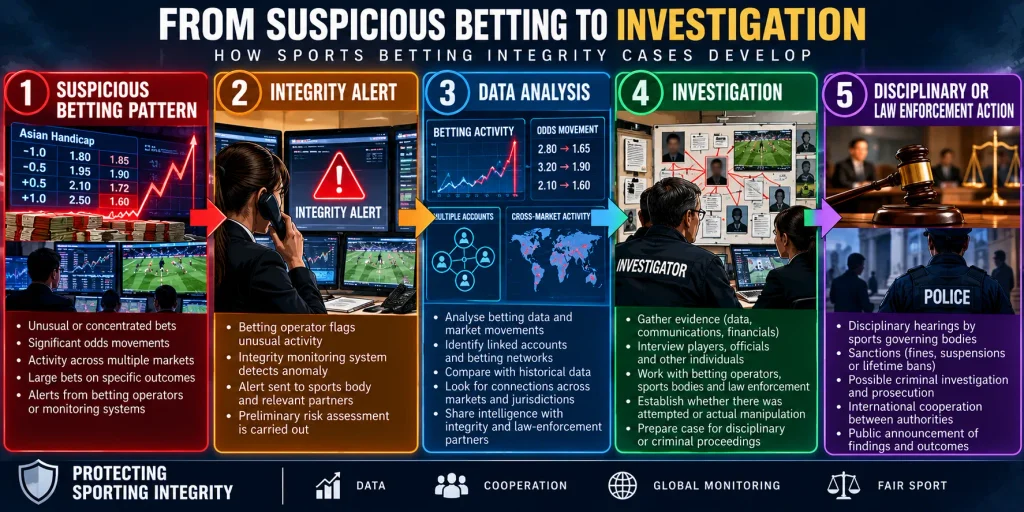
How International Betting Investigations Work
Modern investigations increasingly depend on cooperation.
- A single organisation may not possess all the necessary evidence.
- A betting operator may have account and transaction data.
- A sports federation may have competition information.
- A data company may identify statistical anomalies.
- Law enforcement may obtain communications or financial evidence.
- An international organisation may coordinate information between jurisdictions.
INTERPOL’s Match-Fixing Task Force was created to support precisely this type of cooperation and includes law-enforcement agencies from around the world.
This makes the phrase international betting syndicate more useful than assuming that every operation is based in a single country.
Are Chinese Sports Betting Syndicates Illegal?
There is no single answer because the phrase can describe different activities.
A professional bettor operating legally in a jurisdiction is not automatically committing a crime simply because several bettors cooperate.
Illegal gambling operations are different.
Match fixing is different again.
Money laundering, bribery, fraud and corruption can create additional criminal offences.
Within China, the Sports Law expressly prohibits gambling activities at sporting events.
Consequently, discussions of Chinese sports betting syndicates should always identify the specific activity being discussed and the jurisdiction involved.
The Role of Technology
Technology has created a technological arms race between sophisticated betting operations and sports-integrity organisations.
| Betting groups use | Integrity organisations use |
|---|---|
| statistical models | betting surveillance |
| automated price comparison | anomaly detection |
| historical databases | player education |
| real-time data | confidential reporting |
| market monitoring | intelligence sharing |
| communications platforms | video analysis |
| investigative databases |
The WPBSA’s partnership with Sportradar provides a direct example. Its Integrity Unit says betting on snooker is monitored across markets, and unusual betting patterns can trigger investigation.
Conclusion
Chinese sports betting syndicates are best understood as part of a wider international betting ecosystem rather than as one identifiable organisation. Some syndicates may focus on sophisticated statistical betting, while documented cases show that organised networks can also become involved in illegal gambling or sports manipulation.
Asian handicap markets, real-time data and international betting networks have made sports wagering increasingly sophisticated, while organisations such as FIFA, FIBA, the WPBSA and INTERPOL have developed monitoring and investigative systems to protect sporting integrity.
The 2022–23 Chinese snooker investigation demonstrates how suspicious betting patterns can lead to detailed investigations and serious disciplinary consequences. The essential distinction remains between analysing sport to place a wager and attempting to manipulate sport for financial gain.
FAQ: Chinese Sports Betting Syndicates
What are Chinese sports betting syndicates?
Chinese sports betting syndicates generally refer to organised groups of bettors or betting-related participants who coordinate capital, information, analysis or wagering activity. The phrase does not identify one organisation.
How do Chinese sports betting syndicates work?
A syndicate may divide responsibilities between analysts, bankroll providers, bettors and intermediaries. More sophisticated groups can use statistical analysis and real-time betting information to identify prices they consider attractive.
Are Chinese sports betting syndicates legal?
Legality depends on the activity and jurisdiction. China’s Sports Law prohibits using sporting events for gambling activities, while international betting laws vary between jurisdictions.
What is an Asian handicap?
An Asian handicap is a sports-betting market that applies a virtual advantage or disadvantage to competing teams. It is particularly associated with football betting and is widely used in Asian and international betting markets.
Are Chinese sports betting syndicates involved in match fixing?
Documented cases exist involving Chinese individuals and sports manipulation, including the major 2022–23 snooker investigation. However, this does not establish that Chinese betting syndicates generally engage in match fixing. The specific evidence in each case must be examined.
What happened in the Chinese snooker match-fixing case?
The WPBSA investigated ten Chinese players and subsequently found all ten to have breached its conduct regulations. Liang Wenbo and Li Hang received lifetime bans, while the other eight received suspensions of varying lengths.
How do betting companies detect match fixing?
Betting operators and integrity organisations can monitor unusual betting patterns, price movements and other indicators. FIFA, for example, uses a betting-fraud detection system in cooperation with Sportradar.
Why is basketball vulnerable to betting manipulation?
Basketball offers many betting markets because games contain numerous scoring events. FIBA therefore has specific rules and integrity procedures covering betting and competition manipulation.
Is unusual betting evidence of match fixing?
No. Unusual betting can have many explanations. It can become an investigative indicator, but proving manipulation generally requires additional evidence.
What is the difference between a betting syndicate and a bookmaker?
A betting syndicate generally consists of bettors coordinating their wagering, whereas a bookmaker accepts bets and establishes prices or otherwise facilitates betting. Their economic roles are fundamentally different.
Why are international betting networks difficult to investigate?
A single betting activity can involve participants, bookmakers, payment channels, sporting events, and data providers located in different jurisdictions. International cooperation is therefore important in complex investigations.
Reference List:
Fédération Internationale de Basketball. (n.d.). Betting and match fixing. FIBA.
Fédération Internationale de Basketball. (n.d.). Match manipulation. FIBA.
Fédération Internationale de Football Association. (2025). Betting fraud detection system. FIFA.
INTERPOL. (n.d.). Corruption in sport. International Criminal Police Organization.
National People’s Congress of the People’s Republic of China. (2022). Law of the People’s Republic of China on Sports.
General Administration of Sport of China. (2022). Notice on seriously investigating and dealing with gambling, match fixing and other violations and strengthening industry self-discipline.
Xinhua. (January 29, 2026). Sweeping penalties target soccer corruption in China. China Daily
Sun Xiaochen. (September 11, 2024). Crackdown intensified on illegal activities in soccer. China Daily.
World Professional Billiards and Snooker Association. (2023, January 18). WPBSA statement: 18 January 2023.
World Professional Billiards and Snooker Association. (2023, June 6). WPBSA statement: 6 June 2023.
World Professional Billiards and Snooker Association. (n.d.). Integrity Unit.
World Professional Billiards and Snooker Association. (n.d.). Disciplinary cases September 2020–May 2025.
Ostlere, L. (2026). Inside the Chinese match-fixing scandal that rocked snooker – and how the ringleaders got caught. The Independent.
BBC Sport. (2023, June 6). Snooker match-fixing scandal: Liang Wenbo and Li Hang handed lifetime bans.
BBC Sport. (2023, January 18). Snooker match-fixing investigation: 10 Chinese players charged by WPBSA. Audio.


Sign Up for Our Newsletters
Be the first to know when new content is created.Related Posts

How to Play and Win at Three Card Poker
Three Card Poker is one of the fastest, simplest, and most exciting casino games online. This guide explains how the game works, the best strategies to improve your odds, and the smart betting decisions that help players maximise wins while avoiding common mistakes at real‑money Three Card Poker tables.

How to Use a Blackjack Progression Betting System
Blackjack progression betting is a structured approach to changing wager sizes according to previous results rather than placing the same stake on every hand. A blackjack progression system can increase or decrease bets after wins or losses, but it does not alter the underlying mathematical odds. Understanding progression betting, bankroll requirements, volatility and its limitations is essential before examining any blackjack progression betting strategy.

A Complete Guide to Online Betting Sites
Online betting sites have revolutionized the way people place wagers, offering convenience, variety, and accessibility from anywhere in…

How to Win a Million‑Dollar Poker Tournament
Winning a million‑dollar Texas Hold’em poker tournament requires far more than technical skill. It’s a structured journey involving bankroll management, satellite qualification, physical conditioning, mental preparation, accommodation planning, professional conduct, elite strategy, and responsible post‑win financial management. This comprehensive checklist explains how to qualify, prepare, play, and succeed, while maintaining the mindset and discipline required to compete at the highest level.