


Dark
Light
Illegal gambling in Birmingham between 1890 and 1930 thrived in back‑street pubs, industrial slums, and racecourse networks controlled by gangs like the Peaky Blinders and the Birmingham Boys. Despite strict laws, betting, pitch‑and‑toss, and off‑track bookmaking flourished, shaping the city’s criminal underworld and police responses.
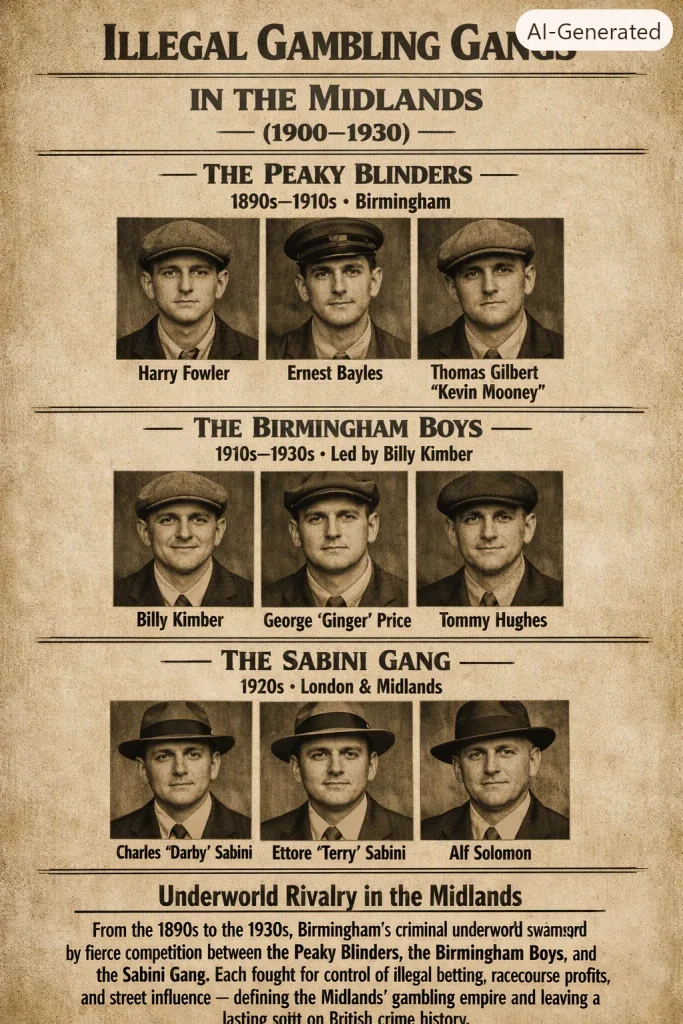
The Illegal Gambling Gangs of Birmingham (1890-1930)
From 1890 to 1930, the illegal gambling gangs of Birmingham thrived. Rival gangs like the Peaky Blinders and Birmingham Boys fought for control of racecourse profits and street betting.
Who Was Involved?
Illegal gambling in Birmingham’s early 20th century was dominated by street gangs, most famously the Peaky Blinders and later the Birmingham Boys led by Billy Kimber. These Midlands gangs controlled betting pitches, extorted bookmakers, and operated protection rackets across the Midlands and racecourses nationwide.
The Peaky Blinders were not just violent street toughs; many members were involved in illegal bookmaking, petty crime, and black‑market dealings. Court records show offenders ranging from 19‑year‑old Harry Fowler and Ernest Bayles to older gang members like Thomas Gilbert, illustrating a mix of young working‑class men and seasoned criminals.
By the 1920s, the Birmingham Boys had become the dominant force, controlling racecourse crime and clashing with rival gangs such as the Sabinis. Their operations extended far beyond Birmingham into Northern England, the Midlands, and London.
Types of Gambling Involved
Street Betting & Bookmaking
The most widespread illegal gambling activity was street bookmaking, banned under the Gaming Act 1845 and later targeted by the Street Betting Act 1906. Bookmakers and runners operated in alleys, factories, pubs, and street corners, taking cash bets from working‑class punters.
Pitch‑and‑Toss
A simple coin‑toss game popular among young men in slum districts like Small Heath, Aston, and Deritend. Police frequently raided these informal gatherings.
Horse Racing & Racecourse Gambling
Racecourses were the most lucrative battleground. Gangs controlled access, extorted bookmakers, and fought violent turf wars. The Birmingham Boys dominated racecourse crime in the Midlands and Northern racecourses until the Sabini gang pushed them out of the South East.
Casino‑Style Games
While formal casinos did not exist, illegal gambling rooms in pubs and back‑street clubs hosted card games, dice, and roulette‑style wheels, often run by gang‑affiliated bookmakers.
Illegal Gambling Hotspots in Birmingham & the Midlands
Birmingham Hotspots
- Small Heath — Peaky Blinders territory; pitch‑and‑toss and street betting.
- Aston & Summer Lane — Home of Billy Kimber; strong bookmaking activity.
- Deritend & Garrison Lane — Known for gang activity and illegal betting circles.
- Navigation Street & Sparkbrook — Frequent police attention for street gambling.
Midlands Hotspots
- Uttoxeter Racecourse — Controlled by Kimber’s network.
- Leeds & Northern Tracks — Part of the Birmingham Boys’ extended territory.
How Authorities Responded To The Midlands Gangs
Police Raids & Street Betting Crackdowns
Birmingham City Police regularly raided betting circles, arresting bookmakers and dispersing crowds. Enforcement was difficult due to the mobility of street bettors and gang intimidation.
Court Prosecutions
Court records show frequent convictions for illegal betting, assault, and extortion. Young offenders often received fines or short sentences; gang leaders faced harsher penalties.
Racecourse Policing
Violent clashes like the Epsom Road Battle led to mass arrests (23 Birmingham Boys were jailed), prompting increased police presence at major racecourses.
Legislative Measures
The Street Betting Act 1906 aimed to curb ready‑money betting, but enforcement remained inconsistent, especially in working‑class districts where gambling was culturally embedded.
Prominent Birmingham Illegal gambling gangs (1890-1930)
The Peaky Blinders (1890s–1910s)
Birmingham — Small Heath, Bordesley, Deritend
Overview: The Peaky Blinders were a loose network of young working‑class men involved in street bookmaking, protection rackets, and small‑scale gambling operations. Their influence peaked before 1910, but their methods shaped Birmingham’s underworld for decades.
Key Figures:
- Harry Fowler — arrested multiple times for street betting and assault
- Ernest Bayles — known for bookmaking and gang intimidation
- Thomas Gilbert (“Kevin Mooney”) — senior member linked to organised betting circles
Role in Gambling: They controlled local betting pitches, extorted bookmakers, and operated small gambling rooms in pubs and back‑street clubs.
The Birmingham Boys (1910s–1930s)
Aston, Summer Lane, Midlands & Northern Racecourses
Overview: Led by Billy Kimber, the Birmingham Boys became Britain’s most powerful racecourse gang in the 1920s. They ran large‑scale betting operations, controlled bookmaker access, and fought violent turf wars with rival gangs.
Key Figures:
- Billy Kimber — national racecourse syndicate leader
- George “Ginger” Price — enforcer and bookmaker protector
- Tommy Hughes — Midlands organiser and pitch controller
Role in Gambling: They dominated racecourse betting, extorted bookmakers, and operated protection rackets across the Midlands, North, and London.
The Sabini Gang (London Influence in the Midlands)
London → Midlands Racecourse Expansion
Overview: The Sabini gang, led by Charles “Darby” Sabini, controlled London’s racecourses and expanded into the Midlands during the 1920s. Their arrival sparked violent clashes with the Birmingham Boys.
Key Figures:
- Charles “Darby” Sabini — Italian‑British gang leader
- Ettore “Terry” Sabini — enforcer and bookmaker intimidator
- Alf Solomon — racecourse lieutenant
Role in Gambling: They specialised in bookmaker intimidation, racecourse control, and violent enforcement of betting territory.
Lesser‑Known Midlands Gambling Gangs (1890–1930)
Supporting Networks & Local Betting Crews
Overview: Alongside the major syndicates, smaller Birmingham and Midlands crews operated street betting circles, pitch‑and‑toss games, and back‑room gambling dens. These groups fed money and manpower into larger organisations.
Notable Groups:
- Summer Lane Bookmakers’ Crew — Kimber’s early associates
- Digbeth Betting Runners — factory‑yard bookmakers
- Wolverhampton Street Betting Syndicate — small but persistent illegal betting network
Role in Gambling: They acted as runners, collectors, and local enforcers, keeping illegal betting alive in working‑class districts.
Conclusion
Between 1890 and 1930, illegal gambling in Birmingham was inseparable from the rise of illegal gambling gangs like the Peaky Blinders and the Birmingham Boys. Street betting, pitch‑and‑toss, and racecourse bookmaking formed the backbone of a thriving underground economy.
Despite police raids, prosecutions, and new legislation, gambling remained deeply rooted in working‑class life, providing income, excitement, and social cohesion. The era’s turf wars, extortion networks, and racecourse battles shaped Birmingham’s criminal identity and inspired modern portrayals of its underworld. Ultimately, illegal gambling gangs defined the city’s street culture.
Frequently Asked Questions
❓ What types of illegal gambling were common in Birmingham in the early 1900s?
Street betting, pitch‑and‑toss, off‑track bookmaking, and illicit card games were widespread.
❓ Who controlled illegal gambling during the Peaky Blinders era?
The most prominent Midlands gangs of the era were the Peaky Blinders initially, followed by the Birmingham Boys under Billy Kimber, who dominated racecourse betting.
❓ Where were the main illegal gambling hotspots?
Small Heath, Aston, Deritend, Sparkbrook, and racecourses across the Midlands.
❓ How did police respond to illegal gambling gangs?
Through raids, arrests, court prosecutions, and increased racecourse policing, especially after violent gang clashes.
❓ Did the Peaky Blinders really run gambling operations?
Yes. Historical records show involvement in illegal bookmaking and betting rackets, though less glamorous than TV portrayals.


Sign Up for Our Newsletters
Be the first to know when new content is created.Related Posts

The Voltaire National Lottery Scam: How It Played Out
For many people, in 2026, when money is involved, almost anything goes. And, when it comes to big money, it doesn't get much bigger than the national lottery. It goes without saying, therefore, that over time some people have been tempted to try to gain an advantage. One man who did just that was the French Enlightenment writer, historian, and philosopher, François-Marie Arouet, better known as Voltaire. This is the story of how Voltaire pulled off the Most Audacious Lottery Scam in History.

Top 10 Movie Stars Who Gamble In Real Life
Movie Stars Who Gamble have always fascinated fans, blending Hollywood glamour with high‑stakes casino excitement. While many celebrities enjoy poker, several famous actors prefer classic casino games like blackjack, roulette, baccarat, and slots. This guide explores ten movie stars who gamble in real life, their favourite games, and their biggest wins and losses.

What I Do All Day as a Live Casino Studio Operations Manager
Working as a Live Casino Studio Operations Manager at (fictional) Elevation Gaming in Riga means overseeing a fast‑paced, high‑security environment where live casino games run 24/7. My day blends studio operations, staff development, equipment integrity, client negotiations, and constant monitoring of live game performance. Here’s what my typical day looks like.

Japan’s Seven Gods of Fortune: A Tale of Luck and Prosperity
Long ago, in the heart of Japan, where mist rolled over rice fields and temple bells echoed through the valleys, seven divine figures emerged to guide humankind toward happiness and prosperity. Known as the Japanese Seven Gods of Fortune (七福神, Shichifukujin), these deities became symbols of luck, wisdom, and joy. Their stories weave together threads of Shinto, Buddhist, Taoist, and Hindu traditions, forming one of the most enchanting mythologies in the world.