


Dark
Light
Roulette has a language of its own. From the traditional French calls of a European casino to the Italian terminology used at roulette tables, understanding the names of the bets is an important part of learning the game. This guide explains the terminology, pronunciations, betting positions and payouts associated with French roulette bets and their Italian equivalents.
PLEASE NOTE: The standard Italian names and payouts are corroborated by Treccani; casino-specific language is distinguished from literal translation; and the historical origins of roulette are treated as uncertain rather than attributing the game’s invention to one person. Pronunciations are approximate, and rules such as La Partage and En Prison are not represented as universal.
A Brief History of Roulette in France and Italy
Roulette is one of the most recognisable casino games in the world, and its history is closely associated with France. The word roulette literally means ‘little wheel’ in French, although the precise origins of the modern game remain uncertain.
The game developed in France during the eighteenth century, drawing on earlier wheel games and gambling traditions. By the nineteenth century, roulette had become established in European gambling houses.
An important development came with the introduction of the single-zero roulette wheel, traditionally associated with François and Louis Blanc during the nineteenth century. The single-zero version eventually became the standard throughout much of continental Europe.
French terminology spread with the game, particularly through fashionable casinos such as Monte Carlo, where roulette became a defining attraction.
Italy developed its own roulette traditions as the game became established in the country’s casinos. Historic venues such as the Casino di Venezia and Casino di Sanremo helped make roulette an important part of Italian casino culture.
The Casino di Venezia traces its origins to 1638, although that date predates modern roulette and should not be interpreted as the date roulette was introduced there.
French and Italian roulette generally use the same European single-zero wheel, containing 37 pockets numbered 0 to 36. The fundamental betting mathematics are identical, although table procedures, special rules, and terminology can differ.
What makes the two traditions particularly interesting is their language. French roulette terminology became internationally established, while Italian casinos developed Italian expressions for many of the same betting positions.
For a casino dealer, knowing both sets of names can be useful, especially when working in international casinos or studying traditional European roulette procedures.
Understanding the European Roulette Betting Layout
Before exploring individual French roulette bets and Italian roulette bets, it is important to distinguish between the two principal categories.
Inside bets are placed on individual numbers or combinations of adjacent numbers on the betting layout. They offer higher payouts but cover fewer possible winning outcomes.
Outside bets cover larger groups of numbers, such as red or black, odd or even, and the three dozens.
A third category consists of call bets, also known as announced bets or racetrack bets. These cover combinations of numbers based on their positions around the roulette wheel rather than their arrangement on the table layout.
The distinction matters because numbers adjacent on the betting layout are not necessarily adjacent on the wheel.
The following pronunciations are approximate English-language guides rather than formal phonetic transcriptions. Actual pronunciation varies by region and accent.
French Roulette Bets Explained
French roulette bet names form the foundation of traditional European roulette terminology. Many are still recognised internationally, particularly in casinos using French-style layouts.

French Roulette Inside Bets: Names, Pronunciations and Payouts
| French bet | English pronunciation | Meaning | Payout |
|---|---|---|---|
| Plein | plen (nasal ending) | Straight-up: one number | 35:1 |
| Cheval | shuh-val | Split: two numbers | 17:1 |
| Transversale pleine | trahns-vair-sal plen | Street: three numbers | 11:1 |
| Carré | kah-ray | Corner: four numbers | 8:1 |
| Sixain | see-zan (nasal ending) | Six-line: six numbers | 5:1 |
Plein — The Straight-Up Bet
A plein is a wager placed directly on one number, including zero.
For example, a £10 bet on number 17 returns £350 in winnings plus the original £10 stake if number 17 wins.
It is the simplest inside bet to understand, although it has the lowest probability of winning among standard roulette bets.
Cheval — The Split Bet
A cheval covers two adjacent numbers on the roulette betting layout.
The chip is placed on the dividing line between the numbers.
For example, a cheval on 17 and 20 covers either number and pays 17:1.
The French word cheval means ‘horse’, but the English casino term is split.
Transversale Pleine — The Street Bet
A transversale pleine covers three numbers arranged in one horizontal row on the roulette layout.
For example, 16, 17 and 18 form a standard street.
The chip is placed at the outside edge of the row, and a winning bet pays 11:1.
Carré — The Corner Bet
A carré covers four numbers forming a square on the layout.
For example, a chip placed at the intersection of 17, 18, 20 and 21 covers all four numbers.
The payout is 8:1.
Sixain — The Six-Line Bet
A sixain covers six numbers across two adjacent rows.
For example, the numbers 13, 14, 15, 16, 17 and 18 can be covered with one six-line bet.
The payout is 5:1.
This wager is also sometimes called a transversale simple in French roulette terminology. Terminology can vary between casinos.

French Roulette Outside Bets
Outside bets are among the most familiar European roulette bets. They generally offer more frequent wins but lower payouts.
| French name | English pronunciation | English equivalent | Payout |
|---|---|---|---|
| Rouge | roozh | Red | 1:1 |
| Noir | nwahr | Black | 1:1 |
| Pair | pair | Even | 1:1 |
| Impair | am-pair (nasal first syllable) | Odd | 1:1 |
| Manque | mahnk | Low numbers, 1–18 | 1:1 |
| Passe | pass | High numbers, 19–36 | 1:1 |
| Douzaine | doo-zan | Dozen: 12 numbers | 2:1 |
| Colonne | koh-lon | Column: 12 numbers | 2:1 |
Zero is neither red nor black, neither odd nor even, and does not belong to any dozen or column.
The Three French Dozens
The three dozen bets are traditionally described as:
- Première douzaine — pruh-myair doo-zen — first dozen, 1–12.
- Deuxième douzaine — duh-zyem doo-zen — second dozen, 13–24.
- Troisième douzaine — trwah-zyem doo-zen — third dozen, 25–36.
Each pays 2:1.
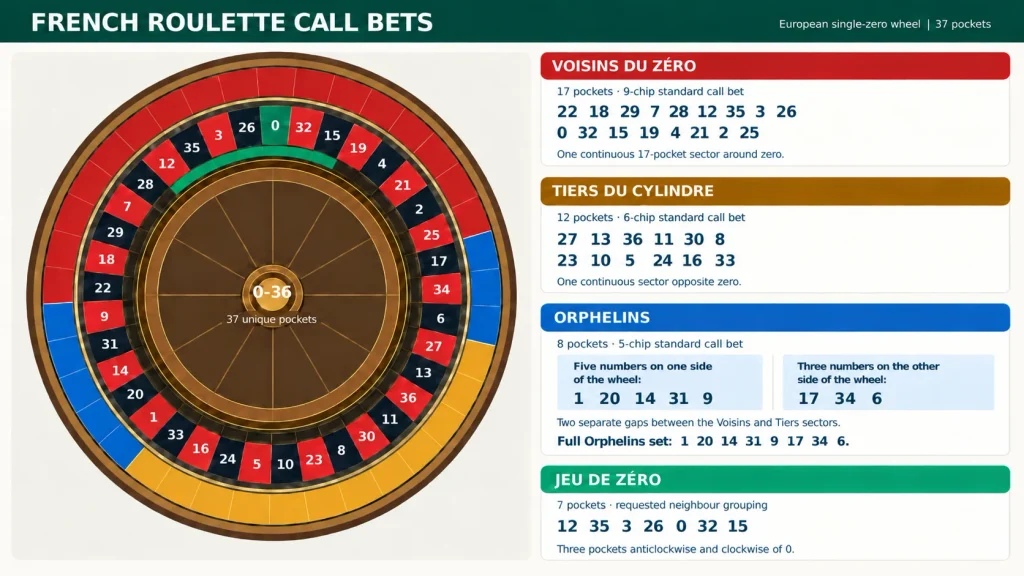
French Roulette Call Bets and Wheel Sectors
Some of the most distinctive French roulette bets are based on the physical order of numbers around the single-zero wheel.
These wagers are commonly displayed on a racetrack betting layout and may also be announced verbally where casino procedures permit.
| French call bet | Phonetic pronunciation | Numbers covered |
|---|---|---|
| Voisins du Zéro | vwah-zan dyoo zay-roh | 17 numbers |
| Tiers du Cylindre | tyehr dyoo see-landr | 12 numbers |
| Les Orphelins | lez or-fuh-lan (nasal ending) | 8 numbers |
| Jeu Zéro | zhuh zay-roh | 7 numbers |
Voisins du Zéro — Neighbours of Zero
This bet covers the 17-number wheel sector surrounding zero, extending from 22 to 25 in the standard European wheel order.
A conventional Voisins du Zéro arrangement uses nine chips:
- Two chips on the 0/2/3 trio.
- Two chips on the 25/26/28/29 corner.
- One chip each on the 4/7, 12/15, 18/21, 19/22, and 32/35 splits.
Tiers du Cylindre — Third of the Wheel
The Tiers bet covers 12 numbers on the wheel sector opposite the Voisins du Zéro area.
It consists of six splits, normally requiring six chips: 5/8, 10/11, 13/16, 23/24, 27/30 and 33/36.
Orphelins — The Orphans
Orphelins covers the eight numbers not included in the Voisins or Tiers sectors.
The conventional arrangement uses five chips: one straight-up bet on 1 and four splits on 6/9, 14/17, 17/20 and 31/34.
Notice that number 17 appears in two of the splits. This is deliberate.
Jeu Zéro — The Zero Game
Jeu Zéro covers seven numbers close to zero on the wheel: 0, 3, 12, 15, 26, 32 and 35.
The standard four-chip arrangement comprises a straight-up bet on 26 and splits on 0/3, 12/15 and 32/35.
French Roulette Special Rules: La Partage and En Prison
Two important French roulette rules deserve particular attention.
La Partage — lah par-tazh — means ‘the sharing’. Where this rule applies, a player normally loses only half of an even-money wager if the ball lands on zero.
En Prison — ahn pree-zohn — means ‘in prison’. Where offered, an even-money bet affected by zero may remain on the table for the next spin, subject to the casino’s particular rules.
Neither rule should be assumed to apply automatically to every French or European roulette table.
Italian Roulette Bets and Their French Equivalents
Italian roulette terminology is particularly interesting because it combines Italian-language betting names with the French vocabulary inherited from the game’s European history.
In fact, Italy’s authoritative Enciclopedia Treccani identifies several traditional roulette combinations by both their French and Italian names. These include pieno, cavallo, terzina, sestina, colonna and dozzina.
Importantly, not every French roulette expression has a universally established Italian equivalent. Many Italian casinos continue to use the original French terms, especially for traditional wheel-sector bets.

Italian Roulette Inside Bets: Pieno, Cavallo, Terzina, Quartina and Sestina
The following table gives the principal Italian roulette bet names alongside their French equivalents and approximate English pronunciations.
| Italian bet | English pronunciation | French equivalent | Payout |
|---|---|---|---|
| Pieno | pyeh-noh | Plein | 35:1 |
| Cavallo | kah-vahl-loh | Cheval | 17:1 |
| Terzina | tehr-tsee-nah | Transversale pleine | 11:1 |
| Quartina | kwar-tee-nah | Carré | 8:1 |
| Sestina | sehs-tee-nah | Sixain | 5:1 |
Quartina is the Italian term for a four-number combination; quadro and the French carré also occur in roulette terminology. Actual table language varies.
Pieno — The Italian Straight-Up Bet
A pieno covers one individual number on the roulette table.
Like the French plein, the chip is placed directly on the chosen number. A winning wager pays 35:1.
For example, a £5 pieno on number 24 produces £175 in winnings, plus the return of the original stake.
The Italian word pieno means ‘full’ or ‘complete’, depending on context.
Cavallo — The Italian Split Bet
A cavallo covers two adjacent numbers on the betting layout and pays 17:1.
A chip placed between 8 and 11, for example, covers both numbers.
The word cavallo means ‘horse’, making it a direct linguistic equivalent of the French cheval.
This is one of the clearest examples of the shared terminology between French and Italian roulette.
Terzina — The Italian Street Bet
A terzina is a three-number bet covering a horizontal row on the roulette layout.
For example, a terzina on 22, 23, and 24 covers those three numbers.
The payout is 11:1.
The name derives from the Italian idea of a group of three, making it relatively easy to remember.
Quartina — The Italian Corner Bet
A quartina covers four numbers arranged in a square.
For example, 10, 11, 13 and 14 form a four-number corner.
The wager pays 8:1.
The Italian terminology is associated with the number four, just as terzina refers to three.
Sestina — The Italian Six-Line Bet
A sestina covers six numbers arranged across two adjacent rows on the roulette layout.
For example, 19, 20, 21, 22, 23 and 24 form a valid six-line combination.
The payout is 5:1.
The word sestina refers to a group of six and corresponds to the French sixain or transversale simple.
Italian Roulette Outside Bets: Rosso, Nero, Pari and Dispari
Italian outside bets operate according to the same fundamental rules as French outside bets.
The principal differences concern their names and pronunciations.
| Italian name | English pronunciation | French equivalent | Payout |
|---|---|---|---|
| Rosso | rohs-soh | Rouge | 1:1 |
| Nero | neh-roh | Noir | 1:1 |
| Pari | pah-ree | Pair | 1:1 |
| Dispari | dees-pah-ree | Impair | 1:1 |
| Minori | mee-noh-ree | Manque | 1:1 |
| Maggiori | mahd-joh-ree | Passe | 1:1 |
| Dozzina | doht-tsee-nah | Douzaine | 2:1 |
| Colonna | koh-lohn-nah | Colonne | 2:1 |
The Italian terms minori and maggiori refer to the lower and higher groups of numbers. They correspond to 1–18 and 19–36 respectively.
It is worth remembering that French terminology remains common at Italian roulette tables. For example, Casino Sanremo’s published French roulette rules use manque and passe for the low and high even-money bets.
The Three Italian Dozens
The Italian dozen bets are:
- Prima dozzina — pree-mah doht-tsee-nah — first dozen, 1–12.
- Seconda dozzina — seh-kohn-dah doht-tsee-nah — second dozen, 13–24.
- Terza dozzina — tehr-tsah doht-tsee-nah — third dozen, 25–36.
Each pays 2:1.
The three columns are similarly called prima colonna, seconda colonna and terza colonna.
Italian Roulette Call Bets and Wheel-Sector Terminology
Italian roulette wheel-sector betting requires an important distinction.
Although the ordinary inside and outside bets have recognised Italian equivalents, the traditional French call bets often retain their original French names in international casino practice.
Italian translations can help explain these bets, but they should not automatically be treated as standard spoken casino calls.
| Traditional French name | Italian descriptive equivalent | English pronunciation of Italian | Meaning |
|---|---|---|---|
| Voisins du Zéro | Vicini dello zero | vee-chee-nee dehl-loh dzeh-roh | Neighbours of zero |
| Tiers du Cylindre | Terzo del cilindro | tehr-tsoh dehl chee-leen-droh | Third of the wheel |
| Orphelins | Orfani | or-fah-nee | Orphans |
| Jeu Zéro | Gioco dello zero | joh-koh dehl-loh dzeh-roh | Zero game |
| Voisins / Neighbours | Vicini | vee-chee-nee | Neighbouring numbers |
These Italian expressions are useful translations, not a verified universal set of formal Italian casino announcements.
Vicini dello Zero — Neighbours of Zero
This describes the same 17-number wheel sector covered by the French Voisins du Zéro.
The conventional arrangement requires nine chips, although the casino’s table limits and accepted procedures determine how the wager can be placed.
Terzo del Cilindro — Third of the Wheel
This refers to the 12-number sector opposite zero, traditionally called Tiers du Cylindre.
The standard bet uses six chips covering six splits.
Orfani — The Orphans
The Italian word orfani means ‘orphans’.
It describes the eight numbers not covered by the Voisins and Tiers sectors.
The conventional French Orphelins arrangement requires five chips, although other arrangements may be available.
Gioco dello Zero — The Zero Game
This is a descriptive Italian translation of Jeu Zéro.
It covers seven numbers clustered around zero on the European roulette wheel.
A conventional Jeu Zéro wager uses four chips.
The four standard French wheel-sector arrangements and their chip placements are documented in roulette training material.
Italian Roulette Announcements: What Does the Dealer Say?
For casino dealer training, understanding the difference between the name of a bet and an announcement made by the croupier is essential.
In traditional French roulette, the most familiar announcements are:
Faites vos jeux — fet voh zhuh — ‘Place your bets.’
Rien ne va plus — ryehn nuh vah ploo — ‘No more bets.’
These announcements are not exclusive to casinos in France.
For example, Casino Sanremo in Italy explicitly describes the use of Faites vos jeux and Rien ne va plus in its published roulette rules.
The corresponding Italian expressions are:
Fate il vostro gioco — fah-teh eel vohs-troh joh-koh — ‘Place your bets.’
I giochi sono chiusi — ee joh-kee soh-noh kyoo-zee — ‘Betting is closed.’
These are understandable Italian expressions, but they should not be assumed to be the prescribed announcements at every Italian casino.
For professional dealer training, the operating casino’s approved terminology and procedures always take precedence.
French vs Italian Roulette: Are the Rules and Payouts Different?
Despite the different terminology, the standard inside and outside wagers use the same mathematical payouts on a single-zero European roulette wheel.
| Bet type | Numbers covered | Payout | Win probability |
|---|---|---|---|
| Straight-up | 1 | 35:1 | 2.70% |
| Split | 2 | 17:1 | 5.41% |
| Street | 3 | 11:1 | 8.11% |
| Corner | 4 | 8:1 | 10.81% |
| Six-line | 6 | 5:1 | 16.22% |
| Dozen / Column | 12 | 2:1 | 32.43% |
| Red / Black | 18 | 1:1 | 48.65% |
| Odd / Even | 18 | 1:1 | 48.65% |
| Low / High | 18 | 1:1 | 48.65% |
Probabilities assume a fair 37-pocket European roulette wheel. Payouts show net winnings, excluding the returned stake.
Under standard single-zero rules, the house edge is approximately 2.70% on ordinary bets.
Where La Partage applies to even-money wagers, the house edge on those particular bets is reduced to approximately 1.35%.
The difference between French and Italian roulette is therefore principally one of language, history and table procedure rather than betting mathematics.
However, individual casinos may offer different zero rules, table limits, accepted call bets and methods of placing wagers.
Why French and Italian Roulette Terminology Matters in Casino Dealer Training
Learning roulette terminology is particularly useful for trainees, roulette dealers and table games supervisors.
A dealer needs to recognise the position of each wager, understand the payout and calculate winnings accurately.
For example, knowing that cavallo and cheval both refer to a two-number split allows a dealer to recognise the intended wager regardless of the language used.
Similarly, recognising terzina, transversale pleine and street as equivalent betting concepts helps establish a consistent understanding of the game.
The wheel-sector bets require additional training because the dealer must understand the order of numbers around the wheel, not simply their arrangement on the betting layout.
A dealer who understands both French and Italian roulette bet names is better prepared to communicate with international customers, although language knowledge does not replace training in the casino’s approved operating procedures.
Conclusion: Two Languages, One Roulette Tradition
French roulette and Italian roulette share a rich European gambling heritage. Although their betting terminology differs, the underlying wagers, payouts, and probabilities are largely the same. Understanding plein, cheval, pieno, cavallo, and the traditional wheel-sector bets provides valuable knowledge for players, casino dealers, and roulette enthusiasts interested in the history and language of this classic casino game.
Frequently Asked Questions About French and Italian Roulette Bets
What are the main French roulette bets?
The principal French inside bets are plein, cheval, transversale pleine, carré and sixain. The outside bets include rouge, noir, pair, impair, manque, passe, douzaine and colonne.
What are the Italian equivalents of French roulette bets?
The principal Italian equivalents include pieno for straight-up, cavallo for split, terzina for street, quartina for corner, and sestina for six-line. Italian terminology can vary between casinos.
What does plein mean in French roulette?
Plein refers to a straight-up bet covering one number. A successful wager pays 35:1.
What is a cavallo bet in Italian roulette?
A cavallo is a split bet covering two adjacent numbers on the roulette layout. It is equivalent to the French cheval and pays 17:1.
What is the difference between terzina and sestina?
A terzina covers three numbers in one horizontal row and pays 11:1. A sestina covers six numbers across two adjacent rows and pays 5:1.
What does manque mean in French roulette?
Manque refers to the low-number even-money bet covering numbers 1–18. Its opposite is passe, covering numbers 19–36.
What are Voisins du Zéro and Tiers du Cylindre?
They are traditional French roulette call bets covering fixed sectors of the European roulette wheel. Voisins covers 17 numbers around zero, while Tiers covers 12 numbers on the opposite side of the wheel.
Do Italian casinos use French roulette terminology?
Yes. French terminology remains established in Italian casino roulette, particularly for traditional roulette games and announcements. Casino Sanremo provides a documented example.
Is French roulette better than Italian roulette?
Neither is inherently better. If both games use the same single-zero wheel, payouts, and rules, their mathematical house edges are identical. Special zero rules can affect the expected loss on even-money wagers.
What is the difference between La Partage and En Prison?
La Partage returns half the stake on qualifying even-money bets when zero wins. En Prison allows an affected even-money bet to remain in play under the casino’s particular rules. Both are associated with French roulette, but availability varies.
What is a roulette racetrack bet?
A racetrack bet covers numbers according to their positions around the physical roulette wheel. The racetrack layout allows players to select traditional wheel sectors and neighbouring numbers.
Why should roulette dealers learn French and Italian betting names?
Understanding both languages can help dealers identify customer requests, interpret traditional betting terminology, and improve communication. Accurate chip placement, payout calculation, and compliance with house procedures remain essential.
Reference List:
The following sources support the historical background, roulette terminology, betting rules, and wheel-sector explanations.
1. Casinò di Sanremo. (n.d.). Roulette. https://www.casinosanremo.it/en/roulette/
2. Casinò di Sanremo. (n.d.). Roulette française. https://www.casinosanremo.it/fr/roulette/
3. Casinò di Sanremo. (n.d.). Fair roulette. https://www.casinosanremo.it/fr/fair-roulette/
4. Istituto dell’Enciclopedia Italiana. (n.d.). Roulette. Treccani. https://www.treccani.it/enciclopedia/roulette/
5. PokerStars. (n.d.). Casino history and origins. https://www.pokerstars.com/casino/guide/casino-origins/
6. Roulettist. (n.d.). Rules. https://www.roulettist.com/en/rules/
7. Wizard of Odds. (n.d.). Roulette française – anglaise [Roulette terminology and betting diagrams, PDF]. https://wizardofodds.com/games/roulette/images/roulette-francaise-anglais.pdf


Sign Up for Our Newsletters
Be the first to know when new content is created.Related Posts

Comparing the 5 Major Card Counting Strategies in Blackjack
Blackjack card counting strategies use mathematics to track how the remaining deck changes as cards are dealt. This guide compares five major systems, Hi-Lo, KO, Omega II, Zen Count, and Wong Halves, explaining their card values, mathematical logic, efficiency, complexity, and practical differences for modern casino play in real conditions.

Improve Your Blackjack: 5 Things You Need to Do Right Now
Want to know how to improve at blackjack? Forget lucky streaks, hunches and supposedly unbeatable betting systems. The best blackjack tips are based on mathematics, good decision-making and understanding the game you are playing. Here are five things you need to learn if you want to become a better blackjack player.

A Complete Etymology of Playing Card Names
Playing card names preserve centuries of language, folklore and gaming tradition. Ace comes from an ancient word for “one”; Jack displaced Knave; French clovers became English Clubs; and individual cards acquired names including the Suicide King, Curse of Scotland and Devil’s Bedpost. This anthology explores their documented origins and meanings.

How to Play European Lotteries Online Safely & Securely
Playing the lottery online can be convenient, but buying tickets requires attention to licensing, eligibility, location rules, and payment security. European lotteries operate under different national systems, so players should use official lottery websites or authorised channels. This guide explains how to play safely, verify tickets, and check results online.