


Dark
Light
The history of casinos stretches from ancient gambling traditions and European gaming houses to the spectacular mega resorts of Las Vegas and Macau. The origins of casinos reveal how gambling evolved from private wagering into a global entertainment industry combining gaming, hospitality, tourism, restaurants and live entertainment.

The Origins of Casinos: Gambling Before the Casino
The history of gambling is considerably older than the casino itself. People have wagered on games of chance, dice, sporting contests, and other uncertain outcomes for thousands of years. Archaeological evidence and historical records demonstrate that forms of gambling appeared in numerous ancient societies, including China, India, Greece and Rome.
However, gambling and casinos are not synonymous. For much of history, people gambled informally among themselves, in taverns, private homes, markets and other gathering places. There was no permanent institution whose principal function was to provide games against a house.
This distinction is important when considering the origins of casinos. A modern casino generally combines a controlled gaming environment, organised games, a house advantage, regulation and a commercial business structure.
The development of playing cards, dice games and lotteries gradually created a foundation for the emergence of organised gambling establishments. By the early modern period, European cities had developed sophisticated gaming cultures, setting the stage for the first casino.

The First Casino: The Ridotto in Venice
The story of the first casino is generally associated with Venice, Italy, and the opening of the Ridotto in 1638.
The Ridotto was established by the Venetian authorities as a regulated gambling house. Rather than simply attempting to prohibit gambling, the government created a controlled environment where gaming could be concentrated and supervised.
This makes the Ridotto particularly important in the history of casinos. It demonstrated an early version of a model that would appear repeatedly throughout casino history: governments could regulate gambling, operators could provide organised games, and players could wager within a designated environment.
The Ridotto operated in connection with Venice’s Carnival season and became associated with elaborate social customs, including masks and formal dress. The atmosphere was very different from the brightly lit casino floors of modern Las Vegas, but the underlying principle was recognisable: players entered a dedicated establishment to participate in organised gambling.
The Ridotto eventually closed in 1774, but the casino concept had already taken root.
The Casino di Venezia, which traces its history to 1638, remains one of the most important names when discussing the oldest casino in the world. The precise terminology requires some care, because the original Ridotto was not continuously operating as the same casino for almost four centuries. Nevertheless, Venice occupies a central position in the history of organised casino gaming.
European Casino History and the Rise of Independent Gambling Houses
Following the development of organised gaming in Venice, gambling establishments spread and evolved throughout Europe.
The European casino history of the eighteenth and nineteenth centuries was closely associated with fashionable resorts, aristocratic society and tourism. Gambling became an attraction for wealthy visitors who travelled to cities and resort destinations for entertainment as well as health, culture and social events.
The word “casino” itself has Italian origins and historically referred to a small house or social gathering place. Over time, its meaning became increasingly associated with establishments devoted to gambling.
European gambling houses developed reputations around particular games and social environments. Card games and table games became increasingly sophisticated, while roulette emerged as one of the defining games of European casino culture.
The development of casino resorts also established a pattern that would become fundamental to the modern industry: gambling could be combined with accommodation, restaurants, entertainment and luxury experiences.
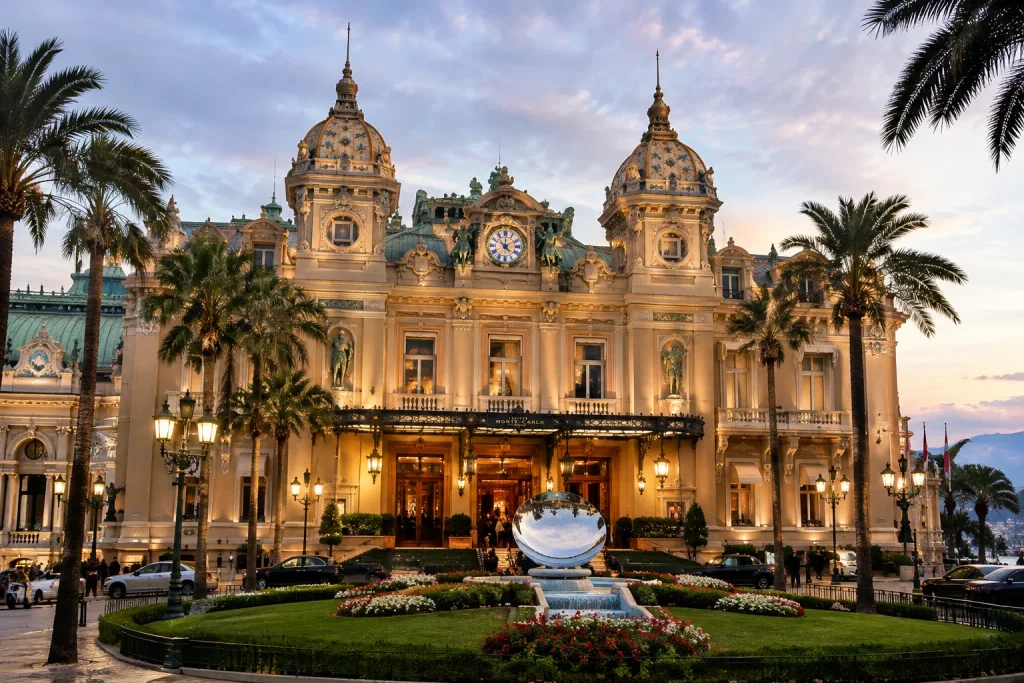
Monte Carlo and the First International Casino Resort
One of the most important developments in the history of casino resorts was the emergence of Monte Carlo as a major gambling destination during the nineteenth century.
The Casino de Monte-Carlo became closely associated with Monaco’s transformation into an international resort. Its success demonstrated the potential of combining gambling with luxury accommodation, architecture, tourism and high society.
This was a major step in the evolution of the casino. The casino was no longer simply a room containing gaming tables. It could become the centrepiece of an entire destination.
The model proved enormously influential. Casinos increasingly competed not only on games but also on architecture, service, entertainment, restaurants and the prestige associated with visiting them.
The idea of the casino as a destination rather than merely a gambling venue would eventually become one of the defining characteristics of Las Vegas and other international gaming centres.
The History of Casinos in America
The history of casinos in America followed a different path from the European model.
Gambling had long existed in colonial and later American society, but legal frameworks varied considerably between states and periods. Riverboats, saloons, private gaming rooms and other forms of gambling appeared in different parts of the country.
Nevada became particularly important. The state had a long association with gambling and ultimately legalised gambling in 1931 during the Great Depression.
That decision helped establish the foundations for the transformation of Las Vegas.
The growth of Las Vegas was also connected to infrastructure, tourism, construction, and entertainment. The construction of Hoover Dam brought thousands of workers to the region during the early 1930s, while the city’s casinos developed alongside the growing population and visitor economy.
The history of Las Vegas casinos therefore cannot be explained by gambling legislation alone. Transportation, tourism, investment, entertainment, and changing social attitudes all contributed to the city’s development.
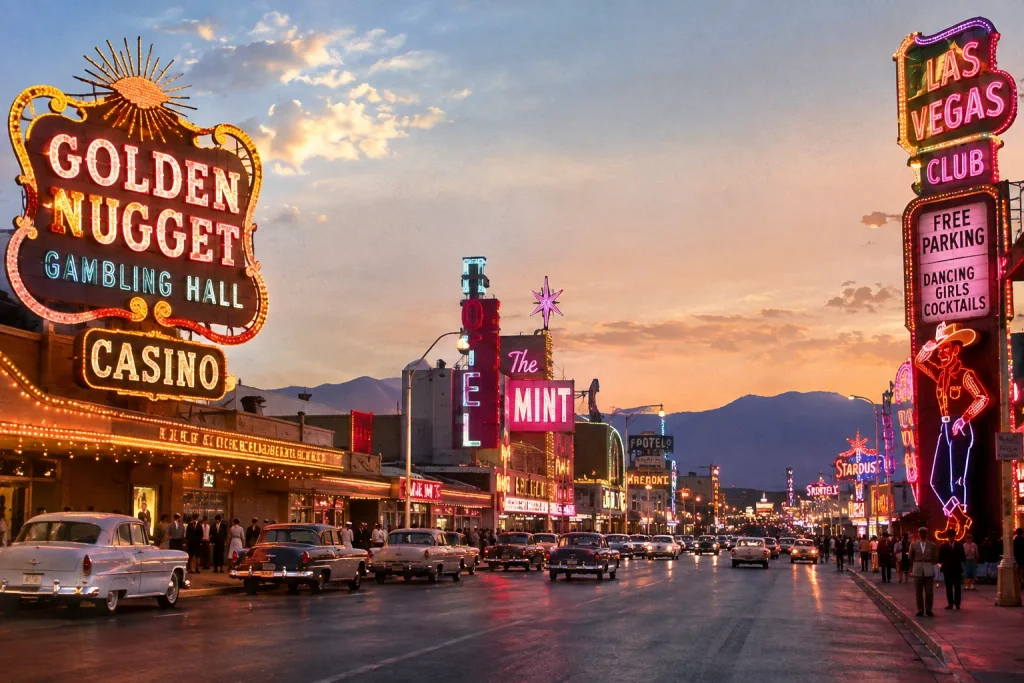
The History of Las Vegas Casinos
Las Vegas became one of the defining destinations in the history of modern casinos.
Early casinos concentrated around Fremont Street, while the development of resorts outside the original downtown area eventually created the Las Vegas Strip.
The 1940s and 1950s brought major changes. Hotel-casinos increasingly combined gambling with restaurants, nightlife, entertainment, and celebrity performances. Las Vegas developed a distinctive identity built around spectacle.
The city’s casino industry was also connected to organised crime during parts of its early development. Later, ownership increasingly shifted towards major corporations and professional casino operators.
The transition from individually controlled properties to corporate ownership fundamentally changed the industry.
A particularly important milestone came with the development of the mega-resort concept. The Mirage, opened in 1989, demonstrated how a casino could be integrated into a much larger entertainment destination incorporating themed architecture, restaurants, attractions, shows, and extensive hotel facilities.
This helped establish modern international mega resorts like the Fontainebleau Las Vegas.
From Casino to Mega Resort
The evolution from gambling house to mega resort represents one of the biggest changes in the history of casinos.
Traditional gambling houses depended primarily on gaming revenue. Modern integrated resorts can generate income from numerous sources, including:
- Casino gaming
- Hotel accommodation
- Restaurants and bars
- Entertainment
- Concerts and theatre
- Shopping
- Conferences
- Nightclubs
- Spas
- Attractions
- Premium and VIP experiences
The casino remains important, but it can become one component of a much larger hospitality and entertainment ecosystem.
This diversification also changed the physical design of casinos. Modern resorts can occupy enormous sites containing thousands of hotel rooms, multiple restaurants, shopping areas, entertainment venues, and extensive gaming floors.
The history of casino resorts is therefore also a history of tourism and hospitality.

Macau and the Expansion of Asian Casino Gaming
The Macau casino history provides another important chapter in the global development of the industry.
Macau has a long gambling tradition, with regulated casino-style gaming becoming particularly important to the territory’s economy during the nineteenth century.
The modern development of Macau accelerated dramatically after the opening of its gaming market to greater competition in the early twenty-first century.
The emergence of large integrated resorts transformed Macau into one of the world’s most important gaming destinations. International investment, luxury hotels, retail, entertainment and large-scale casino operations helped create a distinctly Asian version of the integrated resort model.
Macau also illustrates how casino history is shaped by regulation. Changes to licensing, concessions, taxation and market structure can dramatically alter the development of an entire gaming destination.
The History of Casino Games
The history of casino games is inseparable from the history of casinos themselves.
Different games became associated with different regions and periods. Roulette became strongly identified with European casinos, while baccarat developed an important position in European and Asian gaming cultures. Blackjack became particularly prominent in North American casinos.
Dice games such as craps also became closely associated with American gambling.
The games offered by casinos have continually evolved in response to technology, regulation, and consumer preferences.
Slot machines introduced another major change. Unlike traditional table games requiring dealers and multiple players, machines allowed casinos to offer gaming on a much larger scale.
Electronic gaming subsequently transformed casino floors, while digital technology eventually enabled casino-style games to move online.
The History of Online Casinos
The history of online casinos represents the latest major transformation in casino gaming.
Traditional casinos depend on physical locations. Online casinos such as Hyper Casino moved casino-style games onto computers and, later, smartphones and tablets.
This fundamentally changed accessibility. Players no longer needed to travel to Las Vegas, Monte Carlo, Macau, or another physical gambling destination to access casino-style games.
The development of internet gaming also introduced new regulatory challenges involving licensing, consumer protection, identity verification, responsible gambling, and cross-border activity.
For the casino industry, digital gaming created a new relationship between technology and gambling.
The online casino is therefore not the end of the story. Mobile technology, live dealer games, data systems and other innovations continue to influence how casino gaming is delivered.
The History of Casino Operators
The history of casino operators is another essential part of the industry’s development.
Early gambling establishments could be relatively small operations controlled by individual proprietors or local interests. Modern casino companies can operate enormous portfolios of resorts across multiple countries.
This transformation changed the industry from a collection of independent gambling houses into a highly organised international business sector.
Casino operators increasingly compete through brands, destinations, customer loyalty programmes, entertainment, hospitality and technology as well as gaming.
The rise of corporate ownership was particularly significant in Las Vegas, where major companies eventually replaced many of the smaller and historically influential ownership structures associated with the city’s early decades.
Casino Architecture and the Changing Gambling Experience
The history of casino architecture reflects the industry’s changing commercial ambitions.
European casinos often emphasised elegance, prestige and historic architecture. Las Vegas introduced increasingly theatrical themes, from ancient Rome and Egypt to Paris, New York and Venice.
Modern resorts expanded this concept still further.
The casino became part of a carefully designed customer journey. Hotels, restaurants, shopping, entertainment and gaming could be connected within a single destination.
Casino architecture, such as that demonstrated by Paul Steelman, consequently became part of the branding.
The evolution of casino design demonstrates how the gambling industry has repeatedly adapted its environment to attract visitors and encourage longer stays.
A Casino History Timeline
A simplified casino history timeline illustrates the industry’s development:
Ancient world: Gambling with dice, games, and wagers develops across different civilisations.
1600s: Venice establishes the Ridotto, an important milestone in the origins of casinos.
1700s–1800s: European gambling houses expand and casino culture develops around fashionable resorts.
Nineteenth century: Monte Carlo becomes an influential model for the luxury casino resort.
1931: Nevada legalises gambling, helping create the conditions for modern Las Vegas.
1940s–1950s: Las Vegas expands its hotel-casino and entertainment industry.
1960s–1970s: Corporate ownership becomes increasingly important in Las Vegas.
1970s onward: Casino gaming expands into additional American jurisdictions.
1989: The Mirage helps establish a new era of large-scale Las Vegas mega resorts.
Late twentieth century: Casino tourism expands internationally.
2000s: Macau’s integrated-resort market expands rapidly following changes to its gaming structure.
Twenty-first century: Online and mobile gaming become major components of the wider gambling industry.
From Gambling Houses to Global Entertainment
The history of casinos is ultimately a history of transformation.
The casino began as a controlled place where people could gamble, but the modern casino can be a hotel, restaurant, theatre, shopping centre, conference venue and entertainment destination as well as a gaming establishment.
From the first casino in Venice to the enormous resorts of Las Vegas and Macau, the industry has repeatedly adapted to changing technology, regulation, tourism and consumer behaviour.
Understanding this history also provides a foundation for exploring the people, places, games and companies that shaped the gambling world.
Conclusion
The history of casinos is a story of continuous evolution, from regulated gambling houses such as Venice’s Ridotto to the international mega resorts of Las Vegas and Macau. What began as organised gaming gradually became a global entertainment and hospitality industry. Its future will continue to be shaped by technology, regulation, tourism and changing approaches to the casino experience.
Frequently Asked Questions
What is the history of casinos?
The history of casinos can be traced from ancient gambling traditions to organised European gaming houses. The modern casino emerged as a regulated establishment where players could participate in games operated by a house.
Where was the first casino?
The first casino is generally associated with the Ridotto in Venice, Italy, which opened in 1638 as a government-regulated gambling house.
What is the oldest casino in the world?
The Casino di Venezia in Venice traces its history to 1638 and is widely described as the oldest casino in the world. The original Ridotto was not continuously operating in its original form for the entire period.
When did casinos become popular?
Casinos became increasingly popular in Europe during the eighteenth and nineteenth centuries, particularly in fashionable resort destinations. The twentieth century saw casino gambling expand dramatically, particularly in Las Vegas.
How did casinos begin?
The origins of casinos developed from earlier forms of organised gambling. Governments and commercial operators eventually created dedicated establishments where gambling could be controlled, regulated, and operated as a business.
What was the first casino in America?
There is no single universally accepted answer to the phrase “first casino in America” because gambling establishments existed in different forms and jurisdictions before modern casino regulation. Nevada became particularly important after legalising gambling in 1931.
When did Las Vegas become a casino city?
Las Vegas’ transformation accelerated after Nevada legalised gambling in 1931. The city’s casino and entertainment industry expanded significantly during the following decades.
What is the history of Las Vegas casinos?
The history of Las Vegas casinos includes the development of Fremont Street properties, the growth of the Strip, the rise of hotel-casinos, the expansion of entertainment, and the eventual emergence of corporate mega resorts.
What is the history of casino resorts?
The history of casino resorts began with the combination of gambling and tourism. Monte Carlo was particularly influential in establishing the luxury resort model, while Las Vegas later developed the integrated mega-resort concept on a much larger scale.
What is the history of casinos in Macau?
Macau casino history stretches back centuries, while regulated gaming became particularly important during the nineteenth century. Macau’s modern integrated-resort industry expanded substantially following market reforms in the early 2000s.
How have casinos changed over time?
Casinos have evolved from relatively focused gambling establishments into diversified entertainment destinations. Modern properties may combine gaming with hotels, restaurants, shopping, concerts, conferences, and other attractions.
What are the most important games in casino history?
Important games in casino history include roulette, baccarat, blackjack, craps, poker, and slot machines. Their popularity has tended to vary by geography and historical period.
When did online casinos begin?
The history of online casinos began in the early internet era and developed rapidly as internet access, payment systems, regulation, and digital gaming technology improved.
Who are the most important casino operators in history?
The history of casino operators includes individual entrepreneurs, family-owned businesses, and increasingly large corporate groups. Future Gods of Gambling articles examine individual operators and their influence on casino development.
Reference List:
Casinò di Venezia. (n.d.). Casinò di Venezia. https://www.casinovenezia.it/
Gaming Inspection and Coordination Bureau. (n.d.). History of the Macao gaming industry. Macao SAR Government.
HISTORY.com Editors. (2025). Las Vegas. HISTORY. https://www.history.com/articles/las-vegas
Little, B. (2025). How Las Vegas became a gambling mecca. HISTORY. https://www.history.com/articles/las-vegas-history-mobsters-gambling
National Park Service. (2013). El Cortez Hotel and Casino. U.S. Department of the Interior, National Register of Historic Places.
University of Macau. (2019). UM professor publishes Portuguese book on Macao’s casino gaming history. Macao SAR Government.
Grand Palais. (2018). Qu’est-ce que le Ridotto de Venise? Réunion des Musées Nationaux.


Sign Up for Our Newsletters
Be the first to know when new content is created.Related Posts

The Hippodrome Casino London: The Largest Casino and Entertainment Venue in the UK
This comprehensive overview of the London Hippodrome casino explores the multifaceted aspects of the venue, including its history, architectural significance, gaming facilities, dining experiences, entertainment offerings, and its impact on the local community and economy.

The UK Gambling White Paper 2023: An Overview
The UK Government recently published the UK Gambling White Paper 2023, outlining significant changes and reforms to UK gambling regulations. This white paper aims to modernise the UK’s gambling laws, ensuring they are fit for the digital age while safeguarding consumers and tackling the rising issues related to problem gambling. This document sets forth the government’s objectives, planned changes, and the expected impact on ordinary gamblers and the wider gambling industry.

The Playboy Club London: A Legacy of Glamour and Gambling
The Playboy Club London, also known as the Playboy Casino, is an iconic venue that has carved its niche in the world of entertainment and gaming. Founded by the legendary Hugh Hefner, the Playboy Club has been synonymous with luxury, exclusivity, and a distinctive brand of hedonism. The London branch, in particular, has a storied history spanning over five decades, reflecting the broader cultural shifts and economic trends of its time.

A History of Casinos in Moscow – Legendary Russian Gambling Venues
The story of casinos in Moscow Russia is one of the most fascinating chapters in modern Russian nightlife. Beginning around 1992, Moscow casinos rapidly transformed the capital's entertainment scene, attracting wealthy businessmen, celebrities and international visitors. This guide explores historic casinos in Moscow, including Metelitsa, Gabriela, Beverly Hills, Golden Palace and Metropol, before the city's casino industry disappeared in 2009.