


Dark
Light
Of all the card games in all the world, blackjack is by far the most popular. It is simple, strategic, and it takes 5 minutes to learn. It is also one of the few casino games where you can make all the decisions. On this page, you will learn: the rules of blackjack, hand values, gameplay flow, betting options, table etiquette, basic strategy, and common mistakes.
What Is Blackjack?
Blackjack is a card game played in nearly every casino around the world, as well as online. There are two main protagonists: the player and the house. The house is always represented by a dealer, who deals the cards and controls the game’s pace. Online, this function is fulfilled by a random number generator (RNG).
The reason blackjack is so popular (and what gives it its appeal) is that players can make their own decisions. Effectively, luck is taken out of the equation (well, almost), and players must accept the consequences of their own actions.
Equipment Required
To play a game of blackjack, you need a blackjack table, playing cards (usually 6-8 decks), a dealing implement (known as a shoe) from which to deal the cards, and playing tokens or gambling chips with which to place your bets.
If you are playing at a physical casino, this equipment will be provided, along with a seat, because who wants to stand all night? If you are playing blackjack online at home on your desktop computer or on the move on your mobile device, then all the equipment will be virtual.
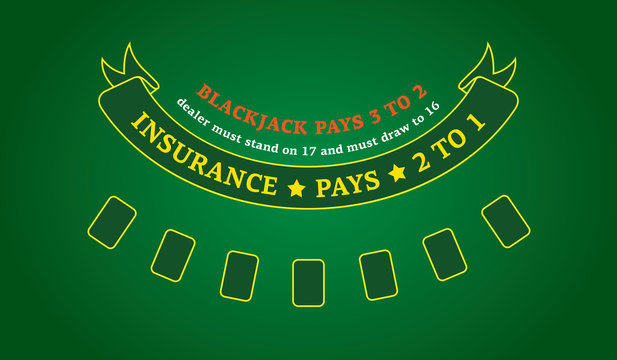
The image above shows a typical blackjack layout. This will nearly always be the same no matter where you play. However, there may be slight regional variations in the standard layout, which we will discuss later.
You will notice that a blackjack layout has seven boxes. These are ‘betting boxes,’ one for each player. This is where you should place your betting tokens in order to take part in a hand of blackjack. There are more betting options available to you, but we will discuss them later.
For those of you playing online blackjack, the table will look exactly as above, except you will have multiple visual options available. Those may include playing tokens of varying values, game information, and links to the cashier or other casino games.
Purchasing Playing Tokens (Funding Your Account)
To play a game of blackjack, you first need to purchase playing tokens. You do this by handing over a sum of money you are prepared to risk to the dealer, and he or she will exchange this for tokens.
If playing online, you must first deposit cash into your online casino account via bank transfer or other preferred payment method. You can then play blackjack online using your available funds.
Placing Your Bet
Once you have purchased your playing tokens, your first decision will be how much to risk on your initial hand. Let’s imagine you are prepared to risk $5. You should place the $5 token inside the betting box that corresponds to your seat at the table.
If playing online, choose any of the betting boxes displayed on your screen and click on it to place your token. You can select a token from the list of available options at the bottom of the screen.
How to Play Blackjack (Play of the Hand)
Once you have placed your bet(s), the dealer (or the RNG) will commence the hand. A hand of blackjack is a single round of betting in which the player receives cards and plays them according to the game’s objectives.
If you are playing in most parts of Europe, the dealer will deal each player in turn one card face-up, followed by a face-up card to himself or herself. They will then deal a second face-up card to each player, but NOT to themselves.
If you are playing blackjack in America, the dealer will deal two face-up cards, one at a time, to each player at the table and two cards to himself or herself. One of the dealer’s cards will always be face up, and one will be face down.
The cards are dealt to the player’s corresponding box or the box where they placed their bet.
Objective:
The objective of the game is to get as close to a count of ‘21’ as possible without going over 21. However, the dealer is also required to take cards, which means that during a single game, should the dealer get closer to 21 than you, the dealer wins.
Card Values and Hand Structure
The values of the cards may seem straightforward; however, there are some things you need to know that are not immediately obvious.
- All numbered cards (1 through 10) have their face value.
- Court cards (picture cards) have a value of 10.
- Aces may have a value of 1 or 11 (depending on the situation)
Natural Blackjack
A blackjack (the name of the game) is a two-card hand that includes any court card or a 10 plus an ace. Such a hand is known as a natural blackjack, where the ace counts as 11 and not 1. It is natural because the hand gives a count of ‘21’ and is an automatic winner, except in situations where the dealer can also potentially achieve a blackjack.
Hard and Soft Blackjack Hands
As disclosed earlier, the Ace is the only card that is truly confusing. Confusing because it can be counted as either 1 or 11. However, the reason behind this is really rather simple.
- A hand that includes an ‘Ace’ where that hand (using the Ace as 1 or 11) totals ‘11’ or more is known as a ‘hard hand’.
- A hand that includes an ‘Ace’, where the combination of the cards would come to less than ‘11’, is known as a ‘soft hand’.
- It is NOT POSSIBLE to have a point total of 11 in any hand containing an Ace. This is because the hand already counts as 21. Example: 7 + 3 + A = 21.
There is an exception to this rule (there’s always an exception), and that is when you have two aces. Should you be dealt such a hand, you now have 2 or 12, or an opportunity to split your aces and make two entirely separate hands. More on that later.
The reason behind this is that any hand that is not a natural blackjack (ace and a 10) cannot bust (go over 21) upon taking a third card. It is designed to provide players with flexibility and increase their chances of forming a winning hand.
Incidentally, in case you were wondering, a two-card ‘21’ or blackjack is a natural winning hand, and you cannot take any further cards.
How a Hand of Blackjack Works
Once you have placed your bets, the game is ready to begin. The dealer (or the RNG) will deal cards to each player according to the pattern described above.
To recap, that is two cards to each player involved in the hand (dealt one at a time) and one (or two cards, depending on where you are) to the dealer.
Once all of the cards have been dealt, the actual gameplay begins. Starting at the first box (the box to the extreme left of the dealer, or your extreme right), the players get to make their decisions as to whether they wish to take further cards or play the hand they were initially dealt.
The player’s decisions are as follows:
- Stand: Does not wish to take further cards.
- Hit: Take a further card.
- Double: Doubling down requires you to place a further bet equivalent to your original stake. For this, you will receive only one more card. This decision is usually made against a dealer’s weak card, such as a 2, 3, 4, 5, 6, or 7. In Europe, you may only have this option if your initial two-card total is 9, 10, or 11.
- Split: Any two cards of the same value (such as a pair of 8s) enables you to place a further wager equivalent to your original stake. This allows you to separate your existing cards into two distinct hands. Again, this play is usually made against a dealer’s weak card.
- Surrender: Typically, surrender is found only in US casinos; it isn’t an option in Europe. You can surrender half of your bet if you believe that you have a poor chance of winning against a strong dealer card, such as an Ace or ten. Although this play can be advantageous under certain circumstances, it isn’t recommended for most players.
- Take Insurance: You will notice that on a standard blackjack table, there is an insurance line just above the betting boxes. It generally reads: Insurance Pays 2:1. A player can take insurance when the dealer shows an ace. They do so by placing up to half of their original stake on the insurance line. If the dealer makes a natural blackjack, the insurance bet wins. Should the dealer fail to make a blackjack, then the insurance bet loses.
- Take Even Money: In Europe, if you have a natural blackjack and the dealer is showing an ace, they will offer you even money. It is effectively the same as insurance, and you should probably take it when offered.
Once each player, in turn (from left to right), has made their decision, it is the dealer’s turn to act. In Europe, the dealer (who only has one card) will deal further cards to him or herself until they reach a count of 17 or higher.
In America, or anywhere the dealer has an initial two cards, the dealer exposes the face-down card to reveal their hand and takes further cards if necessary.
It is essential to note that in most situations, the dealer must stand on a total of ‘17’ (hard or soft) and must draw to a total of ‘16’ (hard or soft). That said, regional variations do exist where the dealer is required to draw to a soft 17; therefore, you should be aware of this.
Paying & Taking
Once the dealer’s total has been established, it is time for them to pay the winners and take the losers.
Starting from the box to the dealer’s left (your right), the dealer verifies the total of each of the players’ hands and pays out even money (1 to 1) to any player with a total greater than the dealer’s. Players whose hand totals are less than the dealer’s lose, and their bets are removed.
The same principle applies online, except the settling of the bets is much faster. Should your hand total the same as the dealer’s, it’s a push and neither wins nor loses.
This is a basic explanation of how blackjack is played. But you’re not here for that; you want to know how and when to make decisions that will help you to win at blackjack.
Player Actions Explained – What to Do in Every Situation
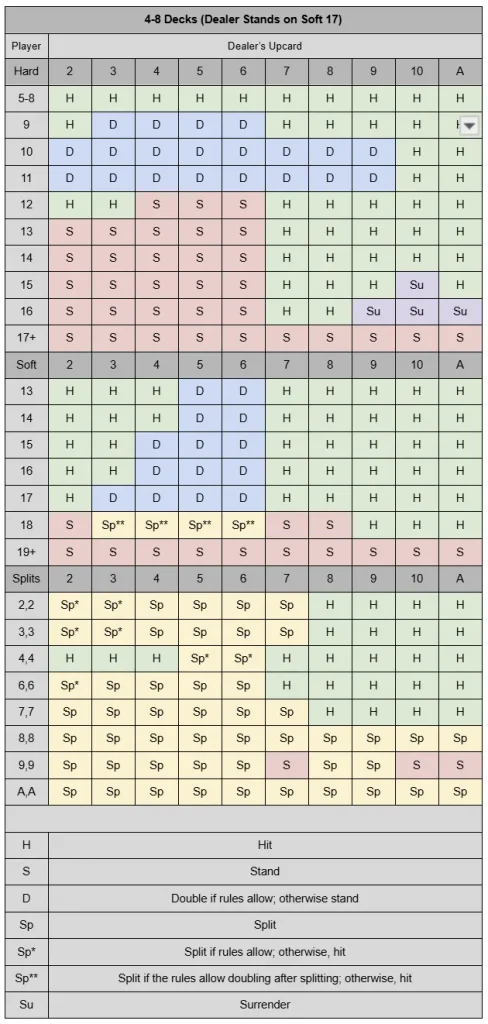
Below is a general overview of how to play blackjack. For the correct play in every situation, please refer to the blackjack strategy chart.
Hit
Generally, it is wise to take another card when your total is 11 or less. Once your total reaches 12 or greater, you should stand against a dealer’s weak card and draw against a strong dealer’s upcard.
Stand
Once again, the importance of dealer upcards is paramount when deciding to hit or stand. Stand with smaller hands (12-16) against weak dealer cards (2-7). Do not take unnecessary risks with strong hands (17-20); always stand.
Double Down
Doubling is optimal against weak dealer cards. If the dealer shows a 6 and you have a 9, 10, or 11, double down. As a rule, you should not double against strong dealer cards (8, 9, 10) unless you yourself have a strong combination. Consult the blackjack strategy chart for the exact rules.
Split
It is advisable to always split Aces & 8s and never to split 10s or 5s.
Surrender
In most cases, you should never surrender. Certainly never surrender a count of 17 or higher, or any soft hand or pairs. Surrendering can be mathematically correct under certain circumstances, but it remains a defensive action nonetheless.
You will not even be given this option in Europe, but when playing blackjack in the USA, you may want to adopt the rules shown below. However, if you are unsure, it’s best to avoid surrender altogether.
| Your Hand | Dealer Upcard | Surrender? |
| Hard 16 | 9 | Yes |
| Hard 16 | 10 | Yes |
| Hard 16 | Ace | Yes |
| Hard 15 | 10 | Yes |
| Hard 15 | 9 or Ace | No |
| Any Soft Hand | Any | No |
| 17 or Higher | Any | No |
Insurance
Insurance is a contentious subject, and we would definitely recommend avoiding it. The house edge on insurance bets is 7%, making it a losing bet.
Blackjack Rules That Alter the Game Dramatically
The rules of blackjack are not always standard, as the game itself has numerous variations worldwide, including in America. Many of these rule differences are designed to boost profits by increasing the house edge.
3:2 vs. 6:5 Blackjack Payouts
No matter where in the world you play, the multi-deck game will nearly always pay 3:2 for a natural blackjack. The single-deck game (rare in Europe) generally pays 6:5, which is less favorable to the player.
A 6:5 table increases the house edge by about 1.4%, which translates to a 20% cut in your winnings every time you make a natural blackjack.
| Blackjack Payout | Winnings on a $10 Bet |
| 3:2 | $15 |
| 6:5 | $12 |
So at a single-deck game, you are losing $3 for every $10 you bet, each time you get dealt a blackjack.
Number of Decks
There are 5 common variations of blackjack in use around the world, though there may be others. These include single-deck blackjack, double-deck blackjack, and 4-8 deck blackjack. The rules are altered slightly for each variation, and, as in the case of single-deck blackjack, not usually in your favor. Our advice would be to stick to multi-deck blackjack, as that has the fairest rules, and avoid one- or two-deck blackjack.
Dealer Hits on a Soft 17
If the dealer is allowed to hit on a soft 17, the house edge increases by about +0.2% to +0.4% compared to the more common dealer standing on a soft 17.
| Dealer Action | Effect on House Edge | Reason |
| Stands on soft 17 | Lower house edge | The dealer cannot improve a weak 17 |
| Hits on soft 17 | +0.2% to +0.4% higher house edge | Dealer improves hand to 18–21 more often |
Hitting on a soft 17 gives the dealer a slightly better than 1 in 3 chance of improving their hand.
Doubling/Splitting Restrictions (after split, on any two cards, etc.)
Some casinos (notably those in Europe) restrict the number of times a player may split, double, or double after a split. American casinos are more likely to allow players to double down on any two cards, whereas in Europe, you can only double on 9, 10, or 11.
Allowing more doubling and splitting options reduces the house edge, while restricting them increases it. These rule variations can shift the house edge in blackjack from 0.28% to 2%+.
We have compiled a list of restrictions that, in theory, you could come into contact with. The reality, though, is that they are mostly regional variations, and some are not in common use. For convenience, we have only listed the effect each rule has on the house edge.
Doubling Rules & Their Impact on the House Edge:
| Doubling Allowed on Any Two Cards | Reduces the house edge by ~0.25% (varies by deck) |
| Doubling Only on 9–11 | Increases house edge by ~0.10%–0.15% |
| Doubling Only on 10–11 | Increases house edge by ~0.20%–0.25% |
| No Doubling After Splitting | +0.12% to +0.15% against the player |
| Doubling After Split Allowed | Reduces house edge by ~0.13% |
Splitting Rules & Their Impact on the House Edge:
| Re‑Splitting Pairs | Reduces house edge by ~0.05%–0.10% |
| Re‑Splitting Aces | Reduces house edge by ~0.07% |
| No Re‑Splitting Aces (common rule) | Increases house edge by ~0.07% |
| One Card Only After Splitting Aces | +0.06% against the player |
| Doubling on Split Aces (rare rule) | Would reduce house edge significantly (approx. –0.15%), but this rule is extremely rare |
Side Bets (Perfect Pairs, 21+3, etc.)
Blackjack side bets give the house a significant advantage over the player. Refer to the table below to understand just how much.
Blackjack Side Bets
The best advice we can offer regarding blackjack side bets is to avoid them. The house edge on novelty bets is horrendous, so while they may look inviting at first glance, in the long run, they could devastate your bankroll. For your interest, we have posted your options, along with the house edge, below.
| Side Bet | Pays Out On | Typical House Edge |
| Perfect Pairs | Mixed, coloured, or perfect pairs | 6-10% |
| 21+3 | Flush, straight, 3‑of‑a‑kind, straight flush | 3-7% |
| Progressive Jackpots | 15-20% | |
| Lucky Ladies | Initial two suited queens | 17% |
| Royal Match | The initial two suited or royal suited cards | 3-10% |
| Insurance | Dealer blackjack | +/- 7% |
Basic Strategy Blackjack – The Foundation of Winning
Basic blackjack strategy is a mathematically proven method for determining the best possible play in every situation. Studying this chart allows you to make optimal decisions every hand.
More importantly, playing basic strategy blackjack reduces the house edge to as low as 0.5%.
The basics of blackjack are that low cards (2 to 6) are bad for the dealer, as they increase their chances of busting. For this reason, it is a sound play for you to stand on smaller totals. Aces and tens are good for the dealer, so the closer you can get to a count of 21, the better.
Basic Blackjack Strategy Chart (Multi-Deck Blackjack)
The following blackjack strategy chart is based on the most common blackjack variation, multi-deck blackjack (4-8 decks), where the dealer stands on a soft 17. However, it can serve as a guide for most variations of the game, with only a few minor differences.
Basic Blackjack Strategy Principles
The basic principles you should take away from reading this guide are:
- Always split Aces and 8s
- Never take insurance
- Stand on 12+ when the dealer shows 4–6
- Double on 10 or 11 when the dealer shows a weak card
If these four points are all that you learn from this article, then it will have been a valuable read.
Deviating from Basic Strategy Will Cost You Money
Playing basic strategy blackjack is advisable, but it’s not compulsory. However, in the long run, it is never a good idea to prioritise emotional decisions over mathematical ones. When it comes to games of chance, proven mathematical principles win out every time.
Bankroll Management
In order to play blackjack successfully, you need to be able to manage your money. This is why effective bankroll management is so important. Here are a few tips that will help you.
- Set yourself a reasonable budget for every session and stick to it
- Bet in manageable unit sizes that should be no more than 1%–2% of your bankroll
- Stay calm and avoid straying too far from the basic strategy chart recommendations
- Know when to walk away; sometimes it just isn’t meant to be
Table Etiquette and Good Casino Behavior
As in life, it is in blackjack. Treat others as you would expect to be treated, and success will surely follow. Of course, this isn’t going to mean too much if you are playing blackjack online. If you are playing at home, you can be as mean as you like, but at the casino, there are a few rules you should know.
- Choose a convenient time to buy in, such as between hands
- NEVER touch the chips or cards whilst a hand is in progress
- Tipping the dealers is a matter of choice; being polite should be a matter of course
- Respect the table – regulars may get upset if you deviate too far from basic strategy
- The chair doesn’t belong to you – other than going to the toilet, if you leave your seat, someone else will surely take it.
Common Mistakes Blackjack Beginners Make
We all have free will, so any decision you make that results in a successful outcome is a good one. The problem is that you can’t rely on this being true every time. In most instances, your best policy is always to make the percentage play. In this way, you will largely avoid huge swings in fortune. Here are a few tips you would be wise to follow.
- Never take insurance — this is not really a mistake, but it’s not advantageous.
- Don’t stand on soft totals (other than 18, 19 & 20). You have a chance to improve your hand.
- Don’t split 10s. A total of 20 will beat the dealer more often than not.
- Chasing losses is always a bad idea.
- Don’t ignore the dealer’s upcards. Use the information you are given to your advantage.
- Playing blackjack without a strategy is like driving a convertible in the rain with the top down. Sure, you can do it, but why?
Following these simple tips will definitely help, but for more advanced players, I have prepared a separate article on how to improve at blackjack that you ought to read.
Online vs. Land-Based Blackjack
Some days you just don’t want to get the car out of the garage and drive all the way out of town to go to the casino. For those times, they created online casinos. The good news is that with online live dealer casinos, you get all the experience without the hassle.
Online Blackjack
Playing online blackjack is not the same as playing at a retail casino; in many ways, it’s better. You can choose between RNG games or live dealer tables, and the game is played at a faster pace, with lower minimum bets.
Land-Based Blackjack
Social interaction is the main reason that players choose to visit a land-based casino. Games are played at a slower pace, and you may encounter more rule variations.
Which Is Better for Beginners?
It’s up to you to weigh up the pros and cons of each environment and decide which is right for you. It may be that they both are, but whichever option you choose, always gamble responsibly.
Conclusion
Blackjack is a straightforward game to learn, but mastering it requires time and practice. Getting to grips with basic strategy and pairing it with a bankroll management system will enable you to take on the house with confidence. Begin by practising in low-stakes games, or better yet, play blackjack online at Betway in a comfortable, stress-free environment.
Frequently Asked Questions
What’s the goal of blackjack?
Beat the dealer without going over 21. You win if your hand is higher than the dealer’s, or if the dealer busts.
How are cards valued?
- Number cards = face value
- Face cards (J, Q, K) = 10 points
- Aces = 1 or 11, whichever helps your hand most
What are my options after the deal?
You can Hit (take another card), Stand (keep your hand), Double Down (double your bet, take one card), or Split (if you have a pair).
What is a blackjack?
An Ace + 10-point card on your first two cards. It pays 3 to 2 unless the dealer also has blackjack.
What happens if I bust?
If your hand exceeds 21, you automatically lose, even if the dealer busts.


Sign Up for Our Newsletters
Be the first to know when new content is created.Related Posts

Chinese Sports Betting Syndicates: How They Operate and Their Role in Global Sports Betting
Chinese sports betting syndicates are best understood as organised groups of bettors, analysts, intermediaries and financial participants who coordinate sports wagering across markets. Their activities can range from sophisticated legal betting strategies to illegal gambling and, in documented cases, match manipulation. The term does not describe one organisation or all Chinese bettors.

Blackjack Basic Strategy Explained So Simply A 10-Year-Old Can Understand
Blackjack basic strategy is simply a set of mathematical rules telling you what to do with your cards. You look at your hand, look at the dealer's card, and choose the action with the best long-term mathematical result. It sounds complicated, but the idea is surprisingly simple once you understand the basics.

Paroli Betting System Explained: How the Positive Progression Strategy Works
The Paroli betting system is a positive progression strategy that increases bets after wins rather than losses. Popularly associated with roulette, it can also be applied to certain other casino games. But does the Paroli system genuinely improve your chances of winning, or simply change how you experience gambling's inevitable ups and downs?

A Complete Guide to Online Betting Sites
Online betting sites have revolutionized the way people place wagers, offering convenience, variety, and accessibility from anywhere in…