


Dark
Light
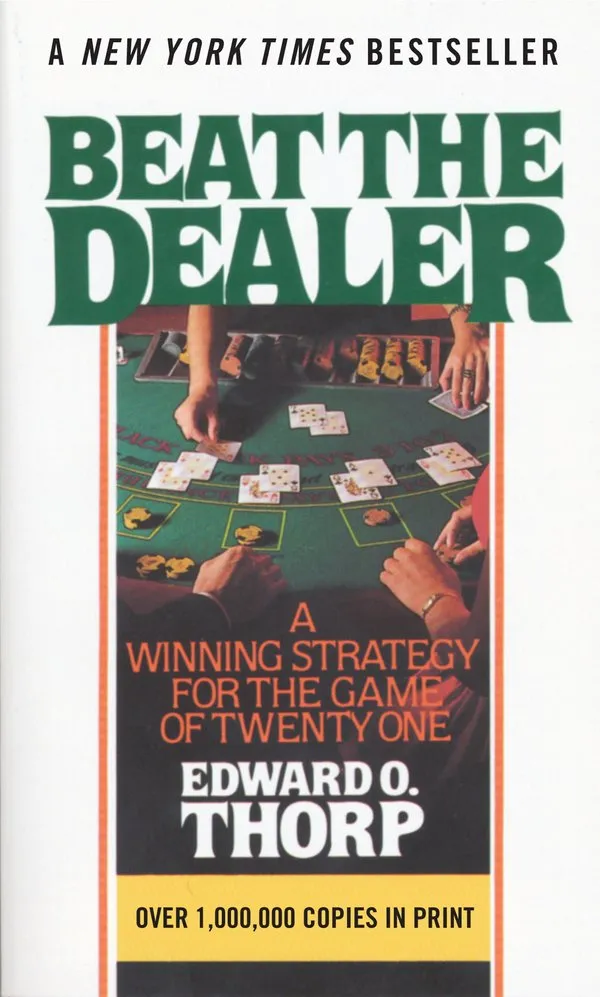
Edward O. Thorp, a mathematician and hedge fund pioneer, revolutionized the world of gambling with his groundbreaking book Beat the Dealer in 1962. Using probability theory and computer simulations, Thorp proved that blackjack could be beaten with a strategic approach. His Ten-Count System gave players a statistical edge over the house, transforming blackjack from a game of chance into a game of skill.
The Origins of the Ten-Count System
The birth of card counting began with a simple question: Could mathematics beat the casino? Collaborating with Claude Shannon, the father of information theory, Thorp used the IBM 704 computer to simulate thousands of blackjack hands. His analysis revealed that the ratio of tens (10, J, Q, K) to non-tens in the deck had a significant influence on the game’s outcome. When more tens remained, the player had a higher chance of winning.

Understanding the Ten-Count System
Card Values
| Card | Value |
|---|---|
| A–9 | +4 |
| 10 | -9 |
The Ten-Count System assigns values to cards based on their impact on the game. Non-tens (A through 9) are counted as +4, while tens (10, J, Q, K) are counted as -9. Players maintain a running count by adding or subtracting these values as cards are revealed.
Calculating the True Count
To determine the true count, divide the running count by the number of decks remaining. This helps adjust for multi-deck games and provides a more accurate measure of the player’s advantage.
Example:
- Cards seen: 2, 3, 5, 7, 10, J, Q
- Running Count: +4 (2) +4 (3) +4 (5) +4 (7) -9 (10) -9 (J) -9 (Q) = -7
- Decks remaining: 1
- True Count = -7 / 1 = -7 → Bet minimum
How Thorp Tested His System
Thorp didn’t stop at simulations. He took his system to the casinos of Reno, Lake Tahoe, and Las Vegas. Using his Ten-Count strategy, he began consistently winning at blackjack, prompting casinos to change their rules, introducing frequent shuffling and limiting deck penetration. Thorp’s success proved that mathematical strategy could outperform intuition and luck.
Strategic Advantages of the Ten-Count System
- Predicts Dealer Busts: High true counts indicate a higher proportion of tens in the deck, thereby increasing the likelihood of dealer busts.
- Informs Player Decisions: Helps determine when to hit, stand, double down, or split.
- Optimizes Bet Sizing: Players can increase bets during favorable counts to maximize profits.
- Reduces House Edge: With perfect execution, the house edge can drop below zero.
Comparing the Ten-Count to Modern Systems
| System | Simplicity | Accuracy | Deck Adaptability |
|---|---|---|---|
| Ten-Count | Moderate | High | Best for single deck |
| Hi-Lo | Easy | Moderate | Multi-deck friendly |
| Omega II | Complex | High | Advanced players only |
While the Ten-Count System is less common today due to its complexity and the prevalence of multi-deck games, it remains a valuable tool for understanding the mathematics behind card counting.
Practicing the Ten-Count System
Training Techniques
- Flash Card Drills: Practice assigning values quickly to each card.
- Deck Walkthroughs: Count through a full deck to verify the total equals zero.
- Simulated Play: Use apps or software to mimic real casino conditions.
- True Count Estimation: Practice dividing the running count by decks left.
Tips for Success
- Start with single-deck games to simplify deck estimation.
- Use a timer to simulate the pace of a casino.
- Track accuracy and speed over time.
Using a Card Counting System in Real Casinos
Preparation
- Dress inconspicuously to avoid attention.
- Understand the casino’s shuffle and deck penetration habits.
- Build mental stamina for long sessions.
Execution
- Flat bet during neutral counts.
- Increase bets when the true count is high.
- Apply basic strategy deviations based on the count.
Risk Management
- Set win/loss limits.
- Vary bet sizes subtly to avoid detection.
- Consider team plays for camouflage and efficiency.
Psychological and Ethical Considerations
Card counting is legal, but it is frowned upon by casinos. Players must maintain discipline, focus, and emotional control at all times. Thorp emphasized intellectual curiosity and strategic thinking over greed, advocating for a respectful and calculated approach to advantage play.
Thorp’s Legacy Beyond Blackjack
Edward Thorp’s influence extends far beyond the casino floor. His hedge fund, Princeton/Newport Partners, applied similar statistical models to financial markets. Thorp’s work laid the foundation for quantitative finance, and Beat the Dealer remains a seminal text in the fields of gambling and probability theory.
Beat the Dealer
Beat the Dealer
5
5
0
1
The Book That Made Las Vegas Change the Rules. Over 1,000,000 Copies in Print.
Edward O. Thorp is the father of card counting, and in this classic guide he shares the revolutionary point system that has been used successfully by professional and amateur card players for generations.
The Book That Made Las Vegas Change the Rules. Over 1,000,000 Copies in Print.
Edward O. Thorp is the father of card counting, and in this classic guide he shares the revolutionary point system that has been used successfully by professional and amateur card players for generations.
5/5
Total Score
iAudiobook: A Winning Strategy for the Game of Twenty-One. Edward O. Thorp (Author), Marc Cashman (Read by)
Amazing
Final Thoughts
The Edward O. Thorp Ten-Count System is a masterclass in applied mathematics. Though complex, it offers deep insight into probability and strategic thinking. With practice and discipline, players can transform blackjack from a game of chance into a calculated opportunity for success.
Frequently Asked Questions
Is Edward Thorp’s Ten-Count System still relevant today?
Yes, especially for single-deck games. While modern systems like Hi-Lo are more common, Thorp’s method remains a foundational strategy.
Is card counting legal in casinos?
Card counting is legal, but casinos reserve the right to refuse service or ban players suspected of using it.
How did Thorp develop his system?
Thorp used IBM 704 computer simulations and probability theory to analyze blackjack outcomes and devise his Ten-Count strategy.
What’s the difference between Ten-Count and Hi-Lo systems?
Ten-Count is more complex and accurate for single-deck games, while Hi-Lo is simpler and better suited for multi-deck play.
Can beginners learn the Ten-Count System?
Yes, with dedication and practice. Begin with flashcard drills and simulated play to develop speed and accuracy.


Sign Up for Our Newsletters
Be the first to know when new content is created.Related Posts

How to Use a Blackjack Progression Betting System
Blackjack progression betting is a structured approach to changing wager sizes according to previous results rather than placing the same stake on every hand. A blackjack progression system can increase or decrease bets after wins or losses, but it does not alter the underlying mathematical odds. Understanding progression betting, bankroll requirements, volatility and its limitations is essential before examining any blackjack progression betting strategy.

A Complete Guide to Online Betting Sites
Online betting sites have revolutionized the way people place wagers, offering convenience, variety, and accessibility from anywhere in…

Baccarat vs Chemin de Fer vs Punto Banco: What Is the Difference?
Baccarat, chemin de fer and punto banco are closely related card games, but they are not identical. While all three use the same basic baccarat scoring system, the major differences involve who controls the Banker hand, how cards are drawn, and how betting works. Understanding these distinctions helps explain why baccarat has developed into several distinct casino formats.

Outsmarted Board Game Fuels The Live Quiz Show Board Game Revolution
The rise of interactive trivia has transformed family game nights and online play alike. Outsmarted: The Live Quiz Show Board Game combines classic quiz mechanics with digital innovation, creating a seamless experience across devices. It’s not just a board game—it’s a live quiz show you can host anywhere, anytime.
