Edward O. Thorp, dubbed The Blackjack Oracle, revolutionized gambling and finance by applying mathematics to blackjack and hedge fund strategy. His book Beat the Dealer proved card counting could beat the house—and got him banned from Vegas for life.
Gods of GamblingLegendary figures who made millions
Edward O. Thorp: The Blackjack Oracle Who Beat Vegas and Wall Street

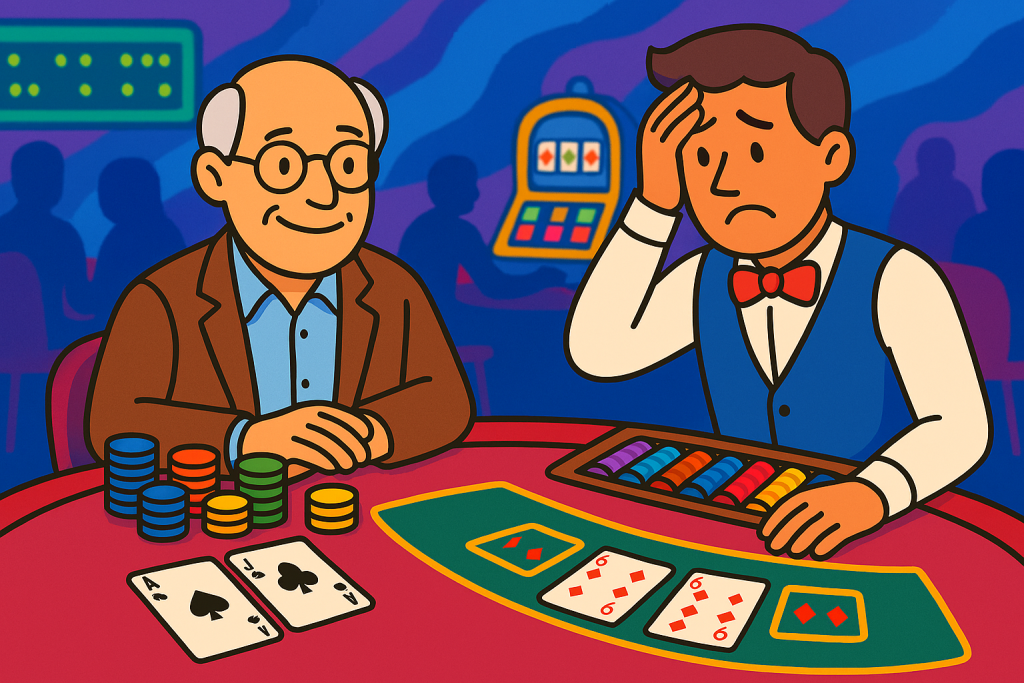
With a chalkboard and a slide rule, Edward O. Thorp cracked the game of blackjack wide open. His groundbreaking book Beat the Dealer turned card counting into a science—and got him banned from Las Vegas for life. But Thorp didn’t stop at the casino. He went on to revolutionize Wall Street, proving that mathematics could beat both the house and the market. This is the story of Edward O. Thorp, the man behind the math, the myth, and the millions.
Early Life and Academic Foundations
Born in Chicago in 1932 and raised in Southern California, Edward Oakley Thorp showed early signs of brilliance. By the age of 12, he was a certified radio operator, already experimenting with electronics and physics. His intellectual curiosity led him to study physics at UC Berkeley before transferring to UCLA, where he earned his Ph.D. in mathematics in 1958.
Thorp’s academic interests centered on probability theory, linear operators, and game theory. He held teaching positions at MIT, New Mexico State University, and later UC Irvine. It was during his time at MIT that Thorp began applying mathematical models to real-world problems—starting with the game of blackjack.
In the abstract, life is a mixture of chance and choice. Chance can be thought of as the cards you are dealt in life. Choice is how you play them.
Edward O. Thorp
Cracking Blackjack with Math
In the early 1960s, blackjack was widely regarded as a game of chance. But Thorp saw something else: a system governed by probability. Using the IBM 704 computer at MIT, he ran thousands of simulations to analyze how the composition of cards in a deck affected the odds. His research led to the development of the first mathematically proven card counting system.
Thorp’s system tracked high-value cards (10s, face cards, aces) and low-value cards (2–6). When more high cards remained in the deck, the player had a statistical edge. By adjusting their bets accordingly, Thorp demonstrated that players could consistently beat the house over time.
This wasn’t guesswork—it was science. Thorp’s use of the Kelly criterion, a formula for optimal bet sizing, ensured that his strategy maximized returns while minimizing risk. His work turned blackjack from a game of luck into a game of skill.
Beat the Dealer: The Book That Changed Everything
In 1962, Thorp published “Beat the Dealer,” a book that would forever change the world of gambling. The first edition was dense with mathematical formulas, but it proved one thing beyond doubt: blackjack could be beaten. The book became a bestseller, and Thorp was soon hailed as the “Blackjack Oracle.”
The second edition, released in 1966, simplified the system for casual players. It included charts, betting strategies, and practical advice for playing at the casino. Suddenly, card counting wasn’t just for mathematicians—it was for anyone with discipline and a good memory.
Casinos responded swiftly. They introduced multiple decks, frequent shuffling, and other countermeasures to neutralize card counters. Thorp himself was banned from many Las Vegas casinos, often escorted out once recognized.
But the damage was done. Beat the Dealer had exposed the vulnerability of the house and empowered a generation of advantage players.
From Blackjack to Wall Street
Thorp’s success at the blackjack table was just the beginning. He soon turned his attention to financial markets, applying the same mathematical rigor to stocks, options, and arbitrage.
In the late 1960s, Thorp founded Princeton/Newport Partners, one of the first quantitative hedge funds. Using statistical models and market inefficiencies, the fund generated consistent returns for over two decades. Thorp’s approach was methodical: identify patterns, test hypotheses, and execute trades with precision.
He also collaborated with Claude Shannon, the father of information theory, to develop a wearable computer that could predict roulette outcomes. Although the device was never widely used, it demonstrated Thorp’s commitment to innovation and a desire for the edge.
Thorp later authored “Beat the Market” and his autobiography, “A Man for All Markets,” detailing his journey from academia to casinos to Wall Street.
Legacy in Gambling and Finance
Edward O. Thorp’s legacy is twofold: he is the father of modern card counting and a pioneer of quantitative finance. His work bridged the gap between gambling and investing, showing that both could be approached with logic, discipline, and mathematical models.
In the gambling world, Thorp was inducted into the Blackjack Hall of Fame. His strategies remain foundational for professional players, and Beat the Dealer is still considered the definitive text on blackjack advantage play.
In finance, Thorp’s influence is seen in the rise of algorithmic trading, risk management, and data-driven investing. He proved that markets, like games, have patterns—and those patterns can be exploited.
Thorp also advocated for ethical investing and transparency. He avoided high-risk speculation, emphasizing long-term value and rational decision-making.
Cultural Impact and Personal Life
Thorp’s story has been featured in documentaries, academic journals, and interviews. He’s known not just for his intellect but for his humility and integrity. Unlike many gamblers or financiers, Thorp never sought fame—only truth.
He married Vivian Thorp and lives in California, where he continues to write, speak, and mentor. His autobiography, A Man for All Markets, offers insights into his philosophy, blending personal anecdotes with deep reflections on probability, risk, and human behavior.
Thorp’s cultural impact extends beyond gambling and finance. He’s a symbol of how intellectual curiosity and disciplined thinking can challenge powerful systems—and win.
Conclusion
Edward O. Thorp didn’t just beat the dealer—he beat the odds. With a chalkboard, a slide rule, and a relentless mind, he turned blackjack into a solvable puzzle and finance into a science. His legacy lives on in every card counter, quant trader, and curious thinker who dares to ask: Can the system be beaten?
From the smoky casinos of Las Vegas to the trading floors of Wall Street, Thorp proved that with logic, discipline, and a little math, the answer is yes.
FAQs
- What is the Kelly criterion, and how did Thorp use it?
The Kelly criterion is a formula for determining the optimal bet size. Thorp used it to maximize returns in blackjack and investing while minimizing risk. - Did Edward Thorp invent card counting?
No, but he was the first to prove it mathematically and publish a working system in Beat the Dealer. - Is Beat the Dealer still relevant today?
Yes. It remains the foundational text for blackjack strategy and card counting. - Did Thorp ever lose money gambling?
Rarely. He tested systems with small stakes and used strict risk management to avoid significant losses. - What’s Thorp’s connection to Claude Shannon?
They co-developed the first wearable computer to predict roulette outcomes, blending math and engineering in a groundbreaking way.