


Dark
Light
Playing card names preserve centuries of language, folklore and gaming tradition. Ace comes from an ancient word for “one”; Jack displaced Knave; French clovers became English Clubs; and individual cards acquired names including the Suicide King, Curse of Scotland and Devil’s Bedpost. This anthology explores their documented origins and meanings.

The familiar 52-card deck contains a surprisingly rich vocabulary. The names of playing cards, developed over centuries, preserve traces of Latin, Old French, medieval social ranks, European suit systems, gambling terminology, and card-playing folklore.
To understand playing card names and meanings logically, it helps to start with the terminology of the deck itself before moving through the four suits, numerical ranks, court cards, Aces, and finally the best-known playing card nicknames.
The terminology explored here developed alongside the cards themselves; for the broader story of their origins, migration, and development across Asia, the Islamic world, and Europe, see our A History of Playing Cards.
Playing Card Names and Basic Terminology
A standard international deck contains four suits:
- Hearts ♥
- Diamonds ♦
- Clubs ♣
- Spades ♠
Each contains thirteen ranks: Ace, Two, Three, Four, Five, Six, Seven, Eight, Nine, Ten, Jack, Queen, and King. This gives 52 cards before Jokers are added.
Several terms are useful when discussing playing card etymology.
- A rank identifies the card’s position or denomination: Ace, Seven, Queen, King, and so forth.
- A suit identifies its family: Hearts, Diamonds, Clubs, or Spades.
- A pip is one of the small suit symbols printed on a numeral card. The Seven of Hearts therefore has seven heart-shaped pips.
Cards from Two through Ten are consequently known as pip cards, spot cards or numeral cards.
The King, Queen and Jack are collectively called court cards because they represent figures associated with a royal court. They are also commonly called face cards because each depicts a human figure.
- The Ace is normally treated separately from both groups.
- The Joker sits outside the four suits and thirteen ordinary ranks.
These distinctions become important because many supposedly mysterious card names describe a card’s rank, visual appearance, or historical function.
Where Does the Word “Card” Come From?
Before examining individual playing card names, it is worth considering the word card itself.
English card in the sense of a playing card appeared during the early fifteenth century. It is related to Old French carte and ultimately to Latin charta, meaning paper, a leaf of paper, or a written document.
The Latin word itself was borrowed from Greek khartēs, associated with papyrus or sheets of writing material.
The same linguistic ancestry remains readily visible in European words such as French carte and Italian carta.
A playing card is therefore named fundamentally for the material or written/printed object on which its information appears.

Playing Card Suit Names and Their Etymology
The modern playing card suit names present an intriguing mixture of French symbols and English terminology.
The familiar French suit system emerged during the fifteenth century. The International Playing-Card Society dates the invention of the familiar French suit signs to around 1470. Their simplicity made them especially suitable for economical mass production.
The four French names are:
- Cœur — Heart
- Carreau — Tile or square
- Trèfle — Clover
- Pique — Pike
English speakers eventually called the same symbols:
- Hearts
- Diamonds
- Clubs
- Spades
The differences between the French and English terminology reveal how older European card traditions influenced the names of playing cards.
Why Are Hearts Called Hearts?
Hearts ♥ provide the most straightforward of the four playing card names and meanings.
The French suit is cœur, literally meaning heart. Its symbol is a stylised representation of a heart, so English players adopted the obvious descriptive name Hearts.
The English and French names therefore refer to essentially the same object.
Why Are Diamonds Called Diamonds?
The French name for ♦ is carreau, a word associated with a square, tile or similarly shaped object.
English players instead described the visual appearance of the suit mark as a diamond.
The English Diamonds suit therefore takes its name from the geometric appearance of ♦ rather than being a literal translation of the French carreau.
This distinction explains why French players still call Diamonds carreaux rather than using their word for gemstones.
Why Are Clubs Called Clubs?
The Clubs ♣ suit demonstrates particularly well how different European traditions became layered together.
In French, ♣ is trèfle, meaning clover or trefoil.
The symbol itself clearly resembles a three-leaf clover.
Yet English speakers call it a Club.
The English terminology preserves an association with the earlier Latin suit of batons or clubs, even though the actual ♣ symbol used in modern English cards comes from the French suit system.
The result is a historical hybrid:
French symbol: clover.
English name: club.
That is why the Club symbol does not resemble a conventional wooden club.
Why Are Spades Called Spades?
The origin of Spades ♠ is similarly revealing.
French players call the suit pique, meaning a pike or pointed weapon.
The English name Spades, however, is associated with the Italian spade, the plural of spada, meaning sword.
Italian cards traditionally use swords (spade) as one of their four suits. The IPCS identifies the Italian Latin suits as batons, swords, cups and coins.
The English card name therefore should not simply be interpreted as referring to a garden spade.
As with Clubs, the modern card combines a French suit symbol with an English name influenced by an older European suit tradition.
Playing Card Rank Names: From Ace to Ten
The numerical names of playing cards seem straightforward today, but several preserve very old gaming vocabulary.
Three terms are particularly significant: Ace, Deuce and Trey.
These words were associated with dice as well as cards, revealing how gaming terminology moved between different games.

Why Is an Ace Called an Ace?
Ace has one of the oldest and most interesting histories in playing card etymology.
The English word derives from Old French as, meaning the one on a die, which in turn derives from Latin as, meaning a unit, one, or whole. It was also the name of a Roman unit of weight and coinage.
The word was being used in English for one on a die before playing cards became established in Europe.
Originally, therefore: Ace = one.
This creates an interesting reversal in meaning.
One is the lowest possible individual throw of a die. Consequently, ace could historically carry associations with something of little value.
In many card games, however, the Ace eventually became the highest-ranking card. Its cultural meaning therefore changed dramatically.
Rather than representing something insignificant, ace eventually came to signify excellence.
That meaning survives in expressions such as ace pilot, ace player, ace marksman and ace in the hole.
The ordinary playing card therefore helped transform an ancient word for one into a modern synonym for exceptional ability.
Why Is a Two Called a Deuce?
The traditional gaming name for Two is Deuce.
The word entered English through French terminology, ultimately connected with the Latin duo — two. Deuce was used for the two-spot on dice and subsequently for cards.
Thus: 2 = Two = Deuce
The word remains familiar in playing card terminology, particularly in poker. Expressions such as pocket deuces refer to a starting hand containing two Twos.
The gaming word should not automatically be confused with the separate expression “the deuce,” meaning the Devil or an exclamation of annoyance. Those meanings developed along a different linguistic path.
Why Is a Three Called a Trey?
The traditional gaming name for Three is Trey.
It derives from Anglo-French and Old French treis, related to modern French trois and ultimately Latin tria, meaning three.
By the late fourteenth century, the term was being used for a card, die face, or similar gaming object displaying three spots.
Thus: 3 = Three = Trey
Like Deuce, Trey survives particularly strongly in poker and traditional gambling vocabulary.
Four, Five, Six, Seven, Eight, Nine and Ten
The remaining numeral cards normally use their ordinary English numbers:
- Four
- Five
- Six
- Seven
- Eight
- Nine
- Ten
Historical gaming language nevertheless contained additional numerical words.
Cinque was used for five and sice for six, particularly in dice terminology. Together with Ace, Deuce and Trey, they belonged to an older vocabulary of gaming numbers.
Unlike Ace, Deuce and Trey, however, Cinque and Sice never became enduring everyday playing card names in English.

Playing Card Court Card Names: King, Queen, Knave and Jack
The next major group in the etymology of playing card names consists of the court cards.
The modern hierarchy is: King — Queen — Jack
But that terminology did not emerge all at once.
Different European packs developed different court structures. Latin-suited Italian cards, for example, traditionally employ a King, Cavalier, and Footsoldier, while Spanish cards use a King, Cavalier, and Servant.
The familiar King-Queen-Jack hierarchy is associated with the French-suited tradition.
Why Is a King Called a King?
King was an ancient English title long before playing cards existed. It derives from the Germanic linguistic family and denotes a male sovereign or ruler. Its role within a deck is therefore primarily hierarchical rather than etymologically mysterious.
The King stands at the head of the card court. In most traditional games, he outranks the Queen and Jack, although the Ace can rank above him in many games.
Why Is a Queen Called a Queen?
Queen is likewise an ancient English royal title. What is historically more interesting is not the word itself but the presence of a female sovereign within the card hierarchy.
Queens were not universal in European playing-card systems. Other traditions used male court hierarchies involving Kings, mounted Cavaliers or Knights, and lower-ranking attendants.
The French system established the familiar: King — Queen — Valet
Which eventually became, in English: King — Queen — Jack.
The Queen is therefore an important distinguishing feature of the French-derived playing card court cards used internationally today.

Why Was the Jack Originally Called the Knave?
The Jack has undergone the most important name change among modern court cards. In traditional English terminology, the card was originally called the Knave.
The word knave comes from Old English cnafa, originally referring to a boy, male child, or servant. Its modern meaning of a dishonest or unscrupulous man developed later.
This older meaning made Knave an appropriate English equivalent for the lower-ranking male attendant depicted beneath the Queen and King.
The corresponding French court card is the Valet, likewise describing a male servant or attendant.
Why Is a Jack Called a Jack?
Jack gradually displaced Knave. Jack had long been used in English as a familiar or generic term for an ordinary man and became associated with the Knave in card-playing terminology.
For many years Knave remained the more formal term, while Jack was considered informal. Practical card design eventually helped Jack triumph.
When manufacturers introduced rank indices into the corners of cards, King could conveniently be represented by K, but Knave required Kn. Using J for Jack provided a much clearer distinction.
The modern K — Q — J system was therefore visually efficient as well as linguistically convenient.
The old name has not disappeared completely. Knave survives in historical writing and discussions of old playing cards, while the equivalent Valet remains standard terminology in French.
Do the Court Cards Represent Real People?
One of the most persistent misconceptions surrounding playing card names and meanings is that the Kings, Queens and Jacks in an ordinary English deck are portraits of famous historical people.
They are not.
The standard English or International pattern descended from card designs produced in Rouen, France. The International Playing-Card Society states that the English-pattern court cards have never carried personal names and are not thought to represent particular people.
The confusion arises because another important French tradition — the Paris pattern — does give names to its court cards.
Those named French courts are historically significant and deserve their own place within an anthology of court card names, but they should not be transferred indiscriminately to a modern English deck.
The Named Court Cards of the French Paris Pattern
The tradition of giving individual names to French court cards goes back centuries.
The Paris pattern became particularly influential within France and eventually formed the basis of the official French pattern. Its court figures bear names drawn from biblical tradition, classical antiquity, medieval history, and heroic legend.
Importantly, these figures are not authentic portraits of the people named. Some, such as Hector of Troy, could never have been based on a known historical likeness.
The Four Named Kings

King of Hearts — Charles
The Paris-pattern King of Hearts is Charles. He is traditionally interpreted as Charlemagne, the medieval Frankish ruler who became Holy Roman Emperor.
King of Spades — David
The King of Spades is David, referring to the biblical King David. Paris-pattern examples reinforce this identification by associating the figure with a harp, one of David’s traditional attributes.
King of Diamonds — Caesar
The King of Diamonds is Caesar, traditionally identified with Julius Caesar. The French name commonly appears as César or historically Cezar.
King of Clubs — Alexander
The King of Clubs is Alexander, traditionally understood to be Alexander the Great.
The four named Kings therefore bring together biblical, classical and medieval heroic traditions: Charles — David — Caesar — Alexander.
The Four Named Queens

Queen of Hearts — Judith
The Paris-pattern Queen of Hearts is Judith. The name is generally associated with the biblical heroine Judith, famous for killing Holofernes.
Queen of Spades — Pallas
The Queen of Spades is Pallas, associated with the classical figure Pallas Athena.
Queen of Diamonds — Rachel
The Queen of Diamonds is Rachel, generally interpreted as the biblical Rachel.
Queen of Clubs — Argine
The Queen of Clubs is Argine. Her name is the least straightforward of the four.
One longstanding suggestion connects Argine with an anagram of Latin regina, meaning queen. Another possibility is that the name developed through corruption of an older name.
The exact etymology should therefore be treated as uncertain rather than presenting the attractive regina explanation as established fact.
The Four Named Jacks or Valets

The named Jacks require slightly more caution because French nomenclature has not remained perfectly consistent across periods and patterns.
Jack of Hearts — La Hire
The Jack of Hearts is La Hire. Étienne de Vignolles, known as La Hire, was a fifteenth-century French military commander associated with Joan of Arc.
He is therefore one of the clearest cases in which a named French court card corresponds to an identifiable historical person.
Jack of Spades — Ogier
The Jack of Spades is traditionally Ogier, also written Hogier. The name refers to Ogier the Dane, a legendary hero associated with Charlemagne and medieval heroic literature.
Jack of Diamonds — Hector
The Jack of Diamonds is Hector. This refers to Hector of Troy, the celebrated Trojan warrior of Greek heroic tradition and Homer’s Iliad.
Jack of Clubs — Lancelot or Judah Maccabee
This card demonstrates why historical playing card names should not be oversimplified.
The modern French tradition commonly associates the Jack of Clubs with Lancelot, the Arthurian knight.
However, older Paris-pattern documentation records Judah Maccabee, also rendered Judas Maccabeus, in this position. The International Playing-Card Society notes more generally that French court-card names have varied over time and have not always been assigned consistently.
It is therefore more accurate to acknowledge the variation than to claim that one name has applied universally throughout French card history.
The Four Aces: Names, Meanings and Historical Associations
Unlike the Paris-pattern courts, the four Aces do not have official personal names.
They have, however, acquired distinctive playing card nicknames through particular games, taxation, visual symbolism and popular culture.
Ace of Spades — Tax Card, Spadille and Death Card
The Ace of Spades is easily the most culturally distinctive Ace.
Its unusual status in British playing cards has genuine historical connections with playing-card taxation. Duty regulations caused the Ace of Spades to become closely associated with evidence that the required tax had been paid.
This helped establish the tradition of an especially elaborate Ace of Spades bearing decorative artwork and manufacturer information.
The card has consequently been associated with the descriptive term: Tax Card
Another historic name is: Spadille
This comes from the historic trick-taking game Ombre, in which Spadille — the Ace of Spades — was a powerful trump.
The later nickname, Death Card, belongs primarily to symbolism, military usage, and popular culture rather than explaining the original name of the Ace.
The distinction is important: the Ace of Spades was not originally created as a “death card.”
Ace of Hearts — Crispin
Crispin has been recorded as a traditional nickname for the Ace of Hearts. Its precise origin is obscure, and its use has never been universal.
It is therefore best regarded as a historical or regional nickname rather than an alternative formal name.
Ace of Diamonds — Pig’s Eye
Pig’s Eye is recorded as a nickname for the Ace of Diamonds. Again, the exact etymology is uncertain.
The existence of an old nickname does not necessarily mean that its original explanation has survived.
Ace of Clubs — Basto
The most historically significant alternative name for the Ace of Clubs is Basto
Like Spadille, Basto comes from the game Ombre, in which it denotes the Ace of Clubs as an important trump.
The card has also acquired descriptive names connected with the appearance of ♣, including Clover and Puppy Foot/Puppyfoot.
Those names reflect the trefoil-like shape of the Club symbol rather than the etymology of the English word Club itself.
Playing Card Nicknames Created by Appearance
Once the basic names of playing cards had become established, players created an additional vocabulary based on how individual cards looked. Several of these playing card nicknames remain familiar today.
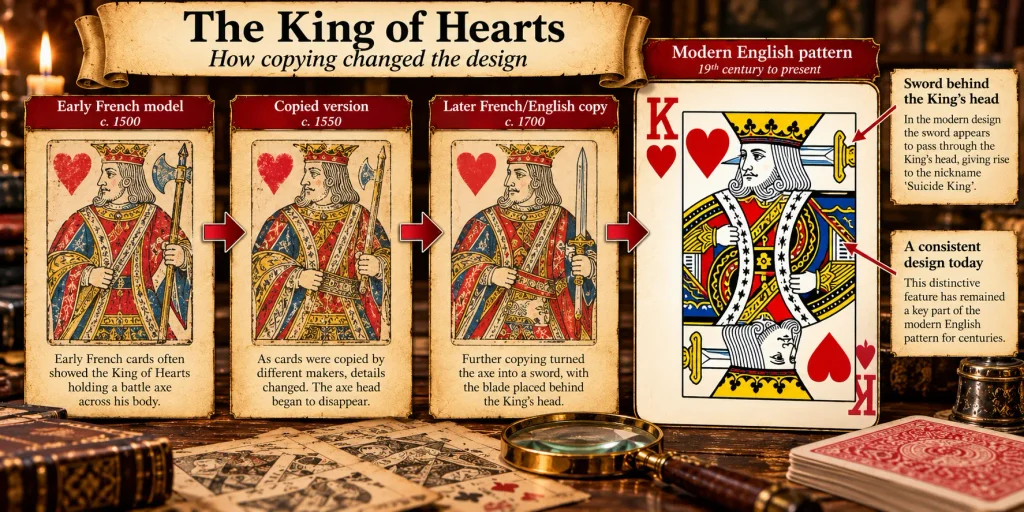
King of Hearts — The Suicide King
The King of Hearts is popularly known as the Suicide King
The nickname comes from the standard English design, in which the King’s sword appears to pass behind or into his head.
The card does not commemorate a king who committed suicide.
Its strange appearance developed as court-card artwork was repeatedly copied and simplified over centuries. The English pattern itself derives from Rouen designs produced before the sixteenth century, and generations of reproduction altered many small visual details.
The nickname therefore describes an optical impression created by the artwork, not a historical event.
Jack of Hearts and Jack of Spades — The One-Eyed Jacks
Two Jacks in the standard English pattern show their heads in profile:
- Jack of Hearts
- Jack of Spades
Because only one eye is visible, they are collectively known as the One-Eyed Jacks. The expression became sufficiently familiar to move beyond card terminology into popular culture.
There is no need for a supernatural or symbolic explanation: the name simply describes their poses.
King of Diamonds — One-Eyed King and Man with the Axe
The King of Diamonds is also shown in profile and therefore displays only one eye. He is consequently sometimes called the One-Eyed King
Together with the Jack of Hearts and Jack of Spades, he forms the trio commonly known as the One-Eyed Royals.
Another nickname is Man with the Axe. This comes from the object carried by the King in the standard English design, which resembles an axe or battle-axe.
Again, the nickname describes the artwork rather than identifying the King historically.
Playing Card Nicknames Created by Games and Tradition
Other playing card nicknames have little to do with portraits. Instead, they arose from card games, local customs, or longstanding folklore.

Queen of Spades — Black Lady and Black Maria
The Queen of Spades became particularly notorious through games in the Hearts family. Two well-known names are Black Lady and Black Maria
In variants of Hearts, the Queen of Spades carries a substantial penalty, making her the card players generally try to avoid taking.
The names therefore arise principally from game-playing culture, rather than identifying the Queen herself.
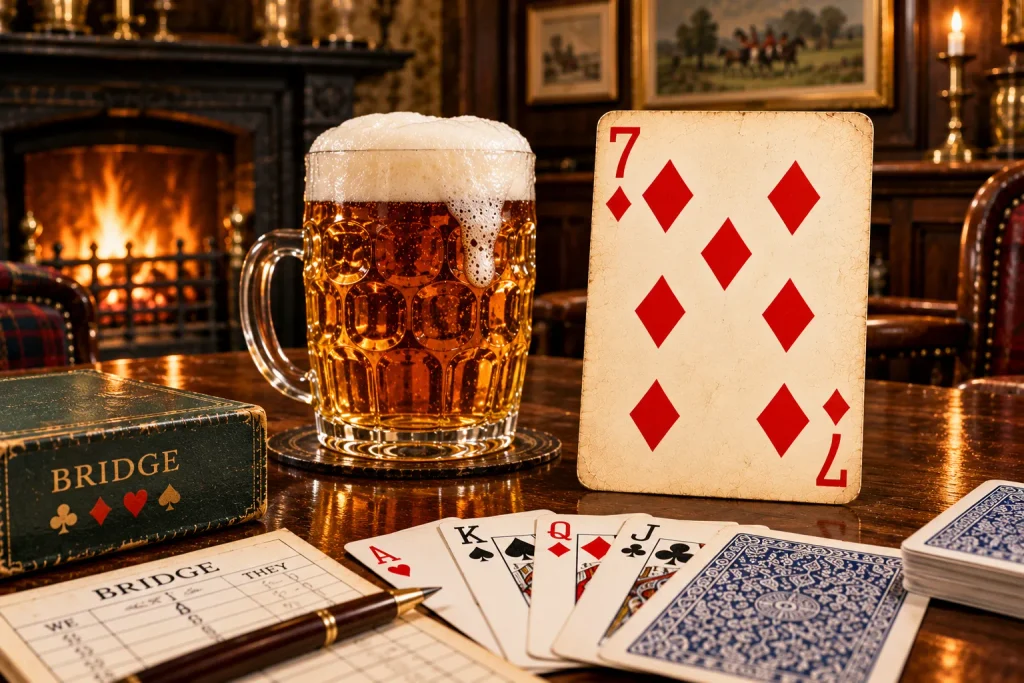
Seven of Diamonds — The Beer Card
The Seven of Diamonds is known among some bridge players as the Beer Card. Under the informal custom, successfully winning the final trick with the Seven of Diamonds can result in a partner owing the successful player a beer.
This is a social convention rather than an official rule of bridge.
The Beer Card is therefore a good example of how players continue to create new card names and gambling slang long after the standard deck itself became established.

Nine of Diamonds — The Curse of Scotland
One of the most famous playing card nicknames belongs to the Nine of Diamonds — the Curse of Scotland.
The nickname is well established. Its origin is not.
Over the centuries, explanations have attempted to connect the card with Scottish history, including:
- the Massacre of Glencoe
- the Battle of Culloden
- the Battle of Flodden
None has been established conclusively.
Popular folklore claims that during the Jacobite rebellion (1689 to 1746), military orders were written on the back of a Nine of Diamonds by an English General, leading to the massacre at Glencoe in 1692.
Some sources suggest that it was during the Battle of Culloden. Either way, either interpretation should be considered folklore, not established fact.
The most historically responsible answer to “Why is the Nine of Diamonds called the Curse of Scotland?” is consequently: Nobody knows for certain.

Four of Clubs — The Devil’s Bedpost
The Four of Clubs is traditionally known as The Devil’s Bedpost or The Devil’s Bedposts. The nickname is historically documented, but its exact origin remains uncertain.
An obvious explanation is that the four club symbols resemble the four posts of a bed. The symbol is also remarkably like the cloven hooves of a Goat, traditionally the lower half of the Devil himself.
The card has also accumulated associations with bad luck and fortune-telling.
The important distinction is that the nickname itself is historical, while the familiar explanations for it are theories rather than established etymology.

Four of Spades — “Ned Stokes”
The Four of Spades was traditionally known as “Ned Stokes” in parts of England, particularly Northamptonshire. It is believed that the name comes from a 16th-century highwayman who operated in the region, but I can find no definite evidence of this.
The nickname is documented as early as 1791 in The Gentleman’s Magazine. Intriguingly, even that early source admitted that the reason for the name was unknown.
Later nineteenth-century writers continued to record Ned Stokes as a regional name for the card, but no convincing identification of the mysterious Stokes has been established.
Claims that the card was named after an English highwayman should therefore be treated as unverified folklore rather than established history.

Four of Hearts — “Hob Collingwood”
In Northumberland and other parts of northern England, the Four of Hearts was traditionally known as “Hob Collingwood” and was regarded as an unlucky card, particularly at Whist.
The name was documented by North Country lexicographer John Trotter Brockett in 1825 and subsequently repeated by nineteenth-century writers on playing cards.
Exactly who, or what, Hob Collingwood originally referred to remains uncertain. A later story claimed that a Northumbrian named Collingwood was found murdered with the Four of Hearts clutched in his hand, supposedly explaining both the nickname and the card’s unlucky reputation.
However, earlier sources record the name without this story, so the murder explanation is better treated as playing-card folklore rather than established etymology.
A Complete Guide to Common Playing Card Names and Nicknames
The following condensed anthology brings the principal playing card names, alternative names, and documented nicknames together without treating regional slang as universal terminology.
General Playing Card Names
- Ace — originally “one”; from Old French as, and Latin as
- Two — also Deuce
- Three — also Trey
- Four — Four or Four Spot
- Five — Five or Five Spot; Cinque occurs in older gaming terminology
- Six — Six or Six Spot; Sice occurs in older dice terminology
- Seven — Seven or Seven Spot
- Eight — Eight or Eight Spot
- Nine — Nine or Nine Spot
- Ten — Ten or Ten Spot
- Jack — formerly Knave; equivalent to French Valet
- Queen — female royal court card
- King — male royal court card
- Joker — additional unsuited card outside the standard thirteen ranks
Collective Playing Card Names
- King + Queen + Jack — Court Cards or Face Cards
- 2–10 — Pip Cards, Spot Cards or Numeral Cards
- Jack of Hearts + Jack of Spades — One-Eyed Jacks
- Jack of Hearts + Jack of Spades + King of Diamonds — One-Eyed Royals
- Hearts + Diamonds — Red Suits
- Clubs + Spades — Black Suits
Ace Nicknames
- Ace of Spades — Spadille, Tax Card, Death Card
- Ace of Hearts — Crispin
- Ace of Diamonds — Pig’s Eye
- Ace of Clubs — Basto, Clover, Puppy Foot/Puppyfoot
Individual Pip-Card Nicknames
- Two — Deuce
- Three — Trey
- Four of Clubs — Devil’s Bedpost/Devil’s Bedposts
- Seven of Diamonds — Beer Card
- Nine of Diamonds — Curse of Scotland
Other local, historical, and game-specific names exist, but they should not be presented as universally recognised playing card terminology.
Jack Names and Nicknames
- Jack generally — formerly Knave; French Valet
- Jack of Hearts — One-Eyed Jack; Paris-pattern La Hire
- Jack of Spades — One-Eyed Jack; Paris-pattern Ogier/Hogier
- Jack of Diamonds — Paris-pattern Hector
- Jack of Clubs — Lancelot in modern French usage; Judah Maccabee/Judas Maccabeus in older Paris-pattern documentation
Queen Names and Nicknames
- Queen of Hearts — Paris-pattern Judith
- Queen of Spades — Paris-pattern Pallas; game-derived Black Lady and Black Maria
- Queen of Diamonds — Paris-pattern Rachel
- Queen of Clubs — Paris-pattern Argine
King Names and Nicknames
- King of Hearts — Suicide King; Paris-pattern Charles
- King of Spades — Paris-pattern David
- King of Diamonds — One-Eyed King, One-Eyed Royal, Man with the Axe; Paris-pattern Caesar
- King of Clubs — Paris-pattern Alexander
These French personal names belong to the Paris pattern. They are not the identities of the figures in the ordinary English/International deck.
[The Paris pattern is a traditional French design system for playing cards that developed in Paris and the surrounding region. A “pattern” in playing-card terminology means a recognisable standard design for the court cards—Kings, Queens and Jacks/Valets—including their poses, clothing, objects and, in some traditions, their names.]
Where Does the Joker Get Its Name?
The Joker is fundamentally different from the other playing card names because it is not part of the original thirteen ranks of any suit.
It developed in the United States during the nineteenth century in connection with Euchre, where an additional high trump emerged alongside the game’s bowers.
The Joker subsequently became an independent extra card and acquired the familiar jester or fool imagery now associated with it.
Claims that the word Joker has one simple, definitively proven derivation should be treated cautiously. Its emergence occurred within nineteenth-century American gaming culture at a time when Euchre terminology and the new additional trump were developing together.
What can safely be said is that the Joker is a later American addition to the standard deck, not one of the original French-suited ranks.
Its jester imagery ultimately proved so appropriate to the word joker that the two became inseparable in popular card design.
How Playing Card Names Preserve Centuries of Language
Taken together, the etymologies of playing card names reveal several layers of history within a single deck.
- Ace preserves an ancient word for one.
- Deuce and Trey preserve French-derived gaming vocabulary for two and three.
- Knave preserves an Old English word for a boy or servant.
- Jack demonstrates how popular speech and practical card design can replace an older formal term.
- Hearts retains the literal meaning of the French suit.
- Diamonds describes the shape of a French suit symbol.
- Clubs and Spades combine French-derived symbols with English terminology influenced by earlier European suit systems.
- King, Queen and Jack preserve the idea of a miniature royal court.
The French court card names add another layer drawn from biblical history, classical antiquity, medieval heroes and legend.
Finally, generations of players added their own language.
- The Suicide King was named for an apparent sword through his head.
- The One-Eyed Jacks and One-Eyed Royals were named for their profile poses.
- The Black Lady became notorious through Hearts.
- The Beer Card grew from bridge culture.
The Curse of Scotland and Devil’s Bedpost became famous even though the origins of their names remain unresolved.
The modern deck can therefore be read as a compact linguistic archive: 52 cards carrying words, symbols, and nicknames accumulated over centuries of European history, printing, gambling, and popular culture.
Conclusion
Playing card names form an extraordinary vocabulary assembled over centuries. Ace, Deuce, Trey, Knave, Jack, Hearts, Diamonds, Clubs and Spades preserve fragments of Latin, French, Germanic and European gaming culture, while names such as Suicide King, Curse of Scotland, Devil’s Bedpost and Beer Card reveal how players continually added their own folklore.
Understanding their etymology transforms the modern casino use of playing cards into a compact anthology of language, history and gambling tradition.
Frequently Asked Questions
Where did playing cards originate?
The ultimate origin of playing cards remains debated, although card-like games existed in Asia before European playing cards. The cards that entered Europe appear to have been strongly influenced by the Islamic world, particularly Mamluk cards. This article concentrates on terminology rather than their wider geographical history.
When did playing cards arrive in Europe?
Reliable references appear in Europe during the fourteenth century, with cards spreading rapidly across different regions during the late 1300s.
Why are there 52 cards in a deck?
The standard international pack contains four suits of thirteen ranks. Earlier European packs varied considerably, so 52 was not always a universal number. The familiar configuration became standard through the development and international spread of French-suited packs.
Why are there four suits in a deck of cards?
Four-suit systems existed in several traditions, but their symbols varied. The internationally familiar Hearts, Diamonds, Clubs and Spades derive from the French suit system.
Who are the kings on playing cards?
The modern English-pattern Kings do not have established individual identities. Paris-pattern French cards traditionally name their Kings Charles, David, Caesar and Alexander. Those names should not simply be transferred to modern English cards.
Who are the queens on playing cards?
Paris-pattern French Queens traditionally carry the names Judith, Pallas, Rachel and Argine. Standard English-pattern Queens are not reliably portraits of these women.
Why is the King of Hearts called the Suicide King?
The sword in the English-pattern King of Hearts appears to enter or pass behind his head, producing the nickname Suicide King. The image developed through generations of copying and does not depict a documented royal suicide.
What is the Curse of Scotland card?
The Nine of Diamonds is known as the Curse of Scotland. Numerous explanations have been proposed, involving Scottish battles, massacres, heraldry and card games, but no single origin has been conclusively established.
What is the Devil’s Bedpost card?
The Four of Clubs is historically documented as the Devil’s Bedpost or Devil’s Bedposts. The reason remains uncertain. The resemblance of its four pips to bedposts is a plausible later explanation, but should not be presented as proven etymology.
Why is the Ace of Spades different from other Aces?
British playing-card taxation played an important part in making the Ace of Spades distinctive. Duty and manufacturing requirements encouraged special designs, helping establish the tradition of an unusually elaborate Ace of Spades.
What are One-Eyed Jacks?
The Jack of Hearts and Jack of Spades are known as the One-Eyed Jacks because their heads appear in profile, leaving only one visible eye.
What are One-Eyed Royals?
The Jack of Hearts, Jack of Spades and King of Diamonds are collectively known as the One-Eyed Royals because each is depicted in profile with only one eye visible.
When was the Joker added to playing cards?
The Joker developed in the United States during the nineteenth century, particularly in connection with Euchre and its special trump-card traditions. It was therefore a much later addition than the ordinary 52-card structure.
Which country buys the most decks of playing cards per year?
There is no authoritative international dataset measuring the exact number of retail decks bought by consumers in every country each year. Trade and market datasets indicate that the United States is among the world’s largest playing-card markets, but imports, market value, and consumer deck purchases measure different things. It would therefore be misleading to claim a definitive country-by-country annual retail ranking without a comparable global dataset.
Are modern playing cards descended directly from tarot cards?
No. Standard playing cards and tarot belong to related branches of European card history, but the modern 52-card pack is not simply a tarot deck with the trump cards removed.
Why do modern court cards look symmetrical?
Double-ended court cards allow a player to recognise the figure without turning the card upright. The design became increasingly common as playing-card manufacture modernised and eventually became a defining feature of the standard international pattern.
Reference List:
Chatto, W. A. (1848). Facts and speculations on the origin and history of playing cards. John Russell Smith.
Harper, D. (n.d.). Ace. Online Etymology Dictionary.
Harper, D. (n.d.). Card. Online Etymology Dictionary.
Harper, D. (n.d.). Deuce. Online Etymology Dictionary.
Harper, D. (n.d.). Knave. Online Etymology Dictionary.
Harper, D. (n.d.). Trey. Online Etymology Dictionary.
International Playing-Card Society. (2006). The Curse of Scotland.
International Playing-Card Society. (2007). Four of clubs = “Devil’s Bedpost”?
International Playing-Card Society. (2007). Why are Jacks called Jacks?
International Playing-Card Society. (2007). Who do the kings, queens, and jacks on the courts represent?
International Playing-Card Society. (n.d.). Playing-card basics.
McLeod, J. (n.d.). Bridge. Pagat.com.
Metropolitan Museum of Art. (2016). The world in play: Luxury cards, 1430–1540. The Metropolitan Museum of Art.


Sign Up for Our Newsletters
Be the first to know when new content is created.Related Posts

Chinese Sports Betting Syndicates: How They Operate and Their Role in Global Sports Betting
Chinese sports betting syndicates are best understood as organised groups of bettors, analysts, intermediaries and financial participants who coordinate sports wagering across markets. Their activities can range from sophisticated legal betting strategies to illegal gambling and, in documented cases, match manipulation. The term does not describe one organisation or all Chinese bettors.

How To Play Poker Like Daniel Negreanu
Learning how to play poker like Daniel Negreanu means mastering discipline, observation, and strategic patience. Negreanu’s approach blends tight starting-hand selection, razor‑sharp reads, and controlled aggression. This guide distills his publicly shared principles into a practical roadmap for players who want to elevate their game using proven, world‑class strategy.

Monte Carlo Simulation for Slots: Understanding RTP, Risk, and Randomness
Behind every slot game is a mathematical model defining possible outcomes and their probabilities. Monte Carlo simulation helps developers and testers explore how that model behaves across repeated play. Understanding the method explains why a slot’s advertised return differs from individual results, and why simulations cannot tell you when to spin.

5 Unusual Gambling Games You Won’t Find at the Casino (and One You Will!)
Unusual gambling games reveal how inventive betting traditions can become. Away from familiar casino tables, players wager on arrow counts, picture dice, shouted finger totals and even cockroaches. These five examples show how local culture can shape the equipment, rules and rituals surrounding a bet.
