


Dark
Light
If you are looking for jobs in casinos, there are far more career choices than simply becoming a dealer. Having spent years around the casino and gambling industry, I have seen careers develop from the gaming floor into supervision, management and VIP operations. In this guide, I explain the main casino jobs, the skills employers look for, and how to start building a career in a land-based casino.
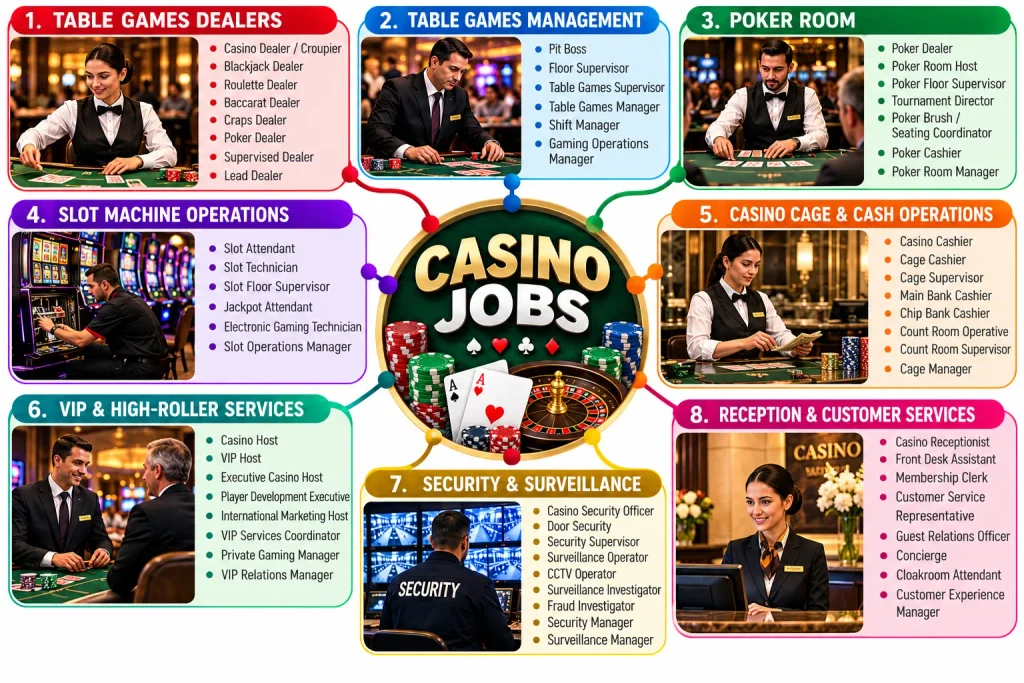
What Jobs Are There in a Casino?
When people ask me about casino careers, they usually think first of the croupier standing behind a roulette or blackjack table. Dealers are certainly at the heart of a traditional casino, but they represent only part of the workforce.
A land-based gaming operation may employ dealers, inspectors, pit bosses, slot attendants, poker staff, cashiers, casino hosts, surveillance operators, security officers, receptionists and senior gaming managers.
For this guide, I have focused on land-based casino jobs rather than careers with online gambling companies.
The terminology also changes between countries and casinos. In Britain and much of Europe, you will commonly hear the term Croupier used for a person who deals the games. In North America, Dealer is more common. Similarly, a job described as an inspector at a European casino might broadly correspond to a table supervisor in the USA.
Despite those differences, the fundamentals of casino employment are remarkably transferable internationally: integrity, numeracy, customer service, concentration, game knowledge and adherence to procedures matter wherever you work.

Casino Dealer and Croupier Jobs
For many people, casino dealer jobs provide the most obvious route onto the gaming floor.
A dealer conducts games, handles chips and gaming equipment, takes losing wagers and pays winning bets according to the game’s rules and the casino’s procedures. The US O*NET occupational database lists Blackjack Dealer, Roulette Dealer, Poker Dealer and Table Games Dealer among recognised job titles.
Typical specialisms include:
- Blackjack dealer
- Roulette dealer
- Baccarat dealer
- Craps dealer
- Poker dealer
A dealer is one of the best starting points for somebody who wants a long-term casino career, because it teaches you how the gaming floor actually works.
You need more than the ability to calculate payouts. A good dealer communicates clearly, protects the integrity of the game, remains composed under pressure, and provides customer service without losing concentration.
The US Bureau of Labor Statistics notes that new dealers may attend gaming school for several weeks to learn games, procedures, and applicable regulations. Casinos also audition and train prospective dealers.

From Dealer to Manager – Casino Career Progression
One of the attractions of working in a casino is the opportunities for progression.
A traditional table-games career might look something like:
Trainee Dealer → Dealer/Croupier → Inspector/Floor Supervisor → Pit Boss → Table Games Manager → Gaming Manager → Casino General Manager
The exact titles and hierarchy differ between companies and countries, but promotion from operational roles to supervisory ones is well established. The BLS notes that dealers can advance to supervisor and ultimately management positions, while managers must have previous casino-floor experience.
What Does a Casino Pit Boss Do?
The traditional pit boss oversees activity across a group or “pit” of gaming tables. Depending on the casino structure, responsibilities can include supervising dealers, monitoring games and customers, resolving disputes, approving certain transactions, and ensuring games are operated correctly.
Modern casinos increasingly use titles such as floor supervisor, gaming supervisor, or table games supervisor, so I recommend searching several variations when looking for vacancies.
What Does a Casino Manager Do?
A casino manager is responsible for overseeing the day-to-day operation of the gaming floor and ensuring that games are run efficiently, professionally, and in accordance with the casino’s procedures and applicable regulations. It is one of the most senior operational jobs in casinos and usually requires considerable gaming-floor experience.

In my experience, the best casino managers understand the business from the ground up. Many begin as dealers or croupiers before progressing through positions such as floor supervisor, pit boss, and table games manager. That practical experience is valuable because a manager may be responsible for several gaming departments and potentially hundreds of employees and customers during a busy shift.
Depending on the size and structure of the property, typical casino manager responsibilities can include supervising gaming operations, managing staff and shift coverage, monitoring table and slot performance, resolving customer disputes, approving certain gaming transactions, and ensuring employees follow established procedures.
Casino managers may also work closely with surveillance, security, cash operations and senior management. They need to understand gaming regulations, internal controls and responsible gambling requirements in the jurisdiction in which they operate.
Customer service is another important part of the job. A casino manager may become involved when a high-value player has a problem, when a dispute cannot be resolved at table level, or when an unusual situation requires senior authority. The ability to remain calm and make defensible decisions under pressure is therefore essential.
In larger casino resorts, management responsibilities are often divided between specialists such as a table games manager, poker room manager, slots manager, gaming operations manager, and casino general manager. In a smaller property, one manager may have responsibility for several of these areas.
For anyone considering a long-term casino career, management demonstrates just how far an entry-level gaming position can lead. A trainee dealer learning blackjack or roulette today could eventually progress into responsibility for an entire gaming floor.

Poker Room Jobs – Working in a Casino Cardroom
Poker creates its own group of jobs in casinos. These can include:
Poker dealer | Poker room host | Poker floor supervisor | Seating coordinator/brush | Poker cashier | Tournament director | Poker room manager
Poker dealers require a slightly different skill set from house-game dealers because they control games played between customers rather than playing a house hand against them.
Tournament operations add another career route. Larger poker rooms need people capable of managing seating, tournament structures, player movements, disputes, and the practical application of tournament rules.
Slot Machine and Electronic Gaming Jobs
The growth of electronic gaming has created another important branch of casino employment.
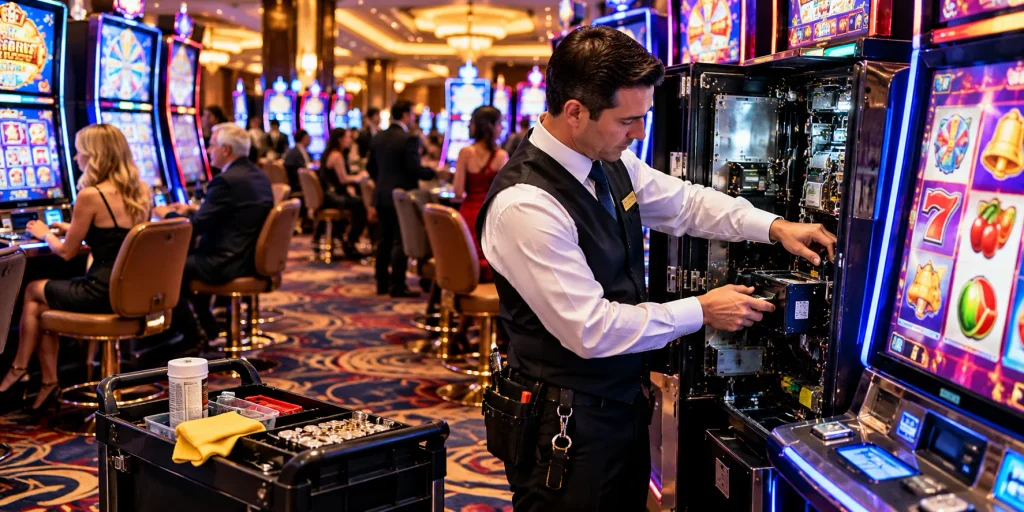
Common roles include slot attendant, jackpot attendant, slot technician, electronic gaming technician, slot supervisor, and slot operations manager.
Technical positions vary from traditional casino roles. If you have an electronics, electrical, mechanical, or technical background, slot operations may provide a way into the casino industry without becoming a croupier.
Slot attendants, meanwhile, generally have considerably more direct customer contact.

Casino Cashier and Casino Cage Jobs
The casino cage is essentially the casino’s secure cash-handling centre.
Depending on the property, casino cashier jobs can involve exchanging cash, chips, processing gaming transactions, and maintaining accurate records under strict procedures.
Possible positions include:
Casino cashier | Cage cashier | Main bank cashier | Chip bank cashier | Count-room operative | Cage supervisor | Cage manager
Accuracy and integrity are crucial. Casinos process substantial amounts of money, chips, and other instruments, and employees must follow tightly controlled procedures.
This is also a good example of why casino jobs with no experience should not be interpreted as jobs with no responsibility. An employer may be willing to train a person without casino experience, but trustworthiness, accuracy, and suitability checks can still be essential.

Casino Host and VIP Services Careers
A casino host occupies one of the industry’s most interesting customer-facing positions.
Hosts develop relationships with players and help the casino provide appropriate service to valued customers. At the upper end are VIP hosts, executive casino hosts, player-development executives, and private-gaming managers.
The job requires excellent interpersonal skills and discretion. Languages can be particularly valuable in international casino destinations where customers come from many countries.
Someone who combines casino-floor knowledge with exceptional customer service may therefore find a route into VIP casino jobs.

Casino Security and Surveillance Jobs
Casinos present unusual security challenges because large sums of money are combined with gaming activity, valuable chips, complex procedures, and substantial customer traffic.
Consequently, casino security jobs include much more than standing at an entrance.
Careers can include:
Security officer | Gaming security officer | Surveillance operator | CCTV operator | Surveillance investigator | Fraud investigator | Security supervisor | Surveillance manager
Surveillance is particularly specialised. Staff observe games, transactions and gaming-floor activity for irregularities and must understand casino procedures to recognise suspicious behaviour.

Casino Reception and Customer-Service Jobs
Not every entry-level casino employee needs to know how to deal blackjack.
Casino receptionist jobs and customer-service positions can provide another route into the industry.
These include casino receptionist, membership clerk, front-desk assistant, customer service representative, guest relations officer, and customer experience positions.
For someone coming from retail, tourism, or another customer-facing industry, these skills can transfer naturally into casino employment.
That matters because customer service is fundamental throughout the industry. The BLS specifically identifies customer service and communication skills among important qualities for gambling-services workers.
What Qualifications Do You Need to Work in a Casino?
There is no universal qualification for working in a casino.
For many operational positions, employers place substantial weight on practical ability, reliability, customer service, and training. US occupational data, for example, identifies a high school diploma or equivalent as the typical entry-level education for gambling dealers and short-term on-the-job training as typical.
However, licensing rules vary substantially by jurisdiction.
In Great Britain, for example, the Gambling Commission currently requires a Personal Functional Licence for specified casino functions, including dealers, cashiers, inspectors, gaming supervisors and security personnel employed to watch gaming. Applicants must be at least 18 and undergo suitability checks.
Nevada operates its own gaming employee registration scheme. Other countries, states and territories have their own systems.
So although the practical route into casino jobs is broadly similar worldwide, never assume that a licence obtained in one jurisdiction automatically qualifies you to work in another.
What Skills Do Casinos Look For?
From my perspective, the most transferable qualities are numeracy, concentration, communication, integrity, customer service, observation, professionalism and the ability to remain calm under pressure.
For dealers, manual dexterity and mental arithmetic matter. For supervisors, judgement and leadership become increasingly important. Surveillance demands sustained observation. VIP work requires relationship-building skills, while cash operations demand accuracy.
Language skills can also be valuable when seeking international casino jobs, particularly at resorts who attract customers from overseas.
And there is one practical consideration that newcomers sometimes overlook: casinos do not necessarily operate on conventional office hours.
Many are open late or around the clock. The BLS notes that casino employees commonly work nights, weekends, and holidays because those periods are often among the busiest.
How to Get a Job in a Casino With No Experience
If you are searching for entry-level casino jobs, I would not automatically begin by applying for management-level vacancies simply because you have managerial experience elsewhere.
Instead, identify where your existing abilities transfer.
Strong customer service experience may suit reception or player services. Cash-handling experience could help with cage positions. Technical skills may point towards electronic gaming. Languages and relationship-management experience could eventually support VIP work.
If you want to become a dealer, investigate reputable dealer training and casino-run trainee programmes in your jurisdiction.
Then learn the industry from the inside.
Casino experience becomes increasingly valuable as you progress because supervisors need to understand what happens at the tables, slots, cage and other customer facing areas.
Are Casino Jobs a Good Career?
They certainly can be.
Casino employment will not suit everybody. Shift patterns can be demanding, customers can be difficult, gaming floors can be noisy, and employees handling games or money work within strict procedures.
But there are advantages.
The industry offers specialist skills, international mobility, customer interaction and recognisable career progression. A dealer who learns multiple games and develops supervisory experience can build a very different career from the trainee who first walked into a dealer school.
US data illustrates that gambling careers remain a substantial occupational category: the BLS counted about 146,500 gambling-services workers in 2025 and projects roughly 20,200 openings per year on average from 2025–2035, largely because workers need replacing as they change occupations or leave the workforce. Those figures are US-specific and should not be treated as a forecast for the global casino industry.
For me, that distinction is important. There is no single worldwide casino labour market. There is, however, a remarkably international profession.
Learn the games, learn the procedures, understand customers and protect the integrity of the operation, and many of those skills can travel with you.
Conclusion
There are jobs in casinos for people with very different abilities, from casino dealers, poker staff and slot technicians to cashiers, surveillance officers, casino hosts and gaming managers.
If you are considering working in a casino, I recommend viewing the first job as the beginning of a career path rather than the destination. Learn the operation, develop specialist skills, and understand your local licensing requirements. Casino careers offer progression both at home and internationally.
Frequently Asked Questions About Casino Jobs
What jobs are there in a casino?
Land-based casinos employ dealers/croupiers, poker dealers, gaming supervisors, pit bosses, slot attendants, slot technicians, cashiers, cage staff, casino hosts, surveillance personnel, security officers, reception staff and gaming managers, among other roles.
Can I get a casino job with no experience?
Yes, some entry-level casino jobs provide training, although requirements vary by employer and jurisdiction. Dealer training schools and trainee-dealer programmes are common routes into table games. US BLS guidance identifies short-term on-the-job training as typical for dealers.
What is the best entry-level casino job?
There is no universal best position. Dealer/croupier work is particularly useful for someone seeking a long-term gaming-operations career, while reception, customer services, cage and slot-floor positions may suit different backgrounds.
Do I need a licence to work in a casino?
Possibly. It depends on your role and jurisdiction. Great Britain requires Personal Functional Licences for specified casino functions, while jurisdictions such as Nevada operate their own systems. Always check with the relevant regulator and prospective employer.
How do I become a casino dealer?
Typical routes involve learning one or more table games, mastering procedures and payouts, meeting local licensing requirements, and passing an employer’s recruitment process or dealing audition. Some casinos provide training, while some candidates attend specialist dealer schools.
Do casino dealers need to be good at maths?
Dealers need practical numeracy because they calculate and settle wagers accurately, although the precise mathematical demands differ between games. BLS identifies maths skills as important for gambling-services workers.
Can casino jobs lead to management?
Yes. Dealer → supervisor → gaming manager is an established career route. BLS specifically notes progression from dealing into supervision and management.
Do casinos operate 24 hours a day?
Many do, although this varies by property and local regulation. Casinos operating around the clock require shift coverage, and nights, weekends, and holidays are common working periods.
Can I work in casinos in another country?
Potentially, but immigration, work-permit, and gaming-licensing requirements apply. Casino experience may be transferable, but regulatory approval in one jurisdiction should not be assumed to transfer automatically to another.
What are the highest-level casino jobs?
Senior positions can include table games manager, director of gaming, casino operations manager, and casino general manager. Titles and responsibilities vary considerably between operators.
Reference List:
Bureau of Labor Statistics, U.S. Department of Labor. (2026). Gambling services workers: Occupational Outlook Handbook. U.S. Bureau of Labor Statistics — Gambling Services Workers
Gambling Commission. (2026). Personal Functional Licence (PFL) guide. UK Gambling Commission — Personal Functional Licence Guide
Gambling Commission. (2026). Casino sector guidance. UK Gambling Commission — Casino Sector Guidance
Gambling Commission. (2026). Specified management offices – casino personal functional licences. UK Gambling Commission — Casino Personal Licence Requirements
Nevada Gaming Control Board. (2026). Gaming employee registration. Nevada Gaming Control Board — Gaming Employee Registration
O*NET Online. (2026). Gambling dealers: 39-3011.00. National Center for O*NET Development. O*NET — Gambling Dealers
Casino Careers. (2026). Featured job openings. Casino Careers


Sign Up for Our Newsletters
Be the first to know when new content is created.Related Posts

The Archie Karas Story: How He Turned $50 into $40 Million
Archie Karas is a gambling legend whose story defies belief. Known for “The Run,” he turned $50 into $40 million in Las Vegas, defeating poker icons and casinos alike. His rise and fall remain unmatched in gambling history—a tale of brilliance, risk, obsession, and the ultimate price of chasing luck.

Who Is Fibonacci And What Did He Do? The Life and Legacy of Leonardo Pisano
Leonardo Pisano, better known as Fibonacci, remains one of the most influential mathematicians of the Middle Ages. His work introduced Europe to the Hindu‑Arabic numeral system and gave rise to the famous Fibonacci sequence, a pattern that continues to fascinate mathematicians, scientists, and even gamblers. From his early childhood in Pisa to his career as a merchant’s son traveling across the Mediterranean, Fibonacci’s discoveries shaped the way numbers are understood today. This article answers the question "who is Fibonacci and what did he do?" and explores his career, the origins of the sequence, and its surprising relevance to gambling strategies.

Joseph Jagger vs Charles De Ville Wells: The Men Who Broke the Bank at Monte Carlo
Two gamblers, Joseph Jagger and Charles De Ville Wells, became legends for “breaking the bank” at Monte Carlo. Their stories reveal contrasting paths to fortune: one guided by engineering precision, the other by audacious risk. This article compares their backgrounds, motivations, and methods, showing how their exploits reshaped modern casino design and fairness.

Meet the Greatest Gamblers in History: Legendary Players Who Changed Gambling
Throughout gambling history, a select group of players have achieved extraordinary results at the tables, racetracks and betting markets. From fearless high rollers to mathematically gifted professionals, these legendary gamblers built reputations through remarkable wins, unusual strategies and spectacular careers. Their stories reveal the risks, rewards and enduring fascination surrounding gambling.