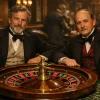
Two gamblers, Joseph Jagger and Charles De Ville Wells, became legends for “breaking the bank” at Monte Carlo. Their stories reveal contrasting paths to fortune: one guided by engineering precision, the other by audacious risk. This article compares their backgrounds, motivations, and methods, showing how their exploits reshaped modern casino design and fairness.
Gods of GamblingLegendary figures who made millions
Joseph Jagger vs Charles De Ville Wells: The Men Who Broke the Bank at Monte Carlo

The men who broke the bank at Monte Carlo
The men who broke the bank at Monte Carlo remain enduring symbols of daring intellect and audacious fortune. In the glittering salons of the late nineteenth century, gambling in Monte Carlo was more than mere chance; it was a stage for brilliance and bravado.
Figures like Joseph Jagger and Charles De Ville Wells became Monte Carlo legends, defying the odds and captivating the world with their exploits. Their mastery of Monte Carlo gambling combined mathematical insight, psychological finesse, and sheer nerve, transforming roulette tables into arenas of strategy and spectacle. These men embodied the allure of risk and reward, proving that fortune favours not only the bold but the analytical. Their stories echo through history as testaments to human ingenuity and the timeless fascination with beating the house.
Joseph Jagger: The English Engineer Who Outsmarted Chance

Background
Born in 1830 in Yorkshire, England, Joseph Jagger was a mechanical engineer in the textile industry. His work with spinning machines gave him a deep understanding of mechanical imperfection, a skill that would later make him famous in gambling circles.
Motivation
Jagger was not a thrill‑seeker but a problem‑solver. He believed that roulette wheels, like any machine, could never be perfectly balanced. His motivation stemmed from curiosity and the desire to test whether mechanical bias could be exploited for profit.
The Monte Carlo Experiment
In 1873, Jagger hired six clerks to record thousands of spins at the Monte Carlo Casino. After analysing the data, he discovered that certain wheels consistently favoured specific numbers. Armed with this insight, he bet strategically on those numbers—turning observation into fortune.
Outcome
Jagger’s methodical approach earned him around £65,000 (equivalent to several million pounds today). His success forced the casino to rotate wheels between tables and redesign them to eliminate bias. He returned to England wealthy and retired quietly, leaving behind a legacy of mathematical gambling.
Charles De Ville Wells: The Adventurer Who Courted Luck
Background
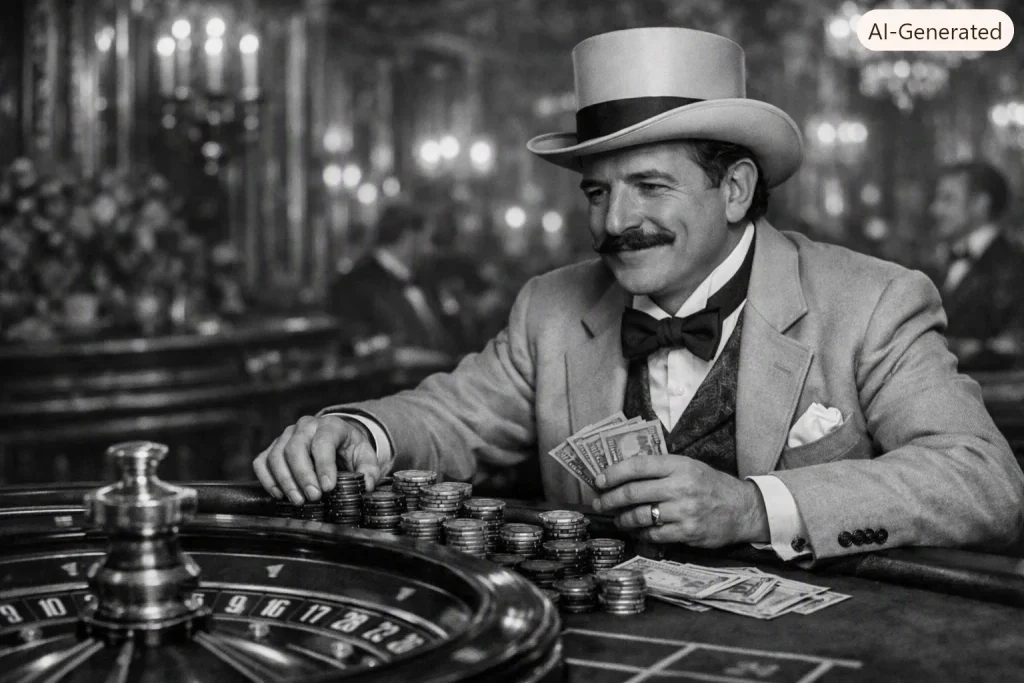
Charles De Ville Wells was born in 1841 in Broxbourne, Hertfordshire. Unlike Jagger, Wells was a flamboyant inventor, con‑artist, and gambler. His life was filled with schemes, from mechanical inventions to dubious investment ventures.
Motivation
Wells was driven by ambition and bravado rather than scientific curiosity. He sought fame and fortune through spectacle. His gambling exploits were as much about self‑promotion as profit, and he cultivated an image of a man who could defy the odds.
The Monte Carlo Miracle
In 1891, Wells arrived at Monte Carlo claiming to have a “system.” Over several nights, he won repeatedly, breaking the bank five or six times. Each time, the casino had to replenish the table’s funds, a symbolic victory that captured public imagination.
Outcome
Wells’s winnings were enormous, but his luck did not last. He later lost his fortune, was convicted of fraud, and served time in prison. Yet his legend endured, immortalised in the song “The Man Who Broke the Bank at Monte Carlo.”
Key Differences in Approach
| Aspect | Joseph Jagger | Charles De Ville Wells |
|---|---|---|
| Era | 1870s | 1890s |
| Background | Engineer from Yorkshire | Inventor and showman |
| Motivation | Scientific curiosity and precision | Fame, fortune, and thrill |
| Method | Statistical analysis of wheel bias | High‑risk betting and luck |
| Outcome | Lasting wealth and casino reform | Temporary success and later downfall |
| Legacy | Pioneer of probability‑based gambling | Symbol of audacious risk‑taking |
Comparing Their Motivations
Rational vs Romantic
Jagger approached gambling as an engineering problem—a test of mechanical reliability. Wells treated it as a performance, a stage for his charisma and daring. Jagger’s motivation was rooted in logic; Wells’s in spectacle.
Discipline vs Impulse
Jagger’s success came from patience and data collection. He spent weeks analysing results before placing a single bet. Wells, by contrast, relied on instinct and bravado, often staking large sums on single spins.
Legacy of Mindset
Their differing motivations highlight two archetypes of gamblers:
- The analyst, who seeks patterns and control.
- The dreamer, who trusts fortune and flair.
Both achieved fame, but only Jagger’s method influenced casino engineering and probability theory.
How They “Broke the Bank”
What “Breaking the Bank” Means
At Monte Carlo, each roulette table had a fixed reserve of chips known as the “bank.” When a player’s winnings exceeded that reserve, the table was temporarily closed while funds were replenished—a rare event symbolising triumph over the house.
Jagger’s Victory
Jagger’s calculated bets targeted biased wheels. His consistent wins drained the bank multiple times, forcing management to rotate wheels and redesign them to ensure fairness.
Wells’s Triumph
Wells’s streak was pure spectacle. He reportedly turned 4,000 francs into over a million in a few nights. His success was so improbable that newspapers worldwide covered it, cementing his reputation as the ultimate lucky gambler.
Impact on Casino Design and Anti‑Bias Measures
Mechanical Improvements
Jagger’s discovery of wheel bias led casinos to introduce precision engineering in roulette design. Modern wheels are balanced to microscopic tolerances, and casinos regularly test them for irregularities.
Procedural Safeguards
Casinos began rotating wheels between tables and replacing them frequently to prevent pattern exploitation. Surveillance and statistical monitoring became standard practice.
Psychological Influence
Wells’s flamboyant success taught casinos the importance of controlling perception. His story showed that luck could attract a crowd, and that publicity could be both a blessing and a risk. Casinos learned to manage narratives around winners carefully.
Modern Legacy
Today’s gambling industry owes much to these two men:
- Jagger inspired data‑driven fairness.
- Wells inspired entertainment‑driven spectacle. Together, they shaped the balance between mathematics and mystique that defines modern gambling.
Frequently Asked Questions
❓ What does “breaking the bank” mean at Monte Carlo?
It refers to winning more money than the table’s reserve, forcing the casino to temporarily halt play to replenish funds—a symbolic victory over the house.
❓ Did Joseph Jagger and Charles De Ville Wells know each other?
No. Their exploits occurred decades apart—Jagger in the 1870s, Wells in the 1890s—and they operated independently.
❓ Was Joseph Jagger’s method legal?
Yes. He exploited mechanical bias through observation, not cheating. His success prompted casinos to improve wheel design rather than pursue legal action.
❓ Did Charles De Ville Wells really have a system?
He claimed to, but no evidence supports it. Most historians agree his wins were due to luck and aggressive betting rather than a repeatable strategy.
❓ How did their actions influence modern casinos?
Jagger’s analytical approach led to precision‑engineered roulette wheels and fairness testing. Wells’s flamboyance influenced casino marketing and the allure of big‑win storytelling.

New Casinos

100% up to £50 + 25 free spins

100 spins plus up to £200 bonus

100 spins plus up to £200 bonus

100% match bonus up to £100

Win up to 500 free spins on Starburst

Double deposit bonus up to £350