


Dark
Light
Random number generators (RNGs) are systems that produce unpredictable values used in computing, gaming, and cryptography. They ensure fairness, simulate chance, and power secure algorithms. By generating sequences without discernible patterns, RNGs replicate randomness found in nature, making them essential for online gambling, simulations, and digital security applications.
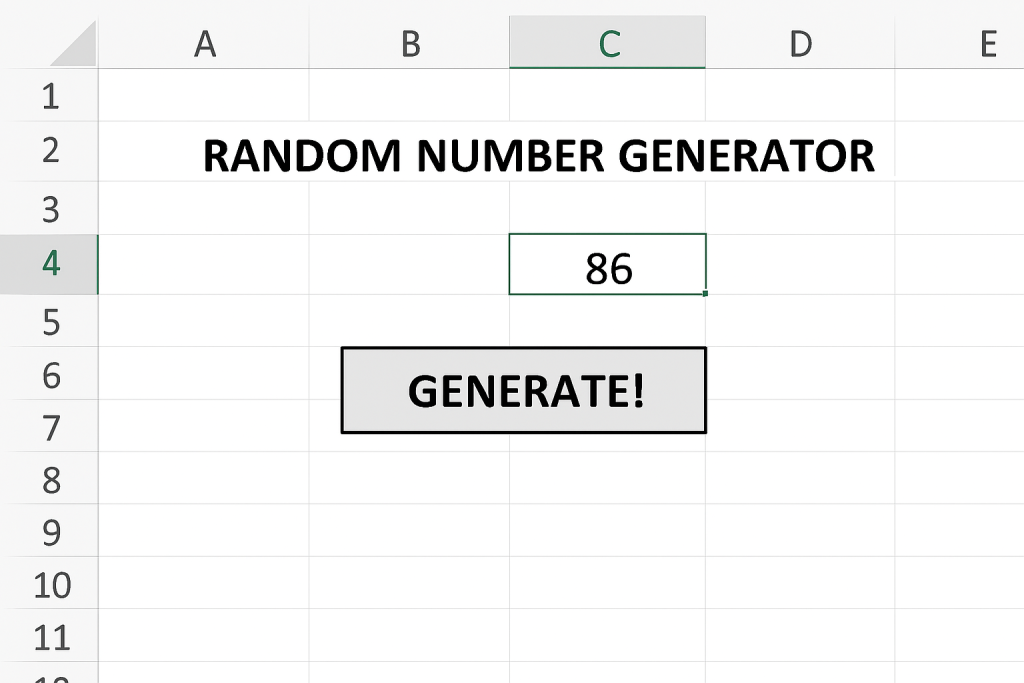
What is an Excel Random Number Generator?
A random number generator in Excel is a powerful tool for creating unpredictable values used in simulations, games, and data analysis. With simple formulas like =RAND() and =RANDBETWEEN(), users can instantly generate random decimals or integers. Excel’s dynamic recalculation makes it easy to refresh results and explore probability-based scenarios.
Who Uses Excel Random Number Generators?
Excel’s built-in random number functions (, , ) are surprisingly versatile, and different groups use them for very practical reasons:
- Students & Educators
- Create practice problems, quizzes, or simulations in math and statistics.
- Demonstrate probability concepts like dice rolls or coin flips.
- Data Analysts & Researchers
- Generate sample datasets for testing formulas or models.
- Run casino RNG simulations to explore risk, forecasting, or uncertainty.
- Business Professionals
- Randomize survey participant selection or assign tasks fairly.
- Model scenarios for financial planning or project management.
- Game Designers & Hobbyists
- Prototype dice rolls, card draws, or lottery-style mechanics.
- Build simple games directly in Excel for entertainment or educational purposes.
- Quality Assurance & Developers
- Stress-test spreadsheets, dashboards, or algorithms with randomized inputs.
- Ensure systems behave correctly under unpredictable conditions.
👉 In short, anyone who needs fairness, unpredictability, or quick simulations without coding can benefit from Excel’s random number generator.
How Excel RNG Knowledge Helps Online Slot Players
Knowing how to create a random number generator in Excel won’t let you beat online slots; casino RNGs are encrypted, regulated, and impossible to predict. But it is useful in several indirect, educational, and strategic ways:
- Understanding Fairness
- By experimenting with Excel functions, players can see how randomness works. This builds trust in the idea that slot outcomes are chance-driven, not rigged.
- Simulating Slot Play
- Players can model spins, payouts, or volatility using Excel RNGs. This helps them grasp concepts like variance, streaks, and probability without risking real money.
- Budgeting & Risk Awareness
- Running mock sessions in Excel shows how quickly bankrolls can rise or fall. It’s a safe way to visualize risk before playing.
- Educational Insight
- Understanding RNG mechanics demystifies free slot games. Players learn that “hot” or “cold” streaks are illusions created by randomness, not patterns to exploit.
- Game Design Curiosity
- Hobbyists or aspiring developers can use Excel RNGs to prototype slot-like mechanics, reinforcing how randomness drives outcomes.
Excel random number generator formulas
- Basic integer 1–100: =RANDBETWEEN(1,100)
- Basic decimal 0–1: =RAND()
- Decimal within a range (e.g., 5 to 10): =RAND()*(10-5)+5
- Multiple numbers (array of 10 integers 1–100): =RANDARRAY(10,1,1,100,TRUE)
Step-by-step: simple RNG (no macros)
- Choose a cell: Type one of the formulas above (e.g., =RANDBETWEEN(1,100)).
- Regenerate numbers: Press F9 to recalculate or edit any cell; the RNG updates automatically.
- Freeze a result: Copy the cell, then use Paste Special → Values to keep a fixed number.
- Create min/max inputs: Put min in A1 and max in B1, then use: =RANDBETWEEN(A1,B1)
Optional: “Generate” button without VBA
- Add a form control: Insert → Illustrations → Shapes → Button shape. Label it “Generate”.
- Trigger recalculation: Clicking the shape doesn’t recalc, but you can press F9 or type in a helper cell.
Tip: Link a spinner control to a hidden cell; each click changes the cell, forcing recalc.
Optional: “Generate” button with VBA
- Add a macro to recalc: Sub GenerateRNG() Application.CalculateFull End Sub
- Assign this macro to the button.
- Use formulas in cells: Keep =RANDBETWEEN(A1,B1) In your output cell, each click regenerates.
Useful variants
- Unique non-repeating integers (1-100,10 numbers): =INDEX(SEQ(100),SORTBY(SEQ(100),RANDARRAY(100)))
- Then take the first 10 with: =TAKE(INDEX(SEQ(100),SORTBY(SEQ(100),RANDARRAY(100))),10)
- Unique sample from a list in A2:A101 (10 items): =TAKE(SORTBY(A2:A101,RANDARRAY(ROWS(A2:A101))),10)
- Seed-like reproducibility (manual approach):
- Label: Save a snapshot by Paste Special → Values, or store a “seed” number in a helper sheet and use it to drive a custom sequence. Excel’s built-in
RAND()doesn’t take a seed parameter; reproducibility requires saving values or using Power Query/VBA for deterministic runs.
- Label: Save a snapshot by Paste Special → Values, or store a “seed” number in a helper sheet and use it to drive a custom sequence. Excel’s built-in
Frequently Asked Questions
Here are 5 key FAQs about Excel random number generators (RNGs): They explain how RNGs work, why they matter, and what players should know about fairness and unpredictability.
What is an Excel random number generator?
A random number generator (RNG) is software that produces unpredictable sequences of numbers used to determine outcomes in online casino games. It ensures that spins, card deals, and dice rolls mimic the randomness of physical casinos.
How do random number generators in Excel work?
Most online casinos use pseudo-random number generators (PRNGs), which rely on a seed value (often system time) and complex algorithms to generate results. These numbers correspond to game outcomes, such as the positions of the slot reel or the pockets on a roulette wheel.
Is a Random Number Generator in Excel Really Random?
- True RNGs (TRNGs): Use physical processes (like atmospheric noise) for natural randomness.
- Pseudo RNGs (PRNGs): Algorithm-based, statistically random but not “truly” random.
Online casinos typically use PRNGs, which are tested to ensure fairness.
Can players beat or predict RNGs?
No. RNGs generate thousands of numbers per second, making outcomes impossible to predict. Attempts to reverse-engineer them are blocked by encryption, audits, and regulatory oversight.
How are RNGs regulated for fairness?
Independent agencies (like eCOGRA or iTech Labs) test casino RNGs regularly. Regulators such as the UK Gambling Commission require casinos to use certified RNGs to guarantee fairness and transparency.


Sign Up for Our Newsletters
Be the first to know when new content is created.Related Posts

How to Play Powerball in the UK: Complete Powerball UK Guide
Understanding how to play Powerball in the UK is essential for British players who want a chance at America’s biggest lottery jackpots. This Powerball UK guide explains how to play US Powerball from the UK, provides clear UK Powerball lottery instructions, and outlines the safest ways to enter Powerball online UK.

Comparing the 5 Major Card Counting Strategies in Blackjack
Blackjack card counting strategies use mathematics to track how the remaining deck changes as cards are dealt. This guide compares five major systems, Hi-Lo, KO, Omega II, Zen Count, and Wong Halves, explaining their card values, mathematical logic, efficiency, complexity, and practical differences for modern casino play in real conditions.

How to Play Blackjack
Of all the card games in all the world, blackjack is by far the most popular. It is simple, strategic, and it takes 5 minutes to learn. It is also one of the few casino games where you can make all the decisions. On this page, you will learn: the rules of blackjack, hand values, gameplay flow, betting options, table etiquette, basic strategy, and common mistakes.

Outsmarted Board Game Fuels The Live Quiz Show Board Game Revolution
The rise of interactive trivia has transformed family game nights and online play alike. Outsmarted: The Live Quiz Show Board Game combines classic quiz mechanics with digital innovation, creating a seamless experience across devices. It’s not just a board game—it’s a live quiz show you can host anywhere, anytime.