


Dark
Light
The Hi-Lo Card Counting Strategy is one of the best-known systems used to track the changing composition of a blackjack deck or shoe. Rather than trying to predict individual cards, the Hi-Lo Counting System assigns simple values to different card ranks and maintains a running count as cards are revealed. The system was introduced by Harvey Dubner in 1963 and remains one of the most widely discussed blackjack card counting methods.
Understanding Hi-Lo Card Counting requires knowledge of card values, the running count, the true count, blackjack basic strategy, deck composition, and the relationship between the remaining cards and mathematical expectation.
What Is the Hi-Lo Card Counting Strategy?
The Hi-Lo Card Counting Strategy is a balanced blackjack counting system based on assigning one of three values to every card:
| Card | Hi-Lo Value |
|---|---|
| 2, 3, 4, 5, 6 | +1 |
| 7, 8, 9 | 0 |
| 10, J, Q, K, A | -1 |
As cards appear, the player adds or subtracts these values to create a running count. The count begins at zero after a new deck or shoe is shuffled.
The principle behind the system is that the remaining decks contain proportionally more high cards, particularly tens and aces, which can produce different mathematical conditions from a deck containing more low cards.
Importantly, card counting does not predict the next card. It is a method of estimating the changing composition of the remaining decks.
How the Hi-Lo Card Counting System Works
The Hi-Lo Counting System is deliberately simple. Low cards from 2 through 6 receive a value of +1, 7 through 9 are neutral, and tens, face cards, and aces are -1.
For example, imagine the following cards are dealt:
5 – K – 3 – 8 – A – 6
The calculation is:
+1 -1 +1 +0 -1 +1 = +1
The resulting running count is therefore +1.
A positive running count means that, according to the Hi-Lo system, more low cards have appeared relative to high cards than in a neutral count. Conversely, a negative count indicates that relatively more high cards have appeared.
The count itself is not a guarantee of what will happen next. It is simply a numerical representation of observed card composition.
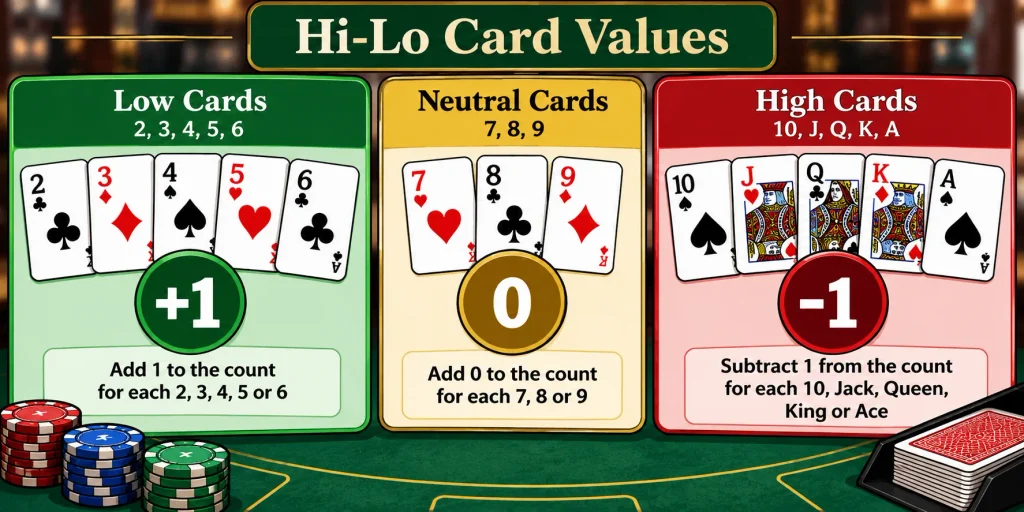
Hi-Lo Card Values: The +1, 0, and -1 System
The simplicity of the Hi-Lo card counting values is one reason the system is so widely studied.
The low cards—2 through 6—are counted as +1 because their removal leaves a greater proportion of high cards behind. The 7, 8, and 9 are assigned 0 because their removal has a comparatively neutral effect within the system.
Tens, face cards, and aces receive -1 because removing them leaves proportionally more low cards in the remaining deck.
The ace deserves particular attention because it has a dual role in blackjack. It can count as either 1 or 11 when determining a hand’s value, but in the Hi-Lo card counting system, every ace has a count value of -1.
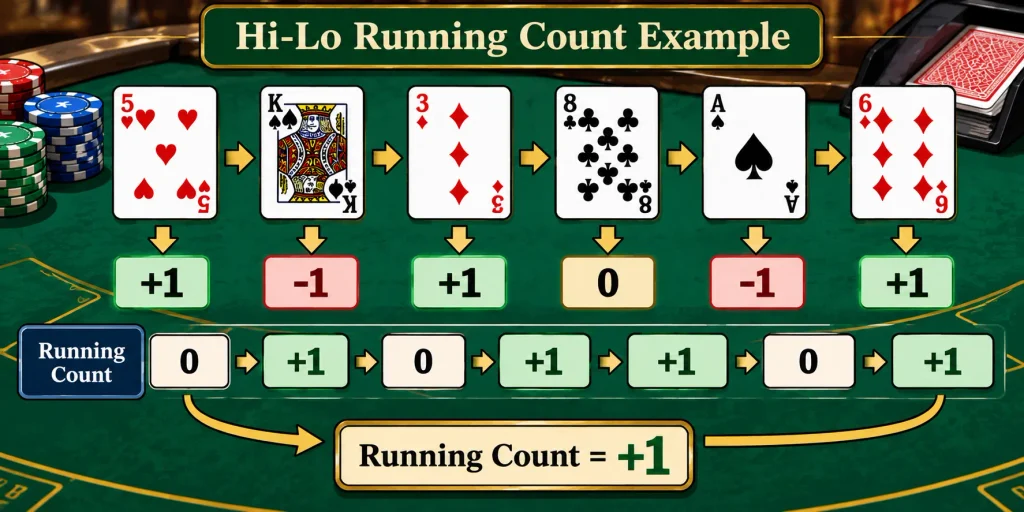
How to Calculate the Running Count
The Hi-Lo running count starts at zero following a shuffle.
Players then update the count as cards become visible. If a 2 appears, the count increases by one. If a king appears, it decreases by one. A 7, 8, or 9 produces no change.
Consider this sequence:
4 – 7 – Q – 6 – 9 – 2 – 10
The calculation is:
+1 +0 -1 +1 +0 +1 -1 = +1
The running count is therefore +1.
With a single deck, the running count provides a straightforward measure of the cards seen so far. With multiple decks, however, another calculation becomes important: the true count.
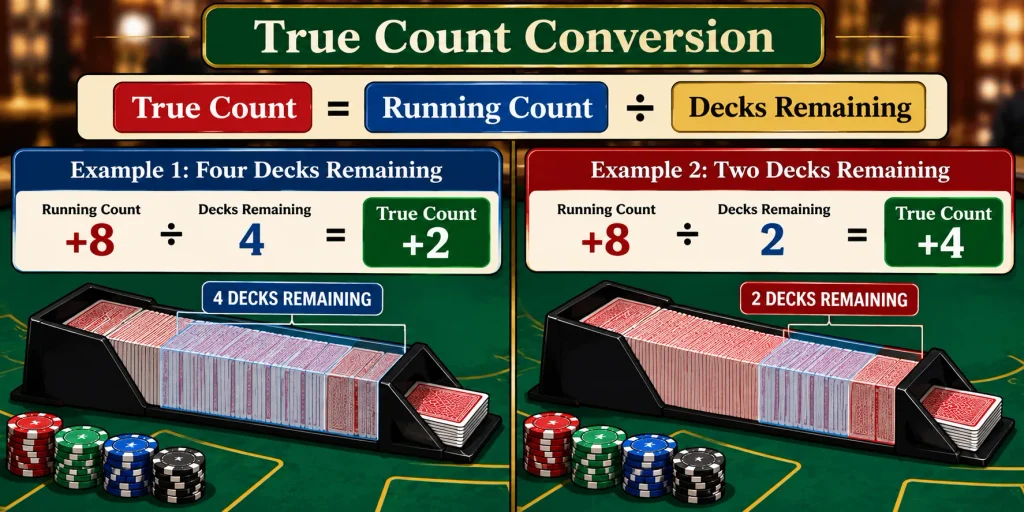
How to Calculate the Hi-Lo True Count
The true count adjusts the running count according to the estimated number of decks remaining.
The basic formula is:
True Count = Running Count ÷ Estimated Decks Remaining
For example, suppose the running count is +8 and approximately four decks remain.
+8 ÷ 4 = +2
The estimated true count is therefore +2.
If only two decks remain:
+8 ÷ 2 = +4
The same running count therefore represents a substantially different card composition depending on how many cards remain in the shoe.
This is one of the fundamental differences between single-deck and multi-deck Hi-Lo play. Accurate estimation of the number of remaining decks becomes increasingly important as the number of decks increases.
Hi-Lo Card Counting Example
Imagine a six-deck blackjack shoe in which several rounds have already been dealt.
The player has observed enough cards to establish a running count of +6. Approximately three decks remain.
The calculation is:
+6 ÷ 3 = +2 true count
The player now has a true count of approximately +2.
This does not mean the next hand will win, nor does it guarantee that a blackjack will be dealt. Instead, the count indicates that the observed cards have altered the composition of the remaining shoe in a direction that can affect the mathematical expectations of future hands.
This distinction is important when explaining how to count cards in blackjack: card counting is fundamentally a probability and composition-tracking technique, not a prediction system.
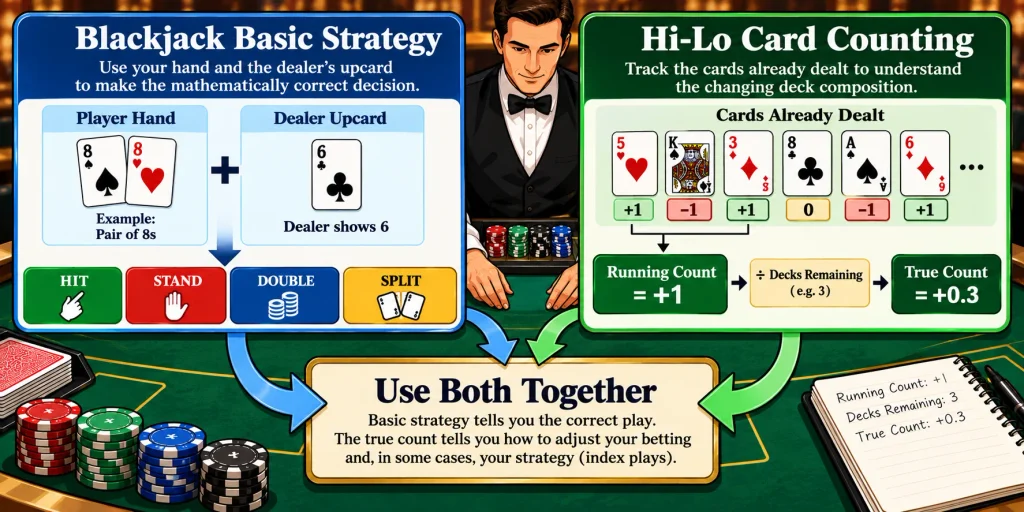
Hi-Lo Card Counting and Blackjack Basic Strategy
Blackjack basic strategy and card counting are related but different concepts.
Basic strategy determines the mathematically correct action for a player’s hand against the dealer’s upcard, taking the game’s rules into account. A basic-strategy player may choose to hit, stand, split, or double based on the specific hand and the dealer’s cards.
Hi-Lo card counting adds information about the cards that have already appeared.
For example, a player using basic strategy does not normally alter their decisions because several low cards appeared during previous hands. A card counter monitors those cards because the changing deck composition can affect the expected value of future decisions.
This is why learning basic strategy before card counting is essential. Card counting does not replace fundamental blackjack strategy.
How the Hi-Lo System Relates to House Edge
The house edge in blackjack depends on the rules of the game and the strategy used by the player. Important variables include the number of decks, blackjack payout, dealer rules, doubling restrictions, splitting rules, and surrender provisions.
A 3:2 blackjack payout, for example, produces different mathematical conditions from a 6:5 payout.
Card counting attempts to exploit information contained in the changing composition of the deck. However, the size of any potential advantage depends on many factors, including rules, penetration, counting accuracy, betting decisions, and variance.
It is therefore inaccurate to describe the Hi-Lo Blackjack Strategy as a guaranteed winning system.
Hi-Lo Card Counting in Single- and Multiple-Deck Games
The Hi-Lo system works with both single-deck and multiple-deck blackjack, but the mechanics differ.
With a single deck, the running count can provide a relatively direct indication of the changing composition. With a six- or eight-deck shoe, the running count needs to be converted into a true count to account for the larger number of cards remaining.
Another important concept is shoe penetration, which is how much of the shoe is dealt before the shuffle. Greater penetration provides more information about the composition of the remaining cards, while frequent shuffling reduces the amount of information available.
The actual mathematical effect depends on the specific rules and conditions of the game.
Common Hi-Lo Card Counting Mistakes
Beginners learning the Hi-Lo Card Counting Strategy commonly encounter several problems.
Losing the running count is perhaps the most obvious. One missed card can corrupt every subsequent calculation.
Another problem is confusing the running count with the true count. The running count is simply the accumulated Hi-Lo value. The true count adjusts that number for the estimated decks remaining.
A third mistake is abandoning basic strategy. Card counting is not a substitute for understanding correct blackjack decisions.
Finally, players can place too much confidence in a short sequence of results. Even when mathematical conditions favour the player, individual hands remain uncertain. Variance means that short-term results can differ substantially from long-term mathematical expectations.
How to Practise the Hi-Lo Counting System
Learning Hi-Lo card counting requires practice rather than simply memorising the card values. Members of the MIT Blackjack Team spent many, many hours practising their skills before they ever ventured onto the gaming tables.
A useful starting exercise is to take an ordinary deck and turn over cards one at a time while maintaining the running count. At the end of the deck, a correctly balanced Hi-Lo count should return to zero.
The next stage is to increase speed while maintaining accuracy. Players can also practise estimating the number of decks remaining and converting the running count into a true count.
Only after becoming comfortable with counting should a learner consider more advanced concepts such as index plays, which alter certain basic-strategy decisions according to the count.
The objective of practice should be accuracy and mathematical understanding rather than attempting to predict individual outcomes.
Is Hi-Lo Card Counting Legal?
The legal position surrounding card counting depends on the jurisdiction and the circumstances.
In Great Britain, the Gambling Commission regulates licensed casino gambling and states that casino operators must provide information about the rules and house edge of games offered.
The Gambling Commission has also stated that it does not hold a general policy or guidance concerning the legality of card counting and that individual matters would depend on the specific facts.
That makes an important distinction: mentally keeping track of cards is not the same thing as using a prohibited device or cheating. Casino rules and local laws can differ, so players should check the applicable rules rather than assuming that the rules are identical everywhere.
Conclusion
The Hi-Lo Card Counting Strategy remains an important part of blackjack history and mathematical strategy because it provides a relatively simple method for monitoring deck composition. Its fundamental concepts, Hi-Lo card values, the running count, true count, basic strategy, house edge, and probability, form the foundation for understanding blackjack card counting.
For anyone studying the subject, the most important point is that Hi-Lo is not a method for predicting individual cards or guaranteeing winning sessions. It is a statistical technique for interpreting changing card composition. Used as an educational framework, it demonstrates how information about previously dealt cards can influence the mathematical analysis of a blackjack game.
Hi-Lo Card Counting FAQ
What is the easiest card counting system?
The Hi-Lo Counting System is relatively simple because cards are divided into three groups: +1, 0, and -1. However, simplicity does not mean that accurate card counting is easy in a live blackjack environment.
What is the Hi-Lo count for an ace?
An ace has a Hi-Lo value of -1. This applies regardless of whether the ace subsequently counts as 1 or 11 in the player’s blackjack hand.
What is the Hi-Lo count for a 7?
A 7 has a Hi-Lo value of 0. The same applies to 8 and 9.
Why are fives important in card counting?
A 5 is one of the low cards assigned +1 in Hi-Lo. Like the other low cards, removing it changes the relative composition of the remaining deck.
What does a positive count mean in blackjack?
A positive Hi-Lo count indicates that more low cards have appeared relative to high cards than would be expected from a neutral count. In some circumstances, this can correspond with a greater concentration of high cards remaining.
Why do card counters use the true count?
The true count accounts for the number of decks remaining. This makes the running count more meaningful when playing a multiple-deck blackjack shoe.
How long does it take to learn Hi-Lo card counting?
The basic card values can be memorised quickly, but becoming consistently accurate requires practice. Speed, concentration, deck estimation, and true-count conversion all require additional training.
Does card counting guarantee winning at blackjack?
No. Hi-Lo card counting does not guarantee winning. Blackjack outcomes remain uncertain, and short-term results can vary substantially even when the mathematical expectation changes.
Reference List:
Wizard of Odds. Introduction to the High-Low Card Counting Strategy.
Wizard of Odds. Card Counting in Blackjack – Introduction & Basics.
Wizard of Odds. Blackjack Basic Strategy.
Wizard of Odds. Blackjack House Edge Calculator.
UK Gambling Commission. Casino Games.
UK Gambling Commission. Section 42 Cheating.


Sign Up for Our Newsletters
Be the first to know when new content is created.Related Posts

How to Use a Blackjack Progression Betting System
Blackjack progression betting is a structured approach to changing wager sizes according to previous results rather than placing the same stake on every hand. A blackjack progression system can increase or decrease bets after wins or losses, but it does not alter the underlying mathematical odds. Understanding progression betting, bankroll requirements, volatility and its limitations is essential before examining any blackjack progression betting strategy.

A History of Playing Cards: From Medieval Courts to Modern Gambling Palaces
The history of playing cards stretches across centuries, cultures and continents. Their precise ancestry remains debated, but cards developed in Asia before related forms appeared in the Islamic world and Europe. From medieval hand-painted decks to mass-produced casino cards, their evolution created one of history's most enduring tools for gaming, gambling and entertainment.

A Complete Guide to Online Betting Sites
Online betting sites have revolutionized the way people place wagers, offering convenience, variety, and accessibility from anywhere in…

Edward O. Thorp and the Birth of Card Counting
Edward O. Thorp, a mathematician and hedge fund pioneer, revolutionized the world of gambling with his groundbreaking book Beat the Dealer in 1962. Using probability theory and computer simulations, Thorp proved that blackjack could be beaten with a strategic approach. His Ten-Count System gave players a statistical edge over the house, transforming blackjack from a game of chance into a game of skill.