


Dark
Light
Sigmund Freud and gambling make an unlikely but fascinating combination. Freud’s most important examination of compulsive gambling came through his analysis of Russian novelist Fyodor Dostoevsky. Rather than seeing gambling simply as a pursuit of money, Freud proposed something far stranger: for some compulsive gamblers, losing itself might satisfy an unconscious psychological need.
IMPORTANT NOTE: Freud’s ideas discussed below are historical psychoanalytic interpretations, principally developed through his analysis of Dostoevsky. They should not be confused with an accepted modern explanation of gambling disorder. Contemporary psychology and psychiatry understand problematic gambling through multiple interacting psychological, behavioural, social, and neurobiological factors.
What Did Sigmund Freud Say About Gambling?
Freud never produced a comprehensive general theory of casino gambling. His most famous contribution to the psychoanalysis of gambling appeared in his 1928 essay Dostoevsky and Parricide (Dostojewski und die Vatertötung).
The essay examined Fyodor Fyodor Dostoevsky, whose relationship with gambling was anything but theoretical.
Freud was interested in Dostoevsky as an artist and psychological subject. He regarded The Brothers Karamazov extraordinarily highly and was fascinated by themes of fathers, sons, guilt, crime, punishment, and parricide running through Dostoevsky’s work. Freud attempted to interpret the novelist through his own theories concerning the unconscious mind, Oedipus complex, father complex, guilt and masochism.
Dostoevsky’s compulsive gambling provided Freud with another piece of this psychological puzzle.
Freud described Dostoevsky’s behaviour during his gambling period as an unmistakable episode of what he called “pathological passion.”
The question Freud wanted to answer was not simply: why did Dostoevsky gamble?
It was: why did he repeatedly gamble until he had lost?
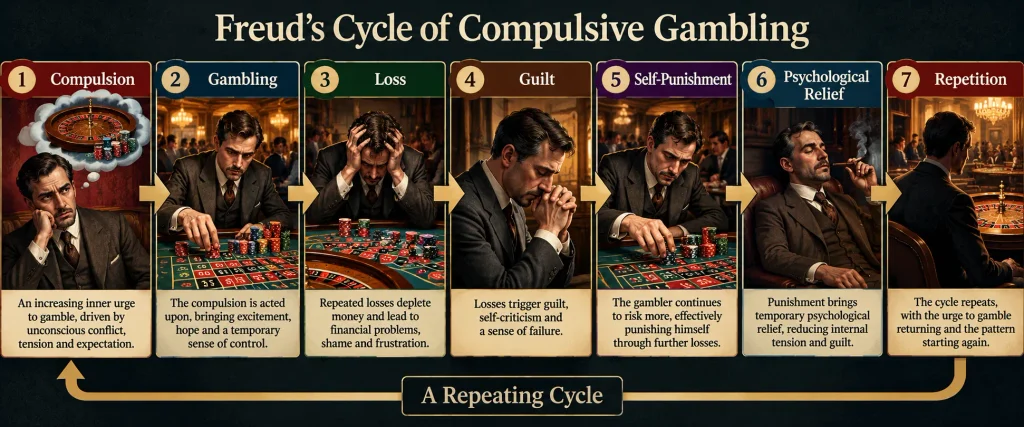
Freud’s Theory of Gambling Addiction
Dostoevsky’s behaviour appeared irrational when viewed purely as an attempt to make money.
He accumulated gambling debts, promised his wife he would stop, broke those promises, and returned to gambling. Freud noted that Dostoevsky could rationalise his behaviour by claiming that gambling winnings might solve his financial problems.
But Freud believed money was not the real explanation.
He argued that Dostoevsky understood that the principal attraction was gambling itself. More importantly, Freud interpreted his tendency to continue until his money was gone as a form of self-punishment.
A simplified version of the Freudian cycle would therefore look like this:
Compulsion → Gambling → Loss → Guilt → Self-punishment → Psychological relief → Repetition
This is central to understanding Freud’s gambling theory.
The conscious gambler apparently wants to win. Freud’s psychoanalytic interpretation proposed that another motive could exist beneath conscious awareness.
The unconscious mind might be pursuing punishment rather than profit.

Freud, Dostoevsky and Roulette
Dostoevsky will never be recognised as one of the greatest gamblers in history despite spending much of his time gambling in European gambling resorts. Yet, he will always be associated with roulette during a particulalrly important time in its development.
His experiences contributed to his 1866 novella The Gambler, a remarkably intense depiction of gambling psychology, obsession, money, relationships and roulette.
Freud later had access not only to Dostoevsky’s literary work but to biographical material, including posthumous papers and information from his wife’s diaries. This helped make the novelist an irresistible subject for psychoanalytic interpretation.
Freud admired Dostoevsky’s artistic achievement enormously. Yet he attempted to connect several aspects of his personality and behaviour, including guilt, masochism and gambling, to conflicts within his psychoanalytic framework.
This is where Freud, Dostoevsky and gambling become inseparable.
For Freud, Dostoevsky’s roulette addiction was not an isolated bad habit. He interpreted it as part of a broader psychological pattern involving guilt, punishment and repetition.
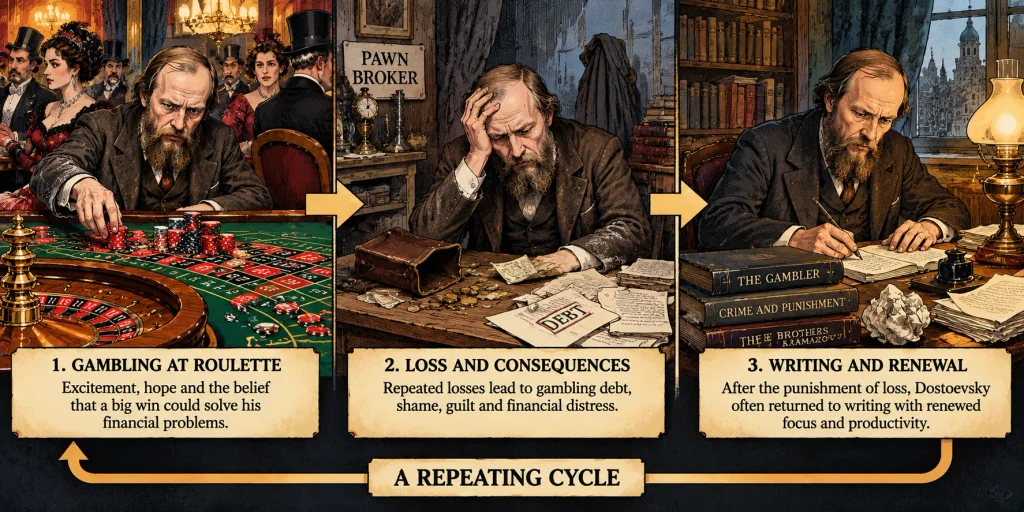
Why Did Freud Believe Gamblers Wanted to Lose?
This requires an important qualification.
It is misleading to reduce Sigmund Freud and gambling to the claim that all gamblers secretly want to lose.
Freud was analysing a particular pattern that he believed he could see especially clearly in Dostoevsky.
According to Freud’s account, Dostoevsky did not simply experience losses accidentally while trying to win. He repeatedly continued until the financial damage became severe.
Freud therefore interpreted gambling as a method of self-punishment.
After losing, Dostoevsky could condemn himself, experience humiliation, and seek forgiveness from his wife. In Freud’s interpretation, the punishment temporarily satisfied the underlying guilt.
Something particularly interesting then happened.
Freud drew upon Dostoevsky’s wife’s observation that his literary productivity could improve after catastrophic losses. Freud interpreted this through psychoanalysis: once punishment had satisfied the sense of guilt, psychological inhibition diminished, and Dostoevsky could work again.
The gambler therefore appeared to be seeking wealth consciously while repeatedly creating loss and punishment unconsciously.
It was an ingenious theory. That does not make it scientifically established.
Gambling, Guilt and Self-Punishment
The idea of gambling and self-punishment sits within Freud’s wider theories about Dostoevsky.
Freud believed Dostoevsky possessed a powerful sense of guilt associated with his relationship with his father. Within classical Freudian psychoanalysis, this became entangled with the Oedipus complex, ambivalent feelings towards the father and fantasies of parricide.
Freud interpreted Dostoevsky’s destructive tendencies as being directed substantially inward, producing masochism and guilt rather than outward criminal violence.
Gambling could consequently provide an arena for punishment.
Money is gained, risked and lost. Promises are made and broken. The gambler suffers, feels remorse and then begins the cycle again.
Freud therefore saw repetition as psychologically significant.
Later psychoanalytic writers developed theories of compulsive gambling further, often retaining ideas surrounding guilt, punishment, omnipotence, parental conflict and an unconscious desire to lose. Freud’s Dostoevsky and Parricide nevertheless remains one of the best-known early psychoanalytic discussions of gambling.
Freud’s Controversial Connection Between Gambling and Masturbation
This is perhaps the strangest element of Freud’s theory of gambling addiction to modern readers.
Freud connected compulsive gambling with masturbation.
His argument was not that the two activities were physically alike. Instead, he believed gambling could reproduce a psychological pattern involving irresistible temptation, pleasure, promises of abstinence, failure to resist, guilt, and punishment.
In Dostoevsky and Parricide, Freud explicitly connected gambling addiction and its opportunities for self-punishment with what he regarded as a repetition of the compulsion to masturbate.
This needs substantial historical context.
Freud’s ideas concerning sexuality, masturbation, neurosis, and the Oedipus complex belong to early psychoanalytic theory. They are important for understanding the history of gambling psychology, but they should not be presented as established contemporary explanations of gambling disorder.
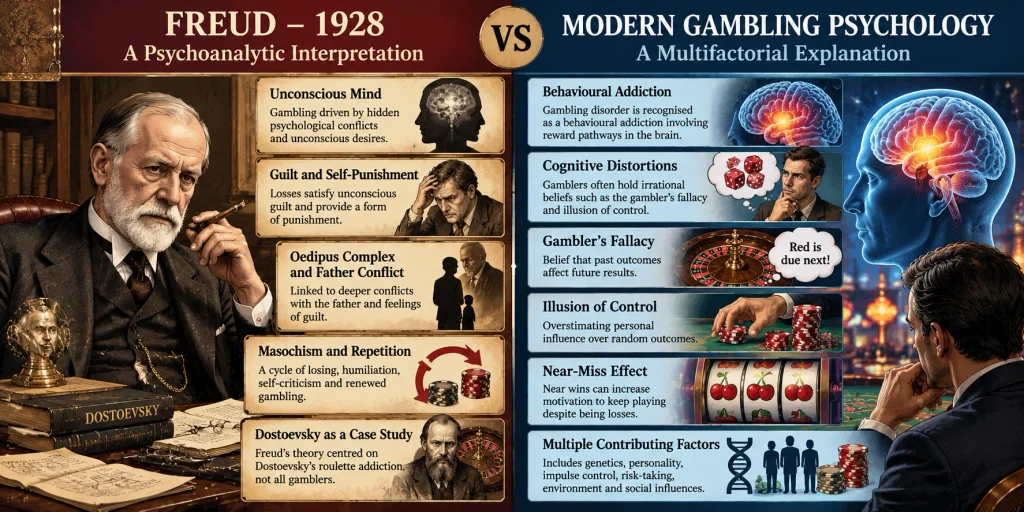
Was Freud Right About Gambling Addiction?
Not in the sense that modern psychology has established an unconscious desire for punishment as the cause of gambling disorder.
Today, gambling disorder is recognised as a behavioural addiction. The American Psychiatric Association places it alongside substance-related disorders within its category concerning substance-related and addictive disorders.
Modern gambling research investigates numerous interacting processes, including impulse control, compulsive behaviour, reward processing, risk-taking, chasing losses and cognitive distortions.
Three particularly important phenomena are:
- Gambler’s fallacy — believing that previous independent outcomes affect what should happen next.
- Illusion of control — overestimating personal influence over outcomes governed primarily or entirely by chance.
- Near-miss effect — responding differently to a loss that appears psychologically close to winning.
Research indicates that gambling-related cognitive distortions can contribute to persistent gambling, while near misses may increase motivation to continue playing despite being objective losses.
These mechanisms differ substantially from Freud’s ideas about the Oedipus complex, father complex, masochism and unconscious self-punishment.
Yet there is an intriguing point of contact.
Freud was trying to explain why rational calculations about money often fail to explain compulsive gambling behaviour. Modern research also recognises that gambling decisions can be powerfully affected by psychological processes that do not reflect the objective probability of winning.
Freud’s proposed mechanism may be disputed; the underlying question remains highly relevant.
Freud’s Legacy in the Psychology of Gambling
Nearly a century after Dostoevsky and Parricide, Freud’s interpretation remains fascinating because he challenged the most obvious assumption about gambling:
People gamble because they want to win money.
For most recreational gamblers, winning is obviously desirable. But compulsive gambling can involve behaviour that appears profoundly self-defeating: chasing losses, accumulating gambling debt, repeated unsuccessful attempts to stop and continuing despite serious consequences.
Modern psychology investigates such behaviour through addiction science, cognition, decision-making and neurobiology rather than relying on a single psychoanalytic explanation. Gambling disorder is consequently understood as considerably more complex than an unconscious wish to lose.
Nevertheless, Freud identified a question that still makes Sigmund Freud and gambling worth examining:
Why does someone who desperately wants to win repeatedly behave in ways that leave them financially and emotionally damaged?
In Freud’s day there was no such thing as safer gambling tips, so the answer must lie deep inside the unconscious mind. In modern psychology, there is no single answer.
Conclusion
Sigmund Freud’s gambling theory emerged principally from his fascination with Dostoevsky and the novelist’s destructive relationship with roulette.
Freud interpreted repeated losses through psychoanalysis, guilt, and self-punishment, proposing that losing could satisfy an unconscious psychological need.
Modern gambling research does not accept this as a universal explanation, but Freud’s provocative theory remains an important chapter in the history of gambling psychology.
FAQ: Sigmund Freud and Gambling
What did Sigmund Freud say about gambling?
Freud’s best-known discussion appears in his 1928 essay Dostoevsky and Parricide. He interpreted Dostoevsky’s compulsive gambling as involving guilt and self-punishment rather than simply a rational desire to win money.
What was Freud’s theory of gambling?
Freud proposed that, in Dostoevsky’s case, gambling could function as an unconscious mechanism of self-punishment. Losing satisfied guilt and was followed by temporary psychological relief.
Did Freud believe gamblers wanted to lose?
This needs qualification. Freud interpreted Dostoevsky’s behaviour as demonstrating an unconscious drive towards loss and punishment. It should not be generalised into the claim that Freud scientifically demonstrated that all gamblers secretly want to lose.
Why did Freud associate gambling with self-punishment?
Freud believed Dostoevsky carried a powerful sense of guilt. He interpreted catastrophic gambling losses as a way of inflicting punishment upon himself and temporarily satisfying that guilt.
What did Freud say about Dostoevsky’s gambling?
Freud considered Dostoevsky’s gambling an example of “pathological passion” and argued that gambling itself—not simply obtaining money—had become the objective.
Was Dostoevsky addicted to gambling?
Dostoevsky unquestionably experienced periods of severe and destructive gambling behaviour, particularly involving roulette. Applying a modern retrospective diagnosis is more problematic because contemporary clinical assessment was obviously impossible.
Why did Dostoevsky gamble at roulette?
Dostoevsky sometimes hoped gambling could solve his financial difficulties, but his own behaviour showed that gambling had become compelling beyond its financial purpose. Freud interpreted this psychologically as involving guilt and self-punishment.
What is the psychoanalytic theory of gambling addiction?
Classical psychoanalytic approaches have interpreted compulsive gambling through unconscious conflict, guilt, punishment, repetition, omnipotence, and other psychodynamic mechanisms. These are historical/theoretical approaches rather than a complete contemporary scientific model of gambling disorder.
What does modern psychology say about gambling?
Contemporary research examines gambling disorder through multiple factors, including reward processing, decision-making, impulsivity, chasing losses, and cognitive distortions such as the gambler’s fallacy, illusion of control, and near-miss effect.
Is Freud’s theory of gambling still accepted today?
Freud’s specific explanation is historically influential but is not an accepted universal explanation of gambling disorder. Modern psychiatry classifies gambling disorder as a behavioural addiction and approaches it through a much broader evidence base.
Reference List:
American Psychiatric Association. (2024). What is gambling disorder? American Psychiatric Association — Gambling Disorder
Clark, L. (2010). Decision-making during gambling: An integration of cognitive and psychobiological approaches. Philosophical Transactions of the Royal Society B, 365, 319–330. Read via PubMed Central
Freud, S. (1928/1961). Dostoevsky and parricide. In J. Strachey (Ed. & Trans.), The Standard Edition of the Complete Psychological Works of Sigmund Freud (Vol. 21, pp. 177–194). Hogarth Press. Freud, Dostoevsky and Parricide — text copy
Kovács, I., Richman, M. J., Janka, Z., Maraz, A., & Andó, B. (2017). Decision-making measured by the Iowa Gambling Task in alcohol use disorder and gambling disorder: A systematic review and meta-analysis. Related contemporary discussion of Dostoevsky and gambling cognition is available through PubMed Central. Dostoevsky and Gambling Disorder discussion
Potenza, M. N. et al. Contemporary reviews of gambling disorder identify cognitive, reward, and decision-making processes alongside gambling-related distortions. Gambling Disorder Integrative Review


Sign Up for Our Newsletters
Be the first to know when new content is created.Related Posts

Amarillo Slim Net Worth: How Much Did the Legendary Gambler Really Make?
Few figures in gambling history are as colorful and controversial as Amarillo Slim, born Thomas Austin Preston Jr. Known as the “World’s Greatest Gambler,” Slim rose to fame after winning the 1972 World Series of Poker (WSOP) Main Event, becoming one of the first poker celebrities to cross into mainstream culture. His life story is a blend of triumphs, eccentric proposition bets, media appearances, and scandals that tarnished his reputation. This article explores Amarillo Slim net worth, poker career, earnings, controversies, and enduring legacy.

What is the Fibonacci Betting System?
The Fibonacci sequence starts with 0 and 1, then each number is the sum of the two before it. It appears in nature, art, and math, forming spirals and patterns.

Doyle Brunson: Godfather of Poker
Doyle Brunson, affectionately known as the "Godfather of Poker," was more than just a card shark, he was a pioneer, author, and ambassador for the game. With an estimated net worth of $75 million at the time of his passing in 2023, Brunson’s fortune was built on decades of poker dominance, savvy business ventures, and cultural influence. This article explores his life, career, earnings, and legacy.

Benny Binion Net Worth & Casino Legacy
Benny Binion, a legendary figure in Las Vegas history, built a gambling empire that transformed the casino industry. From outlaw roots in Texas to founding Binion’s Horseshoe Casino, his story is one of grit, innovation, and controversy. This article explores his net worth, legacy, and rise to prominence.