


Dark
Light
The history of Atlantic City casinos is a story of reinvention. Once one of America’s great seaside resorts, Atlantic City turned to legalized casino gambling during the 1970s in an attempt to reverse decades of economic decline. What followed was a spectacular cycle of investment, expansion, competition, bankruptcies, casino closures and eventual diversification.
Atlantic City Before Casinos
Long before roulette wheels and slot machines dominated its skyline, Atlantic City was a major American seaside resort.
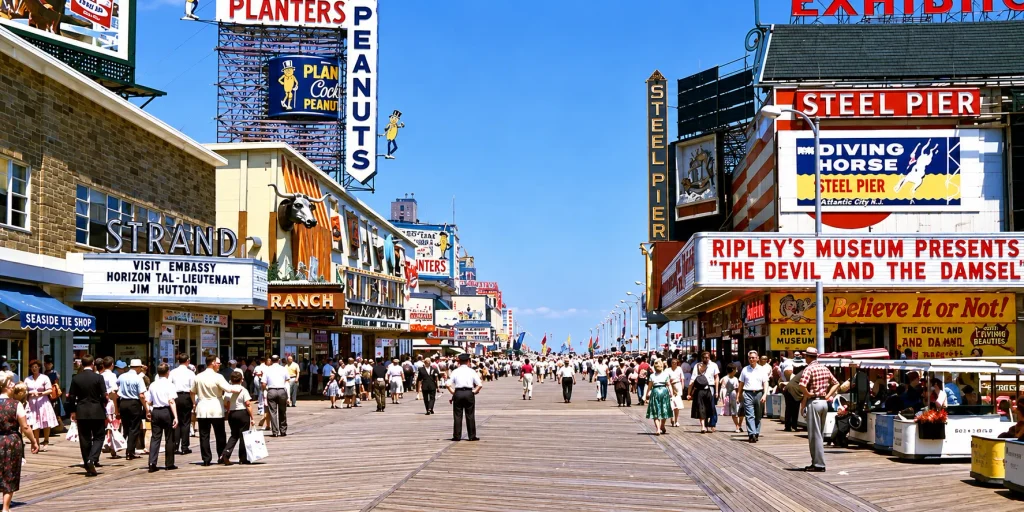
The resort developed rapidly after a railroad connection to Philadelphia opened in 1854. Its beaches, hotels, entertainment venues, and famous Boardwalk helped turn Atlantic City into a popular holiday destination, particularly for visitors from Philadelphia and other cities on the East Coast.
The Boardwalk itself dated from 1870 and eventually became one of Atlantic City’s defining attractions.
During the early twentieth century, the city became associated with grand hotels, nightlife, conventions and entertainment. Atlantic City’s tourism economy nevertheless weakened substantially in the decades following the Second World War.
Greater automobile ownership allowed holidaymakers to travel farther, while inexpensive air travel opened destinations such as Florida and the Caribbean to mass tourism. Atlantic City’s ageing hotel stock and changing American holiday habits contributed to its decline.
By the 1960s and early 1970s, local and state officials were searching for a way to regenerate the resort.
Casino gambling became the proposed solution.
New Jersey Votes for Casino Gambling
The first attempt to legalize casinos came in 1974.
New Jersey voters rejected a proposal that would have permitted casino gambling in approved municipalities around the state. Two years later, supporters returned with a much narrower proposal: casinos would be permitted only in Atlantic City.
The strategy worked.
On November 2, 1976, New Jersey voters approved the constitutional amendment. According to the New Jersey Casino Revenue Fund Advisory Commission, approximately 56% voted in favour.
The proposal presented casino gambling as an instrument for rebuilding Atlantic City while generating revenue for programmes benefiting eligible senior citizens and people with disabilities.
Governor Brendan Byrne signed the Casino Control Act on June 2, 1977.
New Jersey deliberately created a highly regulated system. Casino gambling was tied to large hotel developments rather than small standalone gambling halls, reflecting the state’s intention that casinos should stimulate tourism and investment rather than simply introduce gambling.

Resorts International: The First Casino in Atlantic City
So, what was the first casino in Atlantic City? The answer is Resorts International.
On May 26, 1978, Resorts International opened inside the former Chalfonte-Haddon Hall complex on the Boardwalk.
It was a landmark event.
At the time, Nevada was the only other US state with legal casino gaming. Atlantic City therefore offered casino gambling within easy travelling distance of huge population centres including New York, Philadelphia, Baltimore and Washington.
Demand was enormous.
Resorts demonstrated that regulated casino gambling on the East Coast could attract substantial numbers of customers. Competitors quickly followed.

The Atlantic City Casino Boom
The opening of Resorts triggered one of the most important periods in Atlantic City casino history.
Caesars, originally Boardwalk Regency, opened in June 1979, followed by Bally’s Park Place in December.
The 1980s brought another wave of casino development.
Harrah’s Marina opened in 1980, while Tropicana followed in 1981. Properties and brands including Playboy, Claridge, Golden Nugget, and Sands also became part of Atlantic City’s rapidly changing casino landscape.
Atlantic City was no longer merely a faded beach resort with a casino attached.
Casino gambling had become its dominant industry.
Thousands of jobs were created, old hotels were redeveloped, and enormous amounts of private investment flowed into the city.
Yet the expansion also created a long-running debate: could casino investment regenerate the wider city as successfully as it transformed the casino properties themselves?
In 1984, New Jersey created the Casino Reinvestment Development Authority (CRDA), providing a mechanism for casino-related funds to support redevelopment projects.

Donald Trump and Atlantic City’s 1980s Casino Era
No account of the history of Atlantic City casinos would be complete without mentioning the Donald Trump casino empire.
Trump Plaza opened in 1984 as Harrah’s at Trump Plaza before Trump subsequently took full control. Trump Castle followed in Atlantic City’s Marina District in 1985.
His most ambitious property was the Trump Taj Mahal, which opened in April 1990.
The enormous casino resort became one of Atlantic City’s most recognizable properties. However, the businesses accumulated substantial debt, and Trump’s casino companies underwent multiple bankruptcy restructurings.
Trump’s personal involvement in Atlantic City’s casino industry eventually ended, although his name remained attached to properties for years afterward.
Trump Plaza closed in 2014 and was demolished in 2021.
The Taj Mahal survived longer, closing in October 2016 before being purchased and redeveloped. Its buildings subsequently became Hard Rock Hotel & Casino Atlantic City.
Atlantic City Reaches Its Peak
Atlantic City’s casino market continued expanding through the 1990s and early 2000s.
For years it benefited from an extraordinary geographic advantage: casino gambling remained comparatively scarce in the northeastern United States.
The New Jersey Casino Control Commission records that Atlantic City’s casino gaming revenue passed $5 billion in 2005.
But competition was approaching.
Casinos and racetrack gaming expanded in neighbouring states, reducing the need for customers to travel to the New Jersey coast.
Meanwhile, one development demonstrated what Atlantic City’s next generation of casino resort might look like.

Borgata Changes Atlantic City
Borgata Hotel Casino & Spa opened on July 2, 2003, in the Marina District.
It was Atlantic City’s first new casino in more than a decade and represented a shift toward the large, contemporary destination-resort model associated with modern Las Vegas.
Borgata combined gambling with upscale accommodation, restaurants, nightlife and entertainment.
The New Jersey Casino Control Commission described its arrival as an event that changed the Atlantic City market, and Borgata quickly became the city’s highest-grossing casino property.
But Borgata’s success could not prevent broader competitive pressures from reshaping the market.
Why Did Atlantic City Casinos Decline?
Atlantic City’s casino gaming revenue peaked in 2006 before entering a prolonged decline.
Several forces were involved.
The expansion of casino gambling in Pennsylvania, New York, and other nearby jurisdictions weakened Atlantic City’s regional monopoly. The financial crisis and economic downturn added further pressure.
Atlantic City’s dependence on gambling also became increasingly problematic as consumers gained casino alternatives much closer to home.
The situation became particularly severe in 2014.
The Great Atlantic City Casino Closures
The Atlantic City casino closures of 2014 represented one of the darkest periods in the industry’s history.
Four casino resorts ceased operations that year:
- Atlantic Club
- Showboat
- Revel
- Trump Plaza
The closures reduced the city’s operating casino count dramatically and cost thousands of jobs.
Revel was perhaps the most striking failure.
The enormous resort had opened only in 2012 following a multibillion-dollar development. Despite its spectacular beachfront tower, Revel struggled financially and entered bankruptcy before closing in September 2014.
Two years later, the Trump Taj Mahal closed in October 2016.
For observers who remembered Atlantic City’s casino boom, the abandoned towers and shuttered gaming floors appeared to symbolize the end of an era.
But the story was not finished.
Online Gambling Changes the Atlantic City Model
New Jersey responded partly by moving gambling beyond the physical casino floor.
Legislation authorizing Internet gaming was signed in February 2013, and regulated online casino gaming launched in November that year.
Atlantic City’s licensed casino industry consequently gained another source of gambling revenue.
This was an important change in the business model. A casino license was no longer valuable solely because of the customers physically entering a Boardwalk or Marina casino.
Internet casino gaming became an increasingly important part of New Jersey’s regulated gambling industry.
Another major change arrived in 2018 with regulated sports wagering.

Hard Rock and Ocean: 2018 Revival
June 27, 2018, provided a remarkable moment in the Atlantic City casino timeline.
Two casinos opened on the same day.
The former Trump Taj Mahal reopened as Hard Rock Hotel & Casino Atlantic City following extensive redevelopment.
Meanwhile, the enormous former Revel complex reopened as Ocean Resort Casino, subsequently renamed Ocean Casino Resort.
Instead of demolishing two symbols of Atlantic City’s casino difficulties, investors had transformed them into new resorts.
Their arrival restored activity to a section of the northern Boardwalk that had suffered heavily from previous closures.
Atlantic City Casinos Today
As of 2026, the New Jersey Casino Control Commission lists nine casino hotels operating in Atlantic City:
Bally’s Atlantic City, Borgata Hotel Casino & Spa, Caesars Atlantic City, Golden Nugget Atlantic City, Hard Rock Hotel & Casino Atlantic City, Harrah’s Resort Atlantic City, Ocean Casino Resort, Resorts Casino Hotel and Tropicana Atlantic City.
This modern market looks very different from the Atlantic City casino industry of the 1980s.
Casinos increasingly compete through restaurants, hotel accommodations, concerts, nightlife, conventions, and other attractions alongside traditional table games and slot machines.
Online casino gaming and sports wagering have also fundamentally altered the economics of gambling in New Jersey.

Atlantic City Casino Timeline
1976 — New Jersey voters approve casino gambling in Atlantic City.
1977 — Governor Brendan Byrne signs the Casino Control Act.
1978 — Resorts International becomes the first casino in Atlantic City.
1979 — Caesars and Bally’s enter the market.
1980s — Atlantic City experiences rapid casino expansion.
1984 — Trump Plaza opens, and the Casino Reinvestment Development Authority is created.
1990 — Trump Taj Mahal opens.
2003 — Borgata opens in the Marina District.
2006 — Atlantic City casino gaming revenue reaches its historic peak.
2013 — Regulated Internet casino gaming launches in New Jersey.
2014 — Atlantic Club, Showboat, Revel and Trump Plaza close.
2016 — Trump Taj Mahal closes.
2018 — Hard Rock and Ocean open; regulated sports wagering begins in New Jersey.
2026 — Nine licensed casino hotels operate in Atlantic City.
Conclusion
The history of Atlantic City casinos stretches from a bold 1970s urban-renewal experiment to a modern gambling market encompassing casino resorts, online gaming and sports betting. Atlantic City experienced extraordinary growth, spectacular casino developments and painful contraction, yet repeatedly reinvented itself. Nearly half a century after Resorts opened, casino gambling remains inseparable from the city’s identity.
FAQ: History of Atlantic City Casinos
When did casinos become legal in Atlantic City?
New Jersey voters approved a constitutional amendment authorizing casino gambling specifically in Atlantic City on November 2, 1976. Governor Brendan Byrne signed the Casino Control Act on June 2, 1977.
What was the first casino in Atlantic City?
Resorts International was the first legal Atlantic City casino. It opened on May 26, 1978, in the former Chalfonte-Haddon Hall complex.
Why were casinos legalized in Atlantic City?
Casino gambling was promoted as an economic redevelopment tool intended to revive Atlantic City’s declining tourism industry, encourage investment, and generate public revenue.
When was Atlantic City’s casino boom?
The industry expanded rapidly from the late 1970s through the 1980s and continued generating substantial revenue through the 1990s and early 2000s. Casino gaming revenue reached its historic peak in 2006.
Why did Atlantic City casinos decline?
Increasing casino competition from surrounding states, changing consumer behaviour, and economic pressures weakened Atlantic City’s previous regional advantage. Four casinos closed during 2014 alone.
Which Atlantic City casinos closed in 2014?
Atlantic Club, Showboat, Revel and Trump Plaza ceased casino operations during 2014.
What happened to the Trump Taj Mahal?
Trump Taj Mahal closed in October 2016. The property was subsequently redeveloped and reopened as Hard Rock Hotel & Casino Atlantic City in June 2018.
What happened to Revel casino?
Revel opened in 2012 but suffered severe financial problems and closed in 2014. The property eventually reopened as Ocean Resort Casino in 2018 and is now Ocean Casino Resort.
When did Borgata open in Atlantic City?
Borgata Hotel Casino & Spa opened on July 2, 2003. Its arrival marked a significant shift toward a modern Las Vegas-style destination resort model.
How many casinos are in Atlantic City in 2026?
The New Jersey Casino Control Commission currently lists nine licensed casino hotels in Atlantic City.
Reference List:
New Jersey Casino Control Commission. (n.d.). A brief history of the Casino Control Commission. New Jersey Department of the Treasury.
New Jersey Casino Control Commission. (n.d.). Casino gaming in New Jersey. New Jersey Department of the Treasury.
New Jersey Casino Control Commission. (2023). 2023 annual report: 10 years of Internet gaming.
New Jersey Casino Control Commission. (2024). Atlantic City casino industry: 2024 annual report.
New Jersey Casino Control Commission. (n.d.). Casino information: Atlantic City casino hotels.
New Jersey Casino Revenue Fund Advisory Commission. (n.d.). Overview. New Jersey Department of the Treasury.
New Jersey Casino Revenue Fund Advisory Commission. (2019). Casino industry status.


Sign Up for Our Newsletters
Be the first to know when new content is created.Related Posts

Charlie Chester’s Casino: A Historical Overview
Charlie Chester’s Casino: Birth of an Icon A Playground for the Elite The Rise of Soho Charlie Chester’s…

The Creation of PAGCOR: Philippine Amusement and Gaming Corporation
The Philippine Amusement and Gaming Corporation (PAGCOR) has shaped the country’s gambling landscape for nearly half a century. From its creation during a politically turbulent era to its modern role as a regulator and operator, PAGCOR’s casinos remain central to Philippine entertainment, tourism, and government revenue.

The Hippodrome Casino London: The Largest Casino and Entertainment Venue in the UK
This comprehensive overview of the London Hippodrome casino explores the multifaceted aspects of the venue, including its history, architectural significance, gaming facilities, dining experiences, entertainment offerings, and its impact on the local community and economy.

A History of Casino di Sanremo: From 1905 to The Present
The history of Casino di Sanremo begins in the Italian Riviera’s flourishing resort culture and reaches far beyond roulette tables. Opened in 1905, this landmark has witnessed political change, wartime closure, musical breakthroughs, and modern reinvention. Discover how a seaside entertainment palace became an important part of Italy’s cultural heritage.