


Dark
Light
Gad, the god of fortune, is one of the most intriguing figures associated with luck in the ancient Near East. Mentioned explicitly in Isaiah alongside Meni, the deity of destiny, Gad appears to represent good fortune, prosperity, and favourable outcomes. His associations with Canaanite, Aramaic and other Semitic traditions make him an important figure in the ancient history of chance and fortune.
Editor’s Note: I’ve treated “Pan-Semitic Fortune God” as a convenient framing for this essay rather than an uncontested historical classification. The evidence supports Gad as a deity/personification associated with fortune or good luck, while the extent and precise nature of his worship across Semitic cultures remain the subject of scholarly interpretation.
Who Was Gad, the God of Fortune?
Gad was an ancient deity or personification associated with fortune and good luck. His name is connected with the Semitic concept of fortune or an allotted portion, although the precise development of the term is debated.
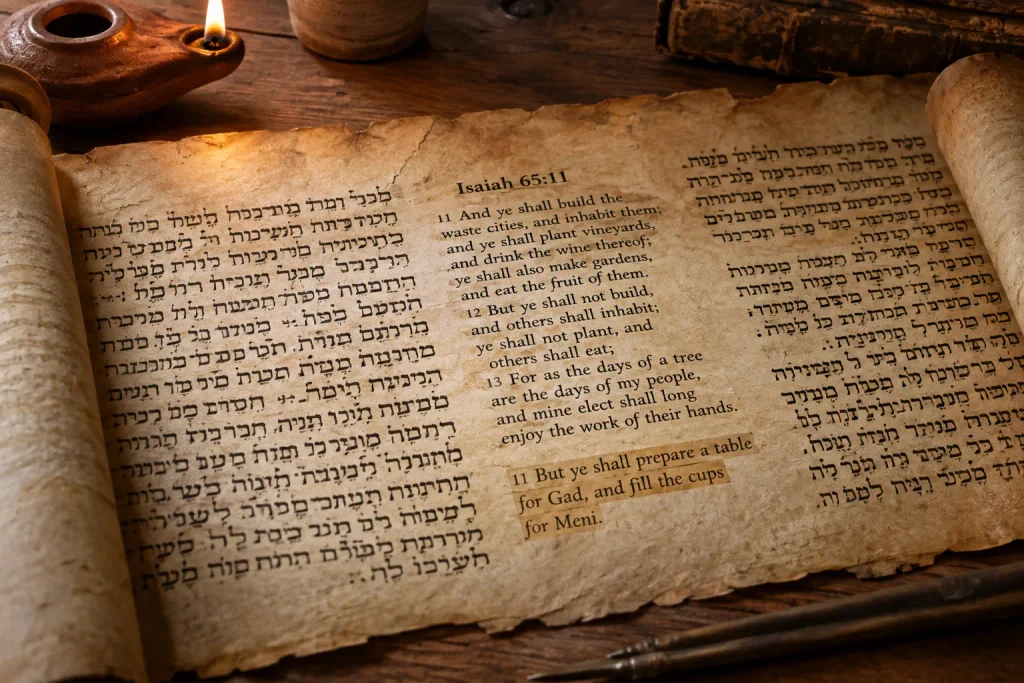
The clearest biblical reference to Gad as a deity occurs in Isaiah 65:11, where the prophet condemns people who “prepare a table” for Gad, god of fortune, and pour out drink offerings for Meni. In this context, Gad is generally understood as Fortune, while Meni represents Destiny.
This distinction is important because Gad should not simply be described as an ancient “gambling god”. There is no reliable evidence that he presided over casinos, gambling games, or wagering in the modern sense. His significance is broader: he personified the unpredictable but potentially favourable forces that could determine a person’s fortune.
Gad and the Ancient Semitic World
The description of Gad as a Pan-Semitic fortune god reflects evidence suggesting that the concept associated with the name extended across several related cultures and regions.
Gad is particularly associated by scholars with western Semitic religious traditions. Evidence comes not only from Isaiah but also from geographical names and personal names containing Gad. Two biblical place names are especially significant: Baal-gad, associated with the region near Mount Hermon, and Migdal-gad, located in the territory of Judah.
Baal-gad can be understood as “Baal of Fortune” or “Lord of Fortune”, although interpretations of the name require some caution. Such names nevertheless provide evidence for the importance of the concept of fortune in the religious vocabulary of the ancient Levant.
The name Gad also appears in personal names, although not every occurrence necessarily refers to the deity. In some cases, Gad may simply have meant fortune or good luck rather than functioning as a divine name.
Gad in Isaiah 65
Isaiah 65 provides the strongest biblical evidence for Gad as a fortune deity.
The passage criticises people who have turned away from the God of Israel and instead prepare a table for Gad and fill cups of mixed wine for Meni. The imagery appears to describe a ritual meal or offering made to divine powers associated with fortune and destiny.
This is particularly interesting from the perspective of gambling history. Ancient societies often sought divine explanations for events that appeared beyond human control. A successful harvest, unexpected wealth, survival in battle or an advantageous turn of events could all be interpreted through the concept of fortune.
Gad therefore belongs to a much wider ancient tradition in which luck was not merely an abstract idea. Fortune could be imagined as a divine power capable of distributing favourable or unfavourable outcomes.

Gad and Meni: Fortune and Destiny
Gad is frequently discussed alongside Meni, another mysterious deity mentioned in Isaiah 65:11.
The traditional interpretation is that Gad represented good fortune, while Meni represented destiny, fate, or what has been allotted. The pairing creates an intriguing conceptual division: Gad could embody favourable fortune, while Meni could represent the determination or allocation of one’s fate.
The precise identity of Meni remains uncertain. Some scholars have connected Meni with the pre-Islamic Arabian goddess Manāt, while older scholarship has proposed astronomical associations involving Venus. These theories should not be presented as established facts.
Similarly, the frequently repeated identification of Gad with Jupiter requires qualification. Later Jewish and Arabic traditions associated Jupiter with “greater fortune”, and some scholars consequently connected Gad with the planet. However, this astronomical identification is an interpretation rather than something explicitly established by Isaiah.
Was Gad a Canaanite or Phoenician God?
Gad is often described online as a Canaanite god, Phoenician god, or Syrian god of fortune. There is evidence for a widespread western Semitic tradition involving fortune, but the precise boundaries of Gad’s cult are difficult to reconstruct.
The place names Baal-gad and Migdal-gad suggest that the concept was known in ancient Palestine. Later evidence from Aramaic and Palmyrene contexts demonstrates that the word gad could continue to denote fortune or a divine manifestation of fortune.
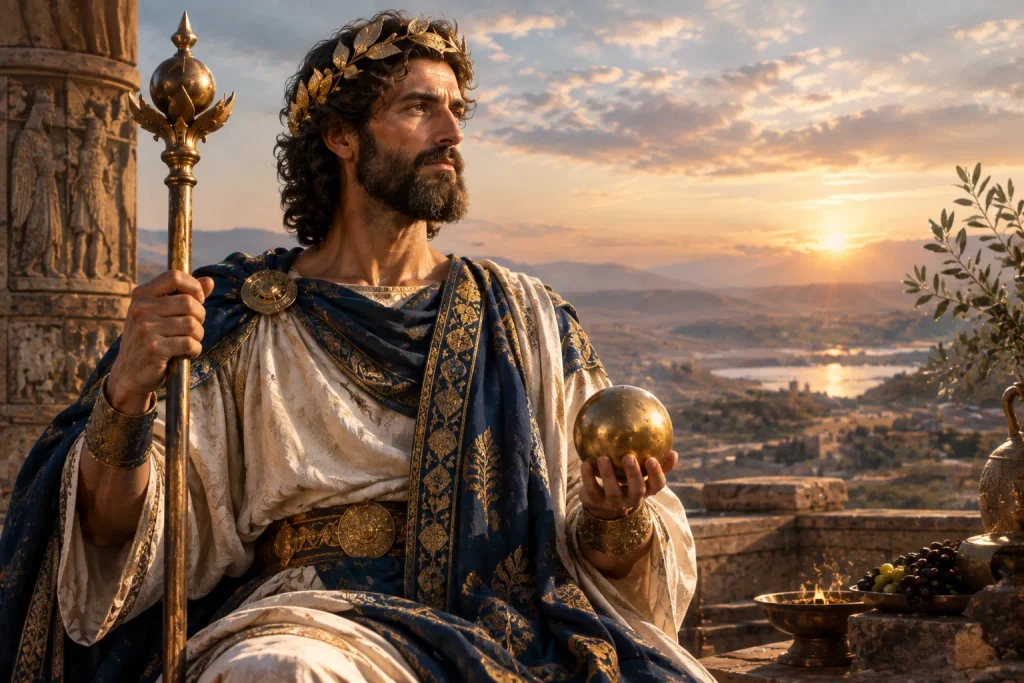
At Palmyra, for example, the Gad of Palmyra was represented in a form comparable to the Greco-Roman Tyche tradition. The Palmyrene evidence is particularly valuable because it demonstrates how the concept of a city’s protective fortune could develop within a multicultural religious environment.
This later evidence should not automatically be projected backwards onto the Gad mentioned in Isaiah. Ancient Near Eastern religions changed substantially over centuries, and the same name could acquire different meanings in different places.

Gad and the History of Gambling
There is an obvious connection between Gad and the themes explored by Gods of Gambling: the ancient human fascination with luck, chance, and uncertain outcomes.
However, Gad was not a gambling god in the specific sense of a deity whose primary responsibility was dice, cards, betting, or casino games. Rather, he represents something more fundamental to gambling culture: the idea of fortune itself.
Modern gambling separates probability, chance, and financial risk from religion. Ancient societies did not necessarily make such a distinction. Fortune could be understood as an active supernatural force influencing human circumstances.
That makes Gad historically relevant to the development of ideas surrounding luck and chance. He represents an early religious attempt to personify an invisible force that could change a person’s circumstances without warning.
Gad, Luck and the Meaning of Fortune
The word gad is associated with the idea of fortune, particularly favourable fortune. This helps explain why the deity is relevant to the study of ancient attitudes towards wealth, prosperity and chance.
The concept is fundamentally different from the modern idea of “luck” as a random statistical outcome. In a religious worldview, good fortune could be understood as something granted, allotted, or controlled by divine powers.
That distinction gives Gad an important place in the history of gambling culture. The modern gambler may speak about being lucky, while an ancient worshipper could conceive of fortune as a power capable of actively shaping human destiny.
Was Gad a God of Gambling?
There is no strong evidence that Gad was specifically a god of gambling.
Calling Gad a “god of gambling” would therefore overstate the available evidence. A more accurate description is a god or personification of fortune and good luck.
His importance to gambling history comes from the much older cultural idea that fortune determines outcomes. Gambling later developed around precisely the same uncertainties that ancient religions attempted to explain through concepts of fate, luck and divine favour.
Gad’s Legacy
Gad remains an elusive figure because the surviving evidence is limited and comes from different periods and cultures. Isaiah provides the clearest biblical reference, while place names, personal names and later Semitic traditions offer additional clues.
The identification of Gad with Jupiter, Tyche, or other fortune figures can be useful for comparative study, but these comparisons should not erase the differences between cultures or periods.
For the history of gambling, Gad is best understood as an ancient personification of fortune itself. Long before modern casinos, people sought explanations for why prosperity came to one person while another experienced misfortune. Gad represents one ancient answer to that enduring question.
Conclusion
Gad, the god of fortune, occupies an intriguing position in the history of ancient Semitic religion. Isaiah associates him with fortune alongside Meni, while place names and later religious evidence suggest that the concept of Gad extended across parts of the ancient Near East. Although there is insufficient evidence to call Gad a specific god of gambling, his association with other ancient Gods of luck, prosperity, and favourable fortune makes him highly relevant to the longer cultural history of chance and gambling.
Frequently Asked Questions About Gad
1. Who was Gad, the god of fortune?
Gad was an ancient deity or personification associated with fortune and good luck. His clearest biblical appearance is in Isaiah 65:11, where people are condemned for preparing a table for Gad and making offerings to Meni. The passage is generally interpreted as referring to divine powers associated with fortune and destiny.
2. What was Gad the god of?
Gad was associated primarily with fortune, good luck, and favourable outcomes. He should not automatically be described as a god of gambling. His sphere was broader, involving the idea that fortune could determine whether circumstances turned out favourably or unfavourably.
3. Is Gad a Pan-Semitic god?
“Pan-Semitic” is a useful descriptive term for discussing evidence for Gad and related concepts across several Semitic-speaking cultures, but it should not be treated as an uncontested historical classification. Evidence connects the concept of Gad with Western Semitic and later Aramaic traditions.
4. Is Gad mentioned in the Bible?
Yes. The clearest reference to Gad as a deity appears in Isaiah 65:11. The name Gad also occurs in other biblical contexts, including the name of Jacob’s son and the Israelite tribe of Gad. These references should not automatically be assumed to refer to the deity.
5. What is the meaning of the name Gad?
Gad is associated with fortune or good fortune in the relevant Semitic religious context. The same word and related forms could have different meanings depending on context, which is why individual biblical occurrences require careful interpretation.
6. Who were Gad and Meni?
Gad and Meni are the two figures mentioned together in Isaiah 65:11. Gad is generally interpreted as Fortune, while Meni is associated with Destiny or Fate. Their exact identities and relationship remain subjects of scholarly discussion.
7. Was Gad the god of gambling?
There is no reliable evidence establishing Gad as a specific god of gambling. His association was with fortune and luck more generally. His relevance to gambling history comes from the ancient belief that supernatural forces could influence prosperity, success, and the outcome of uncertain events.
8. Was Gad associated with Jupiter?
Some Jewish and later interpretive traditions associated Gad with Jupiter, because Jupiter was regarded in Arabic astronomical tradition as the “greater fortune”. However, this identification is not explicitly established in the biblical text and should be treated as a scholarly or traditional interpretation.
9. Was Gad a Canaanite god?
Gad is frequently described as a Canaanite or western Semitic fortune deity. Place names such as Baal-gad and Migdal-gad provide evidence that the concept was known in ancient Palestine. The precise nature and extent of an organised cult of Gad remain uncertain.
10. Was Gad a Phoenician god?
Gad is associated in scholarship with broader western Semitic religious traditions, in areas influenced by Phoenician and Aramaic cultures. However, the surviving evidence does not justify reducing the deity to a uniquely Phoenician god.
11. Is Gad the same as Tyche?
Not necessarily. Tyche was the Greek personification of fortune, while Gad belonged to Semitic religious traditions. Later representations and interpretations could bring the concepts together, particularly in multicultural centres such as Palmyra, but the concepts originated in different religious traditions.
12. Why is Gad important to gambling history?
Gad is relevant because he represents the ancient personification of fortune and luck. Gambling revolves around uncertain outcomes and the human desire to understand or influence chance. Gad therefore provides historical context for the much older cultural idea of fortune determining human prosperity.
Reference List:
Bible Gateway. (n.d.). Gad (deity, a god). Encyclopedia of the Bible.
Hirsch, E. G., Broydé, I., Seligsohn, M., & McCurdy, J. F. (n.d.). Gad. Jewish Encyclopedia.
Metropolitan Museum of Art. (2019). The world between empires: Art and identity in the ancient Middle East. Metropolitan Museum of Art.
Whybray, R. N. (n.d.). Isaiah 65:10–12. In Isaiah 40–66: New Century Bible Commentary.


Sign Up for Our Newsletters
Be the first to know when new content is created.Related Posts

Chris Moneymaker: Poker Career, WSOP Victory and Legacy
Chris Moneymaker transformed poker history when he won the 2003 World Series of Poker Main Event, collecting $2.5 million after qualifying online. His extraordinary journey from recreational player to world champion helped inspire a generation of poker enthusiasts and established one of the game's most enduring legacies.

The Hole-in-One Gang: Who Were They and What Was Their Strategy?
The Hole in One Gang became one of Britain's most remarkable betting stories after two Essex bookmakers used statistical research to challenge conventional assumptions about golf's rarest shot. John Carter and Paul Simons discovered that bookmakers could dramatically underestimate the probability of a hole in one, and built a sophisticated betting strategy around that pricing error.

Stu “The Kid” Ungar: The Tragedy of Poker’s Greatest Mind
Early Life and Rise of a Card Prodigy How Stu Ungar Became a Poker Legend Stu Ungar World…

A Day in the Life of a Casino Games Training Manager
A Casino Games Training Manager occupies an unusual position inside a casino. I am part teacher, part operational manager, part examiner and part guardian of gaming standards. My job is not simply teaching somebody how to deal blackjack or spin a roulette ball. It is making sure people can operate live casino games accurately, confidently and consistently.