


Dark
Light
Blackjack basic strategy is simply a set of mathematical rules telling you what to do with your cards. You look at your hand, look at the dealer’s card, and choose the action with the best long-term mathematical result. It sounds complicated, but the idea is surprisingly simple once you understand the basics.
What Is Blackjack Basic Strategy?
Imagine you are playing a game of blackjack where the dealer has to follow rules, but you get to choose what happens to your cards.
You might have 16, while the dealer shows a 10. Should you hit and risk going over 21, or stand and hope the dealer goes bust?
That is exactly the sort of question blackjack basic strategy answers.
Basic strategy is not a magic trick. It does not predict what the next card will be. Instead, mathematicians calculate the results of millions of possible situations and determine which decision produces the best expected result over the long run.
The first mathematically rigorous blackjack strategy was published in 1956 by Roger Baldwin, Wilbert Cantey, Herbert Maisel, and James McDermott. Their research examined blackjack decisions using mathematical analysis rather than guesswork.
5 Things You Need to Know
For a beginner, blackjack strategy can be reduced to five important actions:
- Hit: Take another card.
- Stand: Keep the cards you already have.
- Double down: Double your original bet and receive one more card, after which you normally must stand.
- Split: If your first two cards form a pair, separate them into two hands and make another equal bet.
- Surrender: In games that offer it, give up the hand and lose only part of your original wager.
Not every blackjack table offers exactly the same options. That matters because the correct blackjack strategy can change when the rules change.
Why the Dealer’s Card Matters
The dealer’s face-up card is one of the most important pieces of information in blackjack.
Suppose the dealer shows a 6. That is generally an uncomfortable card for the dealer because the dealer must continue drawing until reaching at least 17. There is a significant possibility of going over 21.
If the dealer shows a 10, the situation is different. The dealer has a strong starting card and is less likely to bust.
That is why basic strategy sometimes tells you to stand on a relatively low number against a weak dealer card, while recommending you hit against a strong dealer card.
It can feel strange at first. But the chart is not trying to predict one hand. It is trying to make the mathematically strongest decision repeatedly.
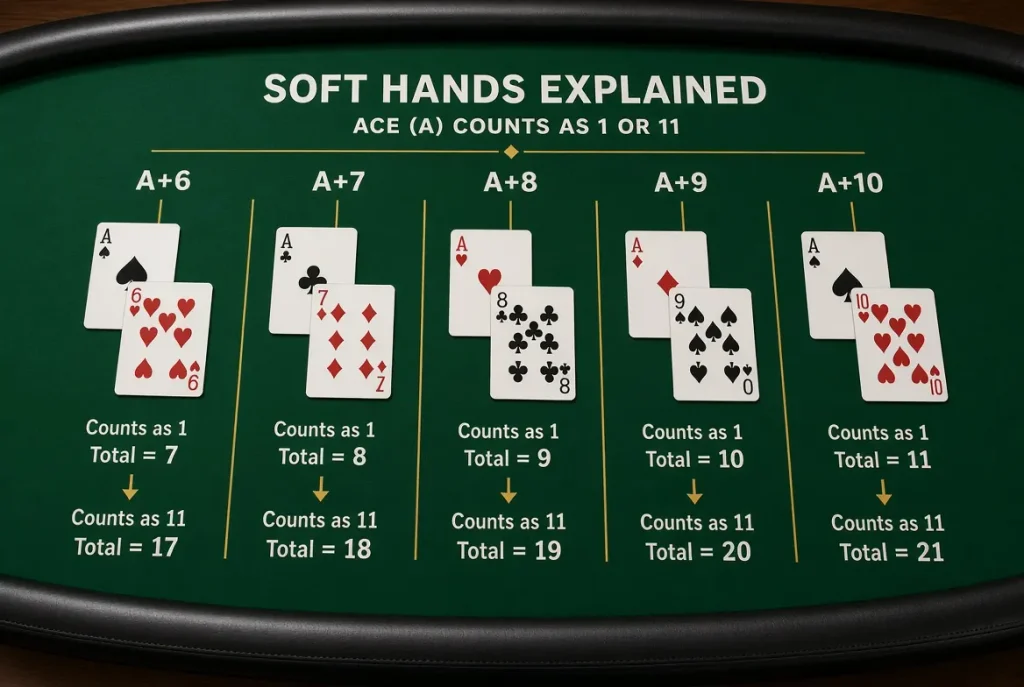
Hard Hands, Soft Hands and Pairs
A hard hand is a hand where an ace either is not present or must count as 1 to avoid going over 21.
For example, 10 + 6 = hard 16.
A soft hand contains an ace that can count as 1 or 11 without busting.
For example, ace + 6 can be 7 or soft 17.
A pair is simply two cards of the same value, such as 8 + 8 or ace + ace.
These three categories are important because they have different blackjack strategy rules.
Easy Blackjack Rules to Remember
Some basic blackjack decisions are especially easy to remember.
- With 17 or more, basic strategy normally says to stand.
- With very low hard totals, you normally hit.
- A total of 10 is often a good opportunity to double when the dealer’s card is weak enough.
- A pair of aces should normally be split.
- A pair of 8s should normally be split because keeping them together creates a difficult 16.
- A pair of 10s should normally not be split because 20 is already an extremely strong hand.
These are general principles. The complete decision depends on the dealer’s upcard and the exact table rules.
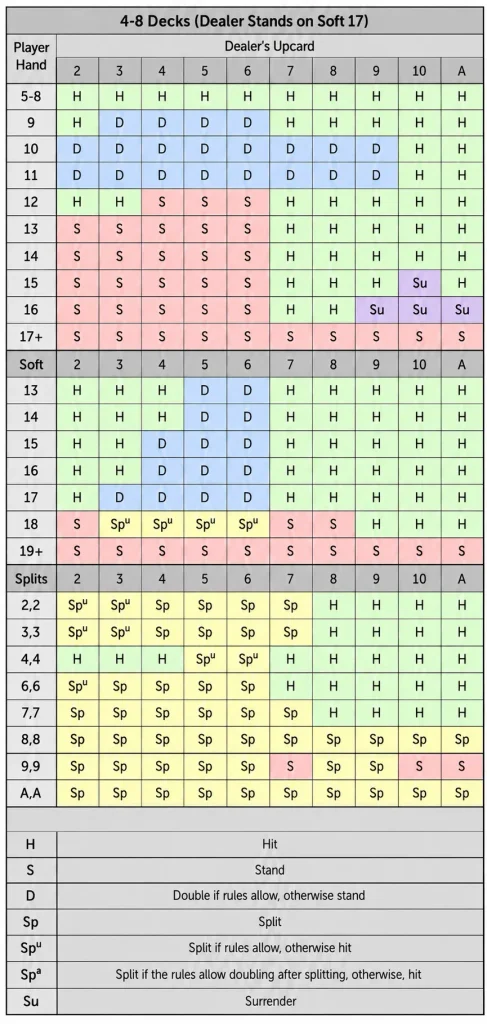
Blackjack Basic Strategy Chart
The following simplified chart is designed for a six-deck/multi-deck game, with the dealer standing on soft 17, double down allowed on any first two cards, double after splitting allowed, and blackjack paying 3:2. These assumptions match a commonly published six-deck S17 strategy chart.
Hard Hands
[Key: H = Hit | S = Stand | D = Double | P = Split]
Player hand Dealer 2–6 Dealer 7–A 5–8 H H 9 D vs 3–6; otherwise H H 10 D vs 2–9; H vs 10–A H 11 D D 12 S vs 4–6; otherwise H H 13–16 S vs 2–6; H vs 7–A H 17+ S S 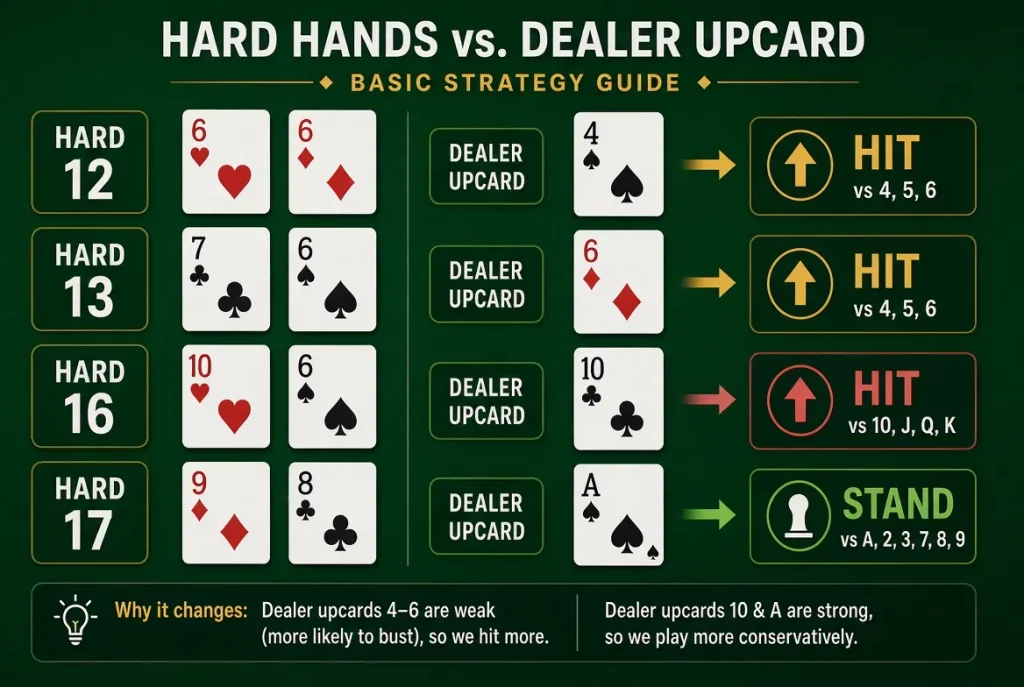
Soft Hands
| Player hand | Typical basic-strategy decision |
|---|---|
| A,2–A,3 | Double vs 5–6; otherwise H |
| A,4–A,5 | Double vs 4–6; otherwise H |
| A,6 | Double vs 3–6; otherwise H |
| A,7 | Double vs 3–6; S vs 2, 7, 8; H vs 9–A |
| A,8–A,9 | S |
Pairs
| Pair | Basic strategy |
|---|---|
| 2,2 | P vs 2–7; otherwise H |
| 3,3 | P vs 2–7; otherwise H |
| 4,4 | P vs 5–6; otherwise H |
| 5,5 | Treat as 10; double against 2–9 |
| 6,6 | P vs 2–6; otherwise H |
| 7,7 | P vs 2–7; otherwise H |
| 8,8 | P |
| 9,9 | P vs 2–6 and 8–9; S vs 7, 10, A |
| 10,10 | S |
| A,A | P |
The chart should always match the actual table rules. Changing from a dealer-standing-on-soft-17 game to a dealer-hits-soft-17 game, for example, can change some decisions.
What About Insurance?
Insurance is a separate bet offered when the dealer shows an ace. In the rules specified for this article, insurance pays 2:1 if the dealer has blackjack.
However, insurance is not part of normal basic strategy. A basic-strategy player generally declines insurance because the side bet has a disadvantage under ordinary conditions. More advanced players may make insurance decisions using information about the remaining cards, which is a different subject from basic strategy.
Does Basic Blackjack Strategy Guarantee Winning?
No.
This is one of the most important things for a beginner to understand.
Basic strategy does not tell you how to win at blackjack. You can make the mathematically correct decision and still lose.
Think of it like choosing the best route on a journey. The best route cannot guarantee there will not be traffic. It simply gives you the best route based on the information available.
Blackjack remains a gambling game, and individual results can vary considerably.
Basic Blackjack Strategy Versus Card Counting
These ideas are often confused.
Basic strategy uses your cards and the dealer’s visible card.
Card counting attempts to track the changing composition of the remaining cards and can alter playing and betting decisions.
You do not need to count cards to use basic strategy. Modern research describes basic strategy as an algorithm for maximising expected return given the rules and the currently visible cards.
For a beginner, learning basic strategy is much simpler than attempting to learn a card-counting system.
The One Simple Lesson
If you remember only one thing, remember this:
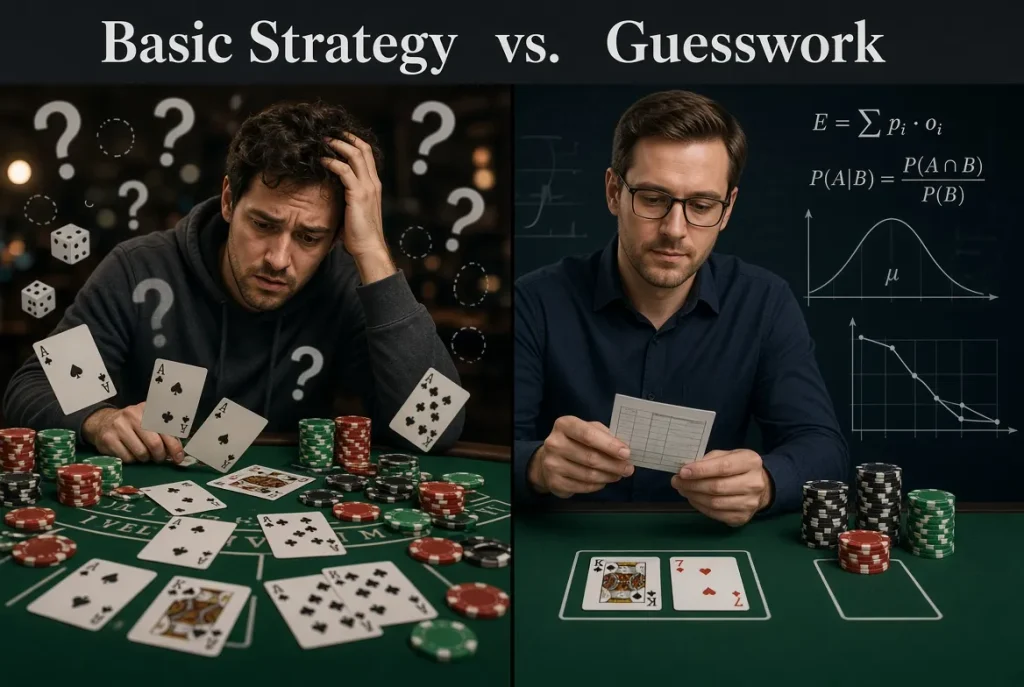
Don’t ask, “What do I feel like doing?” Ask, “What does the basic strategy chart say?”
The chart exists because blackjack decisions can be analysed mathematically. Sometimes the correct decision will feel obvious. Sometimes it will feel completely wrong. That is precisely why the chart is useful.
Basic strategy replaces guessing with a consistent decision-making system.
Conclusion
Blackjack basic strategy is easier than it first appears. Learn whether your hand is hard, soft, or a pair, check the dealer’s upcard, and follow the correct decision. It cannot guarantee winning, but it can replace guesswork with mathematics and help reduce the casino’s built-in advantage over the long run.
Frequently Asked Questions
What is blackjack basic strategy?
Blackjack basic strategy is a mathematically calculated set of decisions showing when to hit, stand, double, split, or surrender based on the player’s hand and dealer’s upcard.
Is blackjack basic strategy difficult to learn?
No. A complete blackjack strategy chart contains many decisions, but beginners can learn it gradually. The key is understanding the difference between hard hands, soft hands, and pairs.
What is the best basic strategy for blackjack?
There is no single chart that applies perfectly to every blackjack game. The correct strategy depends on rules such as the number of decks, whether the dealer hits or stands on soft 17, doubling restrictions, and surrender rules.
Should you always hit 16 in blackjack?
No. The correct decision depends on the dealer’s upcard and the exact rules. For the six-deck, dealer-stands-on-soft-17 game used for the chart in this article, a hard 16 normally stands against a dealer’s 2–6 and hits against 7–Ace.
Should you stand on 17 in blackjack?
Generally, yes. In the standard multi-deck strategy used here, hard 17 or higher is a stand.
Should you split aces?
Yes. Standard basic strategy calls for splitting aces because two separate hands beginning with an ace offer better mathematical possibilities than keeping the two aces together.
Should you split 8s?
Yes. Basic strategy normally recommends splitting 8s because a starting total of 16 is difficult to play.
Should you split 10s?
No. Two 10-value cards make 20, which is already a very strong blackjack hand. Basic strategy normally keeps the 20 together.
Does blackjack basic strategy beat the casino?
Basic strategy does not automatically give the player an advantage. Its purpose is to minimise the house edge under a particular set of rules. The exact remaining house edge depends on those rules.
Does blackjack basic strategy require card counting?
No. Basic strategy can be played without keeping track of previously dealt cards. Card counting is a separate technique.
Does blackjack basic strategy guarantee winning?
No. It improves decision-making over many hands but cannot guarantee the result of an individual hand.
What does soft 17 mean in blackjack?
A soft 17 is a hand containing an ace that can count as 11 while the total remains 17, such as an ace + 6. The dealer’s rule concerning soft 17 can affect the correct strategy.
What does double down mean in blackjack?
Doubling down means increasing the original wager to twice its amount and normally receiving exactly one additional card.
What does split mean in blackjack?
If your first two cards have the same value, you may split them into two separate hands by placing a second wager equal to the first.
Is insurance part of blackjack basic strategy?
Insurance is a separate wager. Under conventional basic strategy, insurance is generally declined rather than treated as a normal playing decision.
Why does blackjack strategy change between casinos?
Blackjack rules are not identical everywhere. The number of decks, dealer soft-17 rule, doubling rules, splitting rules, surrender availability, and blackjack payout can all affect the mathematical strategy.
Reference List:
Baldwin, R. R., Cantey, W. E., Maisel, H., & McDermott, J. P. (1956). The optimum strategy in blackjack. Journal of the American Statistical Association, 51(275), 429–439. Journal of the American Statistical Association article
Blackjack Hall of Fame. (n.d.). Roger Baldwin, Wilbert Cantey, Herbert Maisel and James McDermott. Blackjack Hall of Fame — Four Horsemen of Aberdeen
BlackjackInfo. (n.d.). Blackjack School: Lesson 1 — Basic Strategy. BlackjackInfo basic strategy lesson
BlackjackInfo. (n.d.). Basic Strategy Decision Chart. BlackjackInfo decision chart
Cambridge University Press. (2023). Fear and loathing in Las Vegas: Evidence from blackjack tables. Judgment and Decision Making. Cambridge University Press research article
PokerStars. (2026). Live Blackjack Rules. PokerStars UK Live Blackjack rules
PokerStars. (2026). Blackjack in popular culture and facts. PokerStars blackjack guide
Schlesinger, D. (n.d.). Basic strategy for European blackjack. Wizard of Odds. Basic Strategy for European Blackjack reference
Shackleford, M. (n.d.). Double-deck blackjack strategy. Wizard of Odds. Double-Deck Blackjack Strategy reference
Simon & Schuster. (n.d.). Playing Blackjack to Win: A New Strategy for the Game of 21. Playing Blackjack to Win publisher information
0stakes. (2026). Blackjack basic strategy chart: 6-deck, S17. 6-deck S17 blackjack strategy chart


Sign Up for Our Newsletters
Be the first to know when new content is created.Related Posts

Improve Your Blackjack: 5 Things You Need to Do Right Now
Want to know how to improve at blackjack? Forget lucky streaks, hunches and supposedly unbeatable betting systems. The best blackjack tips are based on mathematics, good decision-making and understanding the game you are playing. Here are five things you need to learn if you want to become a better blackjack player.

How to Use a Blackjack Progression Betting System
Blackjack progression betting is a structured approach to changing wager sizes according to previous results rather than placing the same stake on every hand. A blackjack progression system can increase or decrease bets after wins or losses, but it does not alter the underlying mathematical odds. Understanding progression betting, bankroll requirements, volatility and its limitations is essential before examining any blackjack progression betting strategy.

What Is the Best Way to Win at Blackjack: Progression Betting or Card Counting?
The best way to win at blackjack starts with understanding probability, not betting systems. Basic strategy reduces the house edge, while progression betting changes wager size without changing expected value. Card counting can alter the mathematical advantage when conditions allow, but requires skill, discipline and bankroll management.

Paroli Betting System Explained: How the Positive Progression Strategy Works
The Paroli betting system is a positive progression strategy that increases bets after wins rather than losses. Popularly associated with roulette, it can also be applied to certain other casino games. But does the Paroli system genuinely improve your chances of winning, or simply change how you experience gambling's inevitable ups and downs?