


Dark
Light
The history of Macau casinos stretches from 19th-century gambling houses and traditional fantan to some of the world’s largest integrated casino resorts. This Macau casino history reveals how regulation, tourism, entrepreneurs, and international investment transformed Macau into a global gambling destination.
The Beginnings of Macau Gambling
The foundations of Macau gambling history predate the modern casino. Gambling was widespread in Macau during the 19th century, particularly through traditional Chinese games such as fantan. In 1847, the Portuguese administration formally legalised gambling to increase government revenue and diversify the local economy.
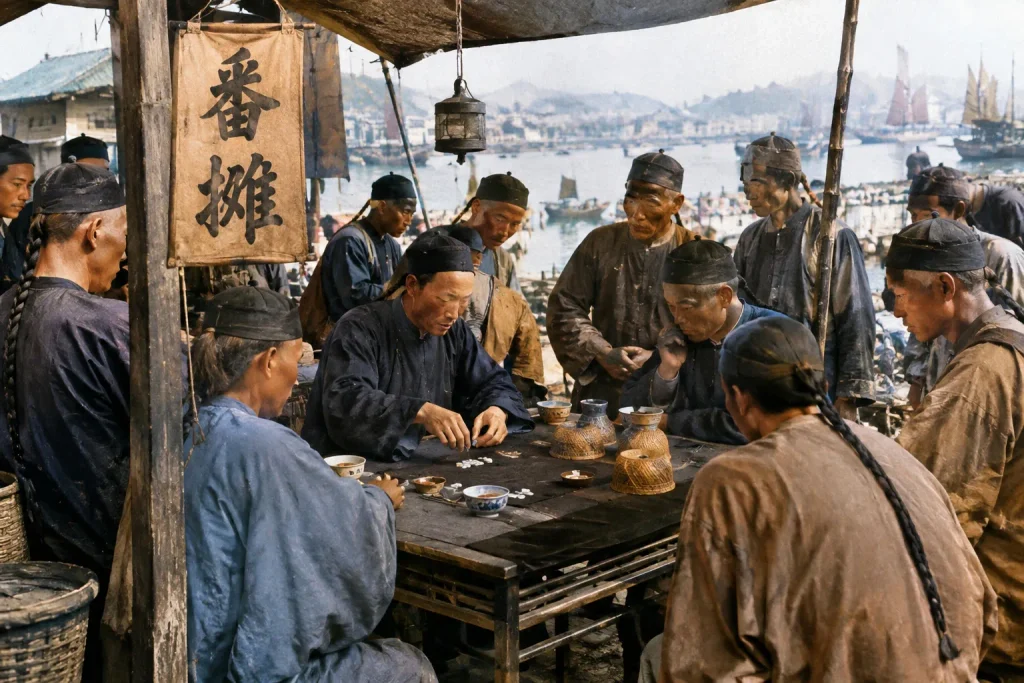
By the 1850s, Macau reportedly had more than 200 fantan gambling stalls. Gambling taxes subsequently became an important source of government revenue, helping establish the economic relationship between Macau and gaming that would define the territory for generations.
Macau became known as the “Monte Carlo of the Orient”, reflecting its growing reputation as a gambling destination.
Macau Casino History Before Stanley Ho
The development of formal casinos accelerated during the 20th century. In 1930, the Hou Heng Company, led by Fok Chi Ting, received a monopoly concession covering approved casino games.
Hou Heng introduced a more sophisticated approach to casino operations, including renovated gaming venues and entertainment intended to attract customers.
A later monopoly was awarded to Tai Heng, but the decisive transformation in Macau casino history came in the early 1960s.
In 1961, the Macau government decided to open the gaming concession to public bidding. A newly formed group involving Stanley Ho, Henry Fok, Ip Hon and Terry Ip Tak Lei won the concession. Sociedade de Turismo e Diversões de Macau, better known as STDM, began operating under the new arrangement in 1962.

Stanley Ho and the Transformation of Macau Casinos
No account of the history of Macau casinos can overlook Stanley Ho.
Stanley Ho arrived in Macau during the Second World War and subsequently became the dominant figure in the territory’s casino industry. Following STDM’s successful bid, the company developed a gaming and tourism model that would shape Macau for four decades.
The Casino Estoril opened in 1962, while the much larger Hotel Lisboa and Casino Lisboa became fully operational in 1970. The Lisboa became a defining symbol of Macau’s casino industry.
STDM’s influence extended beyond the casino floor. Its wider business interests included transportation, hotels, entertainment and tourism infrastructure, helping connect Macau with its principal customer markets.
Ho himself famously described his personal attitude towards gambling in a 2001 interview:
“Don’t expect to make money in gambling. It’s a house game.”
The quotation is particularly revealing because Ho was primarily a casino operator rather than a professional gambler.
The STDM monopoly continued, through extensions and renegotiations, until 2002. Academic research into the period generally divides Macau gambling history into three broad eras: the traditional fantan period, the STDM monopoly from 1962 to 2002, and the integrated-resort era following liberalisation.
Macau Casino Development and the End of the Monopoly
A major turning point in Macau casino development came at the beginning of the 21st century.
Following the handover of Macau to China in 1999, the government restructured the gaming concession system. Law No. 16/2001 established the framework for opening the casino industry to competition.
In February 2002, three provisional concessionaires were announced: Sociedade de Jogos de Macau, Wynn Resorts (Macau) and Galaxy Casino.
This marked the end of the long-standing monopoly system.
The change fundamentally altered the competitive landscape. International casino companies could now invest in Macau, while the territory could develop a new generation of large-scale resorts combining casinos with hotels, restaurants, shopping, entertainment and conference facilities.

Steve Wynn and the New Macau
Among the international figures who helped redefine Macau was Steve Wynn.
Wynn Resorts received one of the three original post-monopoly concessions, and Wynn Macau opened on September 6, 2006. The resort represented a significant shift towards the Las Vegas-style integrated-resort model, combining casino gaming with luxury accommodation, restaurants, retail, entertainment and leisure facilities.
Wynn described the changing market in 2006 by saying:
“This is a new Macau.”
The opening of Wynn Macau came during an extraordinary period of Macau casino development. Other international operators were also expanding, including Las Vegas Sands, whose Venetian Macau became another landmark integrated resort.
The result was a dramatic transformation of Macau’s casino landscape.
Macau Becomes the World’s Largest Gaming Market
The effects of liberalisation were rapid.
Official Macau gaming statistics show that gross revenue from games of fortune increased from approximately MOP22.18 billion in 2002 to MOP56.62 billion in 2006.
The number of gaming tables also expanded dramatically, from 339 at the end of 2002 to 2,762 by the end of 2006.
In 2006, Macau’s casino gaming revenue surpassed that of Las Vegas, making it the world’s largest gaming market by casino gaming revenue at that time.
This represented one of the most important milestones in Macau casino history.
The transformation was not simply about adding more casinos. Macau increasingly developed an integrated tourism model in which gaming operated alongside hotels, retail, restaurants, entertainment, and convention facilities.
The Rise of the Integrated Casino Resort
The post-2002 era fundamentally changed the physical appearance of Macau.
The Cotai area became a major focus of casino investment, with large resort developments creating a new concentration of gaming and tourism infrastructure.
Operators including Galaxy, Venetian Macau, Wynn, MGM and Melco joined SJM in developing Macau’s increasingly competitive casino market.
By 2007, official statistics recorded 28 casinos and 4,375 gaming tables.
This period established Macau as something different from the traditional image of a casino destination. The modern market combined Macau casinos with hospitality, shopping, entertainment and tourism.
This is one of the central themes of Macau casino development: the casino became part of a much larger resort ecosystem.

Macau Casinos and the Evolution of Baccarat
Baccarat has played an especially important role in Macau gambling history.
During the STDM era, baccarat became increasingly central to Macau’s casino economy. Its popularity, particularly among high-value customers, helped distinguish Macau from many Western casino markets.
The development of VIP gaming and junket operations also became an important part of the industry’s history, although the regulatory and commercial environment surrounding junkets subsequently changed significantly.
Understanding baccarat is therefore essential to understanding the evolution of the Macau casino industry.
From Casino Monopoly to Six Concessions
The next major regulatory milestone arrived in 2022.
Macau conducted a new public tender for six gaming concessions. The successful operators were MGM Grand Paradise, Galaxy Casino, Venetian Macau, Melco Resorts (Macau), Wynn Resorts (Macau) and SJM Resorts.
The new concessions took effect on January 1, 2023, for 10 years.
An important feature of the new framework was the increased emphasis on non-gaming development. The six concessionaires committed to aggregate investment of MOP118.8 billion, with MOP108.7 billion allocated to overseas customer development and non-gaming projects, compared with MOP10.1 billion for gaming investment.
This illustrates another stage in Macau casino development: the attempt to broaden the destination beyond casino gambling alone.
Why Macau’s Casino History Matters
The history of Macau casinos is unusual because gaming was not simply an entertainment industry added to an existing tourist destination. Gambling became deeply connected to Macau’s economic development.
From 19th-century fantan stalls to Stanley Ho’s four-decade monopoly, and from the opening of the market to international operators such as Steve Wynn to the modern integrated-resort model, each phase changed the relationship between Macau, tourism, and gaming.
Macau’s story also demonstrates how casinos have evolved from relatively simple gaming venues into complex entertainment and hospitality destinations.
For anyone studying Macau casino history, the territory provides a particularly important case study in regulation, tourism, investment and casino development.
Conclusion
The history of Macau casinos is a story of transformation: from 19th-century fantan houses to Stanley Ho’s STDM monopoly, and ultimately to a competitive market dominated by integrated resorts. The Macau gambling history demonstrates how regulation, tourism and international investment reshaped the world’s most famous Chinese gaming destination.
Frequently Asked Questions
When did gambling become legal in Macau?
Gambling was formally legalised by the Portuguese administration in 1847, primarily to increase government revenue and diversify the local economy.
What is the history of Macau casinos?
The history of Macau casinos can broadly be divided into the traditional gambling era, the STDM monopoly from 1962 to 2002, and the competitive integrated-resort era that followed.
Who was Stanley Ho?
Stanley Ho was the leading figure behind STDM, which held Macau’s casino monopoly for approximately four decades. He played a central role in the development of the modern Macau casino industry.
When did Stanley Ho start operating casinos in Macau?
Stanley Ho and his partners won the public tender for Macau’s gaming monopoly in 1961, with STDM beginning operations under the new concession in 1962.
When did the Macau casino monopoly end?
The STDM monopoly ended in 2002, when Macau opened its casino industry to competition and awarded concessions to SJM, Galaxy and Wynn.
When did Wynn Macau open?
Wynn Macau officially opened on September 6, 2006, becoming an important milestone in the internationalisation of Macau’s casino industry.
When did Macau overtake Las Vegas as a gaming market?
Macau’s casino gaming revenue surpassed Las Vegas in 2006, making Macau the world’s largest casino gaming market by revenue at that time.
What games are important in Macau casinos?
Baccarat has historically been particularly important to Macau’s casino industry. Other games offered over the years have included blackjack, roulette, fantan, and various electronic gaming products.
What is the meaning of Macau’s “Monte Carlo of the Orient” nickname?
“Monte Carlo of the Orient” was a historical nickname reflecting Macau’s growing reputation as a major gambling destination.
How did Macau casinos develop after 2002?
Following liberalisation, Macau experienced substantial casino investment and developed large integrated resorts combining gaming with hotels, restaurants, retail, entertainment and tourism facilities.
How many Macau casino concessions were awarded in 2022?
Six concessions were awarded in the 2022 public tender. They went to MGM Grand Paradise, Galaxy Casino, Venetian Macau, Melco Resorts (Macau), Wynn Resorts (Macau), and SJM Resorts.
Reference List:
Gaming Inspection and Coordination Bureau. (n.d.). History of the gaming industry in Macao. Macao Special Administrative Region Government.
Gaming Inspection and Coordination Bureau. (2007). Gaming statistics 2002–2007. Macao Special Administrative Region Government.
Godinho, J. (2019). The casinos of Macau—History of the world’s largest gaming market. Livraria Almedina.
Godinho, J. (2025). The place of Stanley Ho (1921–2020) in Macau casino gaming history. Gaming Law Review.
Macao Special Administrative Region Government. (2002, February 8). Tender Committee for Gaming Concession tender announced the provisional results of the tender.
Macao Special Administrative Region Government. (2022, December 16). MSAR signs gaming concession contracts with six awardees.
Wynn Resorts. (2006, September 5). Wynn Macau to open on September 6, 2006.
Wynn Resorts. (2006, March 5). Wynn Resorts Limited announces sale of subconcession for $900 million to Publishing and Broadcasting Limited.


Sign Up for Our Newsletters
Be the first to know when new content is created.Related Posts

10 Things You Didn’t Know About Crockford’s Casino Mayfair
A Deep Dive into the Secrets, Legends, and Legacy of London’s Most Exclusive Casino.

The UK Gambling White Paper 2023: An Overview
The UK Government recently published the UK Gambling White Paper 2023, outlining significant changes and reforms to UK gambling regulations. This white paper aims to modernise the UK’s gambling laws, ensuring they are fit for the digital age while safeguarding consumers and tackling the rising issues related to problem gambling. This document sets forth the government’s objectives, planned changes, and the expected impact on ordinary gamblers and the wider gambling industry.

10 Best Casinos in Transylvania
This list highlights the best casinos in Transylvania, focusing on legitimate gambling halls, slot arcades, and poker rooms, as traditional full‑scale casinos are rare in the region. All venues listed are operational in 2026 and represent the most active gambling locations across Brașov, Cluj‑Napoca, Zalău, and Baia Mare.
The Rise and Fall of Star Cruises Asia
The story of Star Cruises, once Asia’s most ambitious cruise empire, begins with Genting’s dream of building a regional fleet to dominate Southeast Asian waters. From glamorous casinos to iconic ships like Super Star Gemini and Star Pisces, this is the tale of how the Star Cruise Line rose, thrived, and ultimately fell.