


Dark
Light
The Knock-Out Card Counting Strategy is an unbalanced card counting system designed to simplify blackjack counting by eliminating the need for true-count conversion. Developed by Ken Fuchs and Olaf Vancura, the KO system assigns simple values to cards and uses the running count to estimate deck composition and guide betting decisions.

What Is the Knock-Out Card Counting Strategy?
The Knock-Out Card Counting Strategy, commonly called the KO card counting system or Knock-Out count, is a level-one blackjack card counting method developed by Ken Fuchs and Olaf Vancura and popularised through their book Knock-Out Blackjack. The original book was published in 1998, with later editions expanding the system and its applications.
The defining feature of the KO blackjack strategy is that it is an unbalanced counting system. In a balanced system such as Hi-Lo, the assigned card values cancel out when a complete deck is counted. KO deliberately does not balance in this way because the seven is assigned a positive value.
The purpose is practical: the player maintains a running count without having to divide that count by the estimated number of decks remaining.
That makes the KO counting system particularly interesting to players researching how to use the Knock-Out card counting system without the additional mathematics associated with a traditional true-count system.
How the KO Card Counting Strategy Works
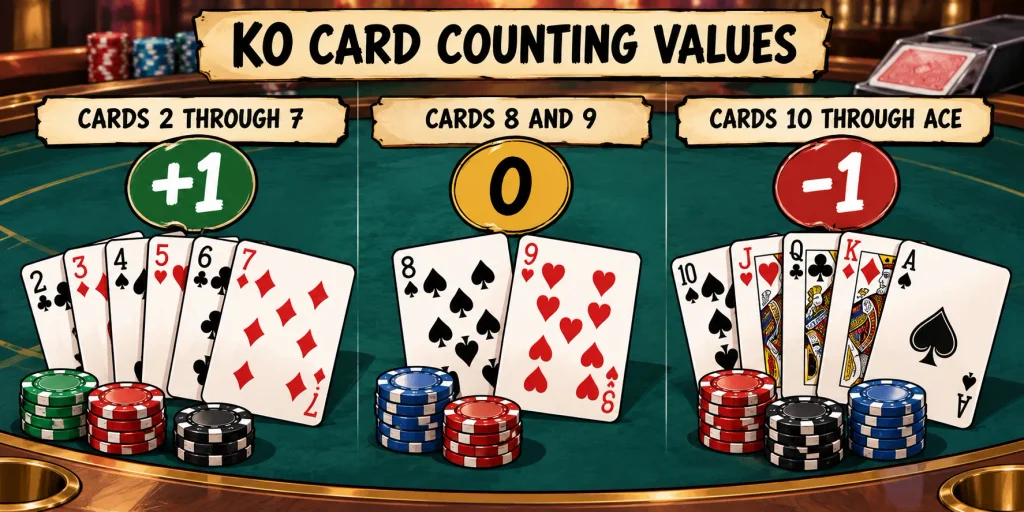
The basic KO card counting values are straightforward:
| Card | KO Value |
|---|---|
| 2, 3, 4, 5, 6, 7 | +1 |
| 8, 9 | 0 |
| 10, J, Q, K, A | -1 |
The important difference from Hi-Lo is the 7. In Hi-Lo, sevens have a value of zero; in the standard KO count, sevens are worth +1.
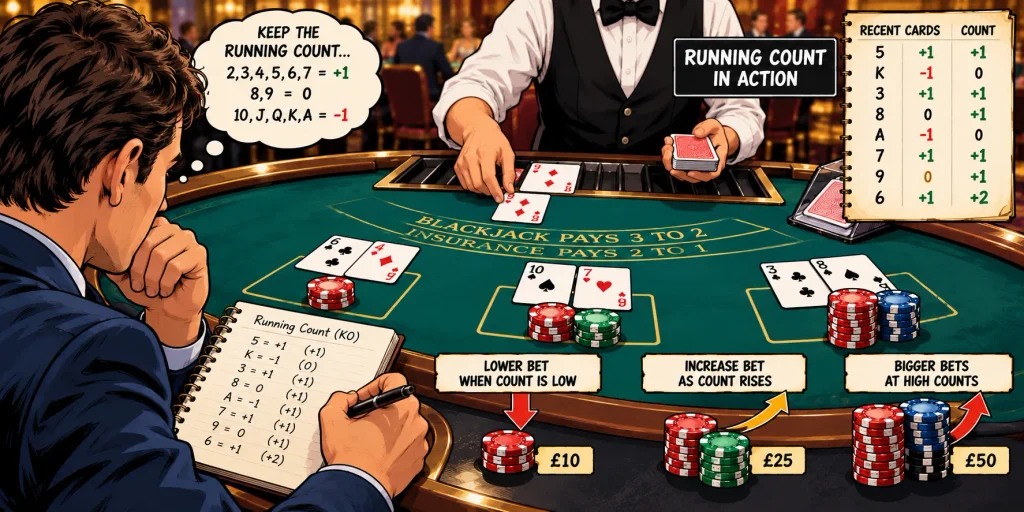
As cards appear, the player adds their values to the running count. A five therefore adds one point, a nine has no effect, and a king subtracts one point.
For example, if the exposed cards are:
5, K, 7, 9, A
the running-count changes are:
+1 -1 +1 +0 -1 = 0
This simple calculation illustrates why the KO blackjack counting system is relatively easy to explain and practise.
The underlying principle is the same as other blackjack counting systems: when more low cards have already been removed, the remaining shoe contains proportionally more high cards, while removal of high cards tends to leave a greater concentration of low cards.

The Starting Count and Pivot Point
A crucial difference between the KO card counting strategy and a conventional balanced system is the starting count.
Because the KO card counting strategy is unbalanced, the player does not normally begin every shoe at zero. The standard starting count, or initial running count (IRC), changes according to the number of decks.
A commonly published standard formula is:
IRC = 4 − (4 × number of decks)
This produces the following starting counts:
| Decks | Starting Count |
|---|---|
| 1 | 0 |
| 2 | -4 |
| 4 | -12 |
| 6 | -20 |
| 8 | -28 |
The exact implementation can vary depending on the KO version and game conditions, so players should follow the specific rules of the system they are using.
The pivot point is an important concept in the KO card counting strategy. The standard KO count is designed so that the same approximate reference point can be used across different shoe sizes. This is one of the mathematical consequences of using an unbalanced count.
The system therefore embeds some information that a balanced system obtains through true-count conversion into the running count itself.
KO With Advanced Side Counts
KO With Advanced Side Counts
5
5
0
1
Unlock the most powerful Blackjack strategy with KO and advanced side counts. Blackjack Rebel (Author)
Unlock the most powerful Blackjack strategy with KO and advanced side counts. Blackjack Rebel (Author)
5/5
Total Score
iBuy this Ebook for only £7.99!
Amazing

Why the KO Counting System Does Not Require a True Count
One of the most frequently searched questions about KO is: Does the KO counting system use a true count?
The answer is no, not in its standard form.
With a balanced system such as Hi-Lo, a player normally maintains a running count and then estimates the number of decks remaining. The running count is divided by the estimated decks remaining to produce the true count.
The standard Knock-Out card counting strategy avoids this conversion. The player maintains the KO running count and interprets it using the system’s reference points.
This is the central reason that an unbalanced card counting system can appeal to players who find estimating remaining decks and performing a true-count conversion difficult.
It does not mean the mathematics have disappeared. Rather, the system has been structured so that some of the information normally obtained through conversion is incorporated into the unbalanced count.
Using Basic Strategy with the KO Counting System
Learning blackjack basic strategy remains essential before attempting card counting.
Card counting does not replace basic strategy. Instead, the count can provide information about the changing composition of the cards remaining in the shoe, while basic strategy provides the mathematical baseline for decisions based on the player’s hand and dealer’s upcard.
Some advanced versions of KO also use index numbers to alter particular playing decisions according to the count. The original Knock-Out Blackjack includes more advanced versions of the system, including the KO Preferred approach.
For someone searching for how to count cards with the KO counting system, the sensible learning sequence is therefore:
- Learn blackjack rules.
- Master basic strategy.
- Memorise the KO card values.
- Practise maintaining the running count.
- Learn the appropriate starting count.
- Understand the pivot and relevant count thresholds.
- Only then study betting and advanced playing variations.
Betting With the Knock-Out System
Card counting becomes meaningful because the composition of the remaining cards can affect the expected value of blackjack.
A player using a KO blackjack betting strategy may vary wager size according to the running count rather than betting the same amount throughout a shoe. The precise KO betting ramp depends on factors including the number of decks, penetration, table rules, bankroll, and the particular KO strategy being used.
The original KO literature includes specific betting approaches, while modern simulations also demonstrate that different betting ramps can produce different results.
This is important because card counting does not guarantee winning sessions. Even a player who correctly counts cards can experience substantial short-term variance. Wizard of Odds notes that card counting is difficult and that realistic player advantages, where they exist, are relatively small under contemporary conditions.
Consequently, blackjack bankroll management, bet sizing, and risk of ruin are important parts of the broader subject.

Knock-Out vs Hi-Lo Card Counting
The most useful comparison is Knock-Out vs Hi-Lo.
| Feature | KO | Hi-Lo |
|---|---|---|
| System type | Unbalanced | Balanced |
| 2–6 | +1 | +1 |
| 7 | +1 | 0 |
| 8–9 | 0 | 0 |
| 10–A | -1 | -1 |
| True-count conversion | Not required | Normally required |
| Running count | Yes | Yes |
| Complexity | Relatively simple | Relatively simple |
Both are level-one systems using only +1, 0, and -1 tags. KO’s defining difference is the treatment of the seven and the resulting unbalanced count.
The two systems therefore illustrate a wider principle in blackjack counting systems: different methods trade simplicity against precision and complexity. There is no need to describe KO as universally superior or inferior to Hi-Lo; the relevant choice depends on the player’s objectives, game conditions, and ability to execute the system accurately.
Advantages and Limitations of the KO System
The principal attraction of the Knock-Out card counting system is simplicity.
It has only three card values, does not require standard true-count conversion, and provides a structured way to track changes in deck composition. These characteristics explain why the system is frequently discussed as an accessible entry point into blackjack card counting.
There are limitations.
The player still needs to count accurately, maintain concentration, understand basic strategy, and select appropriate games. Poor rules, shallow penetration, errors in counting, and inappropriate betting can all reduce or eliminate any theoretical advantage.
Furthermore, card counting is not simply a mathematical exercise. Real blackjack involves casino procedures, varying rules, table conditions, bankroll requirements, and significant short-term variance.
Is the Knock-Out System Suitable for Beginners?
The KO blackjack counting system for beginners is often presented as accessible because its arithmetic is uncomplicated. A beginner can learn the card tags without needing to calculate a true count.
However, “easy to learn” should not be confused with “easy to execute profitably.”
A player still needs to count a deck accurately, maintain the count while playing, use basic strategy correctly, and understand how blackjack rules affect the underlying house edge. I always stress the importance of mastering basic strategy before attempting card counting.
For educational purposes, the KO system is therefore best understood as a simplified counting framework rather than a guaranteed blackjack winning formula.
Conclusion
The Knock-Out Card Counting Strategy is an unbalanced card counting system designed to simplify blackjack counting by using a running count without conventional true-count conversion. Its distinctive feature is assigning +1 to cards 2 through 7, 0 to 8 and 9, and -1 to 10-value cards and aces.
The system uses a deck-dependent starting count and a common pivot reference. KO can be easier to learn than more mathematically demanding systems, but it does not eliminate variance, bankroll risk, or the need for accurate basic strategy. Understanding the KO card counting system therefore requires learning both its mechanics and its limitations.
Frequently Asked Questions About the Knock-Out Card Counting Strategy
What is the Knock-Out card counting strategy?
The Knock-Out card-counting strategy is an unbalanced blackjack card-counting system developed by Ken Fuchs and Olaf Vancura. It uses card values of +1, 0, and -1 and does not require conventional true-count conversion.
How does the KO card counting system work?
The standard KO card counting system assigns +1 to cards 2 through 7, 0 to 8 and 9, and -1 to tens, face cards, and aces. The player maintains a running count as cards are dealt.
Is the Knock-Out system easier than Hi-Lo?
The KO system can be simpler operationally because it does not require the standard Hi-Lo step of converting a running count into a true count. Both systems, however, require accurate counting and knowledge of basic strategy.
Does the KO system use a true count?
The standard KO system does not require a conventional true-count calculation. Its unbalanced structure is designed to allow the running count to be interpreted without dividing it by the estimated number of decks remaining.
What is the starting count in the KO system?
The standard starting count depends on the number of decks. A commonly published formula is 4 − 4 × the number of decks, producing -20 for six decks and -28 for eight decks. Different KO implementations may use specific adjustments.
What is the pivot point in KO card counting?
The pivot point is a reference count used to identify a particular level of deck composition within the KO system. The standard KO approach uses a common pivot reference, while the starting count changes according to the number of decks.
What cards count as +1 in the KO system?
Cards 2, 3, 4, 5, 6, and 7 are normally assigned a value of +1.
What cards count as zero in the KO system?
The 8 and 9 are assigned a value of zero in the standard KO count.
What cards count as -1 in the KO system?
The 10, Jack, Queen, King, and Ace are assigned a value of -1.
Can the KO system beat blackjack?
A card counting system can potentially provide a mathematical advantage under favourable conditions, but it does not guarantee winning sessions. Results depend on rules, penetration, accurate counting, betting decisions, bankroll, and variance.
What is the difference between KO and Hi-Lo card counting?
The main difference is that KO is unbalanced and assigns +1 to the seven, while Hi-Lo is balanced and assigns zero to the seven. Standard Hi-Lo also uses true-count conversion, whereas KO normally does not.
Is KO card counting suitable for beginners?
The KO system is often regarded as relatively accessible because it uses only three card values and avoids conventional true-count conversion. Beginners nevertheless need to master blackjack basic strategy and practise accurate counting before attempting to use the system.
Can the KO count be used on six-deck blackjack?
Yes. The KO methodology can be adapted to multi-deck games, including six-deck blackjack. The appropriate starting count and strategy depend on the number of decks and the particular KO approach being used.
Does KO card counting guarantee an advantage?
No. KO card counting does not guarantee a player advantage in every blackjack game. Game rules, penetration, betting spread, playing accuracy, and other conditions influence the mathematical outcome.
Reference List:
Fuchs, K., & Vancura, O. (1998). Knock-Out Blackjack: The easiest card-counting system ever devised. Huntington Press. Google Books
Vancura, O., & Fuchs, K. (2015). Knock-Out Blackjack: The easiest card-counting system ever devised (3rd ed.). Huntington Press. huntingtonpress.com
Wattenberger, N. (n.d.). Knock-Out strategy. QFIT. QFIT — Knock-Out Strategy
Shackleford, M. (2026). Card counting in blackjack: Introduction & basics. Wizard of Odds. Wizard of Odds — Card Counting in Blackjack
Shackleford, M. (2026). Blackjack — Counting cards. Wizard of Odds. Wizard of Odds — Blackjack Counting Cards
Blackjack Global. (2026). Knock-Out card counting.


Sign Up for Our Newsletters
Be the first to know when new content is created.Related Posts

How to Play Breakout Blackjack — The Complete Breakout Blackjack Guide
Breakout Blackjack by NB Games LLC redefines casino table games with a fast, modern twist on traditional blackjack. This breakout blackjack guide explains how to play Breakout Blackjack, covering blackjack rules, betting options, and blackjack strategy tips to help players master the game confidently and enjoy its dynamic pace.

Is a Random Number Generator Really Random?
Random number generators (RNGs) are the digital heartbeat of online gambling, ensuring fairness, unpredictability, and integrity across games. By simulating randomness through algorithms or physical processes, RNGs guarantee that every spin, card, or roll is unbiased—mirroring the chance-based nature of traditional casinos.

Baccarat vs Chemin de Fer vs Punto Banco: What Is the Difference?
Baccarat, chemin de fer and punto banco are closely related card games, but they are not identical. While all three use the same basic baccarat scoring system, the major differences involve who controls the Banker hand, how cards are drawn, and how betting works. Understanding these distinctions helps explain why baccarat has developed into several distinct casino formats.

Comparing Popular Betting Systems: Fibonacci vs Martingale vs Labouchere
These three betting systems—Fibonacci, Martingale, and Labouchere—are widely used in games of chance like roulette, blackjack, and sports betting. Each follows a different progression strategy to manage wins and losses.
