


Dark
Light
Behind every slot game lies a complex combination of mathematics, software and chance. Independent casino game testing laboratories examine whether those elements work as intended. GLI, BMM Testlabs and eCOGRA help assess gambling products, checking randomness, payouts and compliance before players encounter them in regulated casinos and online gambling markets.
Independent casino game testing laboratories: what do they do?
A slot game can look convincing while containing a mathematical error, an incorrect prize calculation, or a software fault. Independent testing provides an external technical assessment of whether the submitted product meets the applicable requirements.
Depending on the assignment, laboratories examine game mathematics, software, random number generation, player-facing rules, hardware and supporting systems.
A testing laboratory is distinct from a gambling regulator. The regulator sets or enforces the requirements for its market; the laboratory assesses products against the relevant standards. In Great Britain, certain gambling products must undergo testing by an appropriately approved test house before release.
GLI, BMM and eCOGRA are three prominent international names. Other approved laboratories operate internationally, and approvals differ by product, jurisdiction, and laboratory entity.
GLI vs BMM Testlabs vs eCOGRA: the main differences
The most useful comparison concerns what each organisation tests and where its work is accepted.
| Laboratory | Main scope | Examples of testing |
|---|---|---|
| Gaming Laboratories International — GLI | Land-based gaming equipment and online gaming | Slot software, game mathematics, RNGs and electronic gaming machine platforms |
| BMM Testlabs | Land-based and online gaming products and systems | Mathematical models, source code, RNGs, cabinets, peripherals and accounting systems |
| eCOGRA | Online gambling software and systems | Online slots, RNGs, game engines, casino platforms, websites and integration |

GLI: assessing the machine and the game
GLI’s explanation of electronic gaming machine testing separates the platform from the individual game. Platform assessment covers the underlying hardware and software; game testing examines whether a particular title implements its intended design.
For game verification, GLI describes building independent simulations from source code, mathematical documentation, and game rules. It also uses tools to trigger specific outcomes, allowing testers to examine unusual winning combinations and bonus events without waiting for them to appear naturally.

BMM Testlabs: broad coverage across products and systems
BMM’s published services range from mathematical analysis and source-code review to gaming cabinets, peripheral devices and casino monitoring systems.
Its online testing also covers artwork, functional play, accounting and game rules. This demonstrates why checking a casino game involves more than testing whether its reels produce plausible results: the surrounding software must record and process play correctly too.

eCOGRA: a specialist in online gambling
eCOGRA focuses on remote gambling products, including RNG-driven slots and table games, casino platforms, websites and internal control systems.
Its certification process includes evaluation followed by an independent review by personnel who were not involved in that evaluation. Certification relates to a defined product and assessment scope. eCOGRA describes product certification as a point-in-time assessment, with changes potentially requiring further evaluation.
The UK approval list illustrates the distinction: eCOGRA is approved for remote technical standards, while listed GLI entities and BMM Spain also have gaming-machine and casino-equipment testing approvals. This UK-specific list should not be treated as a complete worldwide service map.
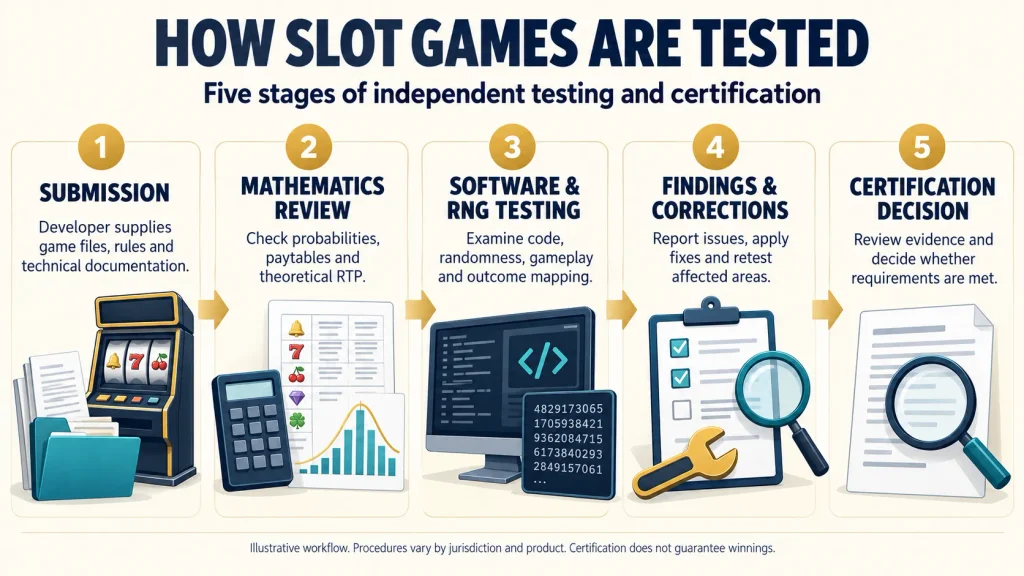
How online slot games are tested
Although procedures vary, the process starts with understanding the submitted game.
Developers provide the information needed to reconstruct its operation: rules, paytables, reel strips or symbol weights, bonus mechanics, mathematical calculations, and the software version being assessed. BMM’s submission guidance specifically requests materials such as prize probabilities, simulation source code, game configurations, and RTP contributions.
The subsequent work typically combines several methods:
- Design review: Check that the mathematics and advertised rules agree.
- Source-code review: Examine how the software implements the design.
- Automated testing: Run simulations or emulations to compare behaviour with expected results.
- Manual testing: Check displayed outcomes, rules and gameplay.
- Integration testing: Where needed, assess the game with its intended platform and RNG.
All major global Gambling Commissions’ testing procedures explicitly cover these areas. Problems must be addressed, and relevant checks repeated before a satisfactory result can be established.
Rare events deserve particular attention. A jackpot or unusual bonus combination might hardly ever appear during ordinary play. Controlled test tools can force such events in the laboratory to check their awards. That testing technique is not evidence that an operator can select outcomes during normal live play.
How testing laboratories verify slot RTP
Return to player is the expected proportion of stakes returned as prizes over the long run. Testing laboratories verify whether a game’s mathematics and implementation support its stated RTP.
The starting point is the developer’s mathematical model. A slot game mathematician designs the probabilities and prize structure; the laboratory independently evaluates the submitted calculations and implementation.
BMM requests information covering the base game, features, mini-games, and overall return. This matters because a headline RTP may combine several different sources of payout.
For a deliberately simplified example:
| Component | Illustrative RTP contribution |
|---|---|
| Base-game prizes | 65 percentage points |
| Free-spin feature | 25 percentage points |
| Other bonus prizes | 6 percentage points |
| Total theoretical RTP | 96% |
eCOGRA describes using mathematical programs and large-sample simulations to examine whether paying combinations approach their expected probabilities. Its assessment considers game modes and volatility when determining whether results fall within an acceptable statistical interval.
There is no universal number of spins that certifies every game. GLI describes simulations running to billions of games in its electronic gaming machine workflow, but the appropriate method depends on the product and requirements.
A 96% theoretical RTP corresponds to a 4% theoretical house edge on the same wagering basis. It does not promise £96 back from an individual £100 session. Actual results fluctuate, and RTP cannot be judged from one player’s short run of play.
Pre-release verification also differs from live monitoring. Remote operators are required to monitor game performance because design, implementation, or operational faults can escape initial testing and cause overpayment or underpayment.
Try out my RTP & House Edge Calculator next time you play slots online.
How casino random number generators are tested
A random number generator (RNG) supplies values used to determine game outcomes. Checking it involves examining both the generator and how the game uses its output.
eCOGRA describes reviewing source code, analysing output statistically, evaluating the unpredictability of starting seeds and assessing resistance to attempts to predict or influence results. It also considers the hardware and software environment.
Three questions explain the process:
Does the implementation have weaknesses? Reviewers investigate the algorithm and its code, rather than trusting a reassuring-looking sequence of numbers.
Does the output behave as expected? Statistical tests examine whether the generated data shows unexpected patterns or distributions.
Is the output converted into outcomes correctly? A functioning RNG can still feed an incorrectly implemented game. Scaling and mapping checks examine how its numbers become reel positions, cards, or other results. The UK testing procedure specifically includes raw RNG output and scaled or shuffled data.
Randomness does not mean every slot symbol or prize must be equally likely. The important distinction is between unintended bias and the probabilities deliberately specified in the game’s mathematical model.
Nor does certification mean losses should alternate neatly with wins. A properly functioning random game can produce losing streaks. Testing evaluates compliance and implementation; it does not remove the game’s house edge or guarantee a profitable session.
Read my article on how to create your own random number generator using Excel.
Conclusion
Independent casino game testing laboratories provide an important technical check between game development and regulated gambling. GLI and BMM offer broad coverage across land-based and online products, while eCOGRA specialises in remote gambling.
Their work combines mathematical assessment, software examination and practical testing. For players, the useful question is what was tested, for which market, and under which configuration. Certification supports confidence in a game’s operation, but it cannot guarantee winnings or replace ongoing oversight.
Frequently Asked Questions
What are the main independent casino game testing laboratories?
GLI, BMM Testlabs, and eCOGRA are three prominent international laboratories. They are not an officially ranked global top three; other approved test houses operate in regulated markets.
What is the difference between GLI, BMM and eCOGRA?
GLI and BMM test both land-based and online gambling products. eCOGRA specialises in online gambling software and systems. Specific approvals depend on the laboratory entity, product category, and jurisdiction.
Do testing laboratories decide a slot game’s RTP?
The developer designs the mathematical model and its RTP. Laboratories assess whether the submitted model and software support the declared return and meet applicable requirements.
Does RNG certification guarantee that a slot game is fair?
RNG certification covers a defined assessment of the generator. Full game assessment also needs to consider mathematics, mapping, payouts, and rules. A certified RNG alone does not establish that every part of a casino’s operation has been tested.
Can a certified slot game still develop problems?
Yes. Testing cannot identify every possible fault. Operational issues and later changes can affect performance, which is why live monitoring and appropriate retesting matter.
Reference List:
Gambling Commission. (n.d.). Test houses. https://www.gamblingcommission.gov.uk/licensees-and-businesses/guide/test-houses
Gambling Commission. (n.d.). Approved test houses. https://www.gamblingcommission.gov.uk/licensees-and-businesses/guide/page/approved-test-houses
Burger, M. (2025, June 24). How casino games are tested. Gaming Laboratories International. https://gaminglabs.com/blog/how-casino-games-are-tested/
BMM Testlabs. (n.d.). Testing; iGaming. https://bmm.com/testing/ ; https://bmm.com/igaming/
eCOGRA. (n.d.). eCOGRA certification. https://ecogra.org/ecogra-certification/
BMM Testlabs. (n.d.). BMM mathematics. https://bmm.com/bmm-mathematics/
Gambling Commission. (2024, September 13). Testing strategy: Procedure for testing. https://www.gamblingcommission.gov.uk/strategy/testing-strategy-for-compliance-with-remote-gambling-and-software-technical/3-procedure-for-testing
eCOGRA. (n.d.). RTP percentage testing. https://ecogra.org/services/rtp-percentage-testing/
Gambling Commission. (n.d.). RTP games. https://www.gamblingcommission.gov.uk/about-us/freedomofinformation/rtp-games
Gambling Commission. (2025, January 29). Live return to player performance monitoring of games of chance. https://www.gamblingcommission.gov.uk/licensees-and-businesses/guide/live-return-to-player-performance-monitoring-of-games-of-chance
eCOGRA. (n.d.). RNG certification. https://ecogra.org/services/random-number-generator-rng-certification/


Sign Up for Our Newsletters
Be the first to know when new content is created.Related Posts

What Is the Best Way to Win at Blackjack: Progression Betting or Card Counting?
The best way to win at blackjack starts with understanding probability, not betting systems. Basic strategy reduces the house edge, while progression betting changes wager size without changing expected value. Card counting can alter the mathematical advantage when conditions allow, but requires skill, discipline and bankroll management.

How to Play Breakout Blackjack — The Complete Breakout Blackjack Guide
Breakout Blackjack by NB Games LLC redefines casino table games with a fast, modern twist on traditional blackjack. This breakout blackjack guide explains how to play Breakout Blackjack, covering blackjack rules, betting options, and blackjack strategy tips to help players master the game confidently and enjoy its dynamic pace.

The influence of the Church of England and Protestantism on UK gambling legislation
Early History of Gambling in the UK Influence of the Church of England and Protestantism Evolution of Gambling…

Improve Your Blackjack: 5 Things You Need to Do Right Now
Want to know how to improve at blackjack? Forget lucky streaks, hunches and supposedly unbeatable betting systems. The best blackjack tips are based on mathematics, good decision-making and understanding the game you are playing. Here are five things you need to learn if you want to become a better blackjack player.
