


Dark
Light
An online casino manager is responsible for the commercial success, product strategy, and operational performance of a digital casino business. Understanding how to run an online casino requires expertise in gaming products, player behaviour, financial analysis, and customer retention. Plus the ability to identify growth opportunities in a competitive, regulated industry.
What Does an Online Casino Manager Do?
An online casino manager oversees the performance and development of a casino’s digital gaming operation.
Unlike a traditional casino manager, whose responsibilities often involve supervising gaming floors and employees, the online role concentrates on commercial strategy, gaming content, customer acquisition, revenue generation, and product performance.
Depending on the organisation, the position may carry direct responsibility for the casino’s commercial budget, game portfolio, promotional strategy and contribution to company profitability.
Successful management requires understanding both the mathematical characteristics of casino games and the commercial factors influencing player preferences, retention and revenue.

How to Develop a Successful Online Casino Strategy
The foundation of online casino management is a commercial strategy aligned with the company’s wider business objectives.
An online casino manager must establish priorities for revenue growth, operating margins, customer acquisition, retention and product development.
This includes creating budgets, setting performance targets and allocating resources between gaming content, promotions, technology and marketing.
A manager also needs to understand the casino’s target market. Customer preferences differ between jurisdictions, demographics and gambling products.
For example, a business targeting experienced live casino customers may require a different product strategy from one concentrating on mobile slots.
An effective manager translates these commercial objectives into measurable activities, ensuring that every major initiative has a clear business purpose.
Managing and Optimising the Casino Game Portfolio
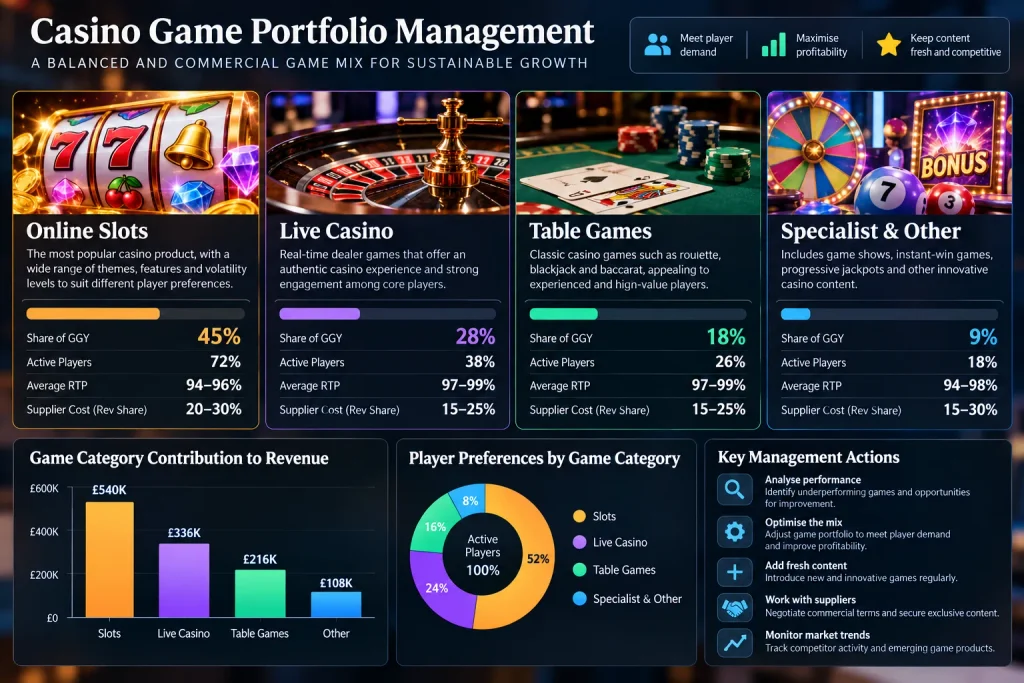
Casino game portfolio management is among the most important responsibilities of an online casino manager.
The objective is to provide an attractive, competitive and commercially sustainable selection of games.
A typical online casino portfolio includes:
- Online slots: Traditional reels, video slots, progressive jackpots and other permitted slot formats.
- Live casino: Dealer-operated roulette, blackjack, baccarat and selected game-show-style products.
- Table games: Digital roulette, blackjack, baccarat and other casino classics.
- Specialist games: Other approved instant-win or casino gaming products.
The manager must understand game mechanics, theoretical Return to Player (RTP) percentages, volatility, supplier pricing and customer demand.
Game selection should reflect the preferences of the target market rather than simply maximise the number of available titles.
New releases, exclusive content and carefully organised game categories can improve the customer experience.
The manager must continually evaluate which products deserve prominent placement, additional exposure or removal from the portfolio.
Analysing Casino Performance and Commercial KPIs
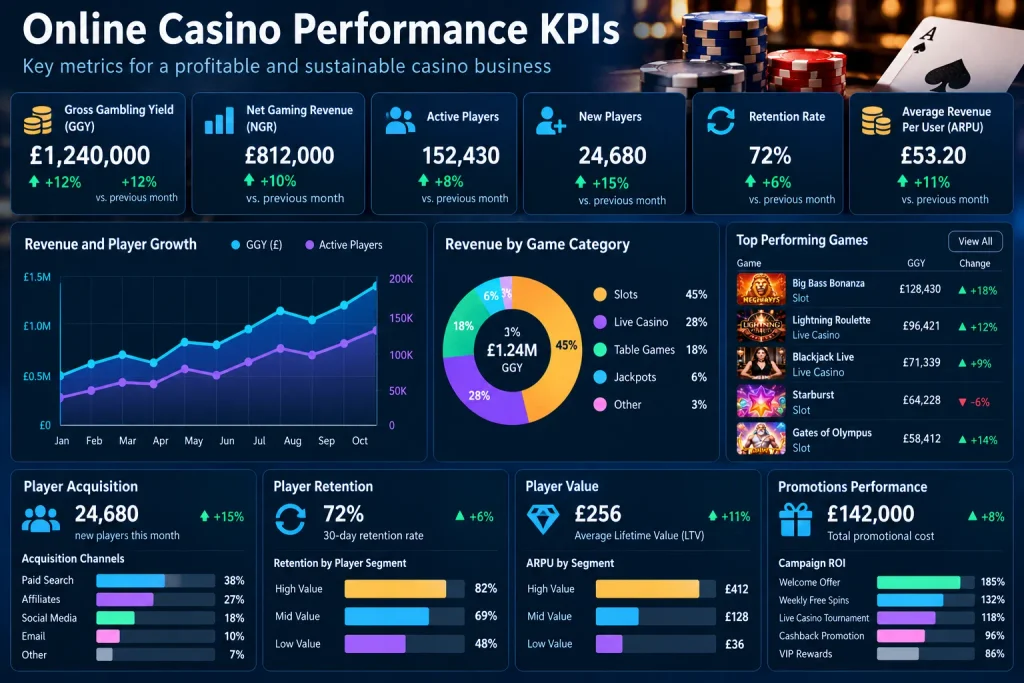
Strong analytical skills are essential for understanding online casino profitability.
Managers use reporting systems and business intelligence tools to monitor commercial performance and identify emerging trends.
Important casino performance KPIs include:
| KPI | Commercial importance |
|---|---|
| Gross Gambling Yield (GGY) | Stakes received minus winnings paid |
| Net Gaming Revenue (NGR) | Revenue after specified deductions, using the operator’s reporting definition |
| Active players | Measures customer participation |
| Customer Acquisition Cost (CAC) | Evaluates marketing efficiency |
| Retention and churn | Measures returning and departing customers |
| Customer Lifetime Value (LTV) | Forecasts expected customer contribution |
| Bonus cost | Measures promotional expenditure |
| Game-level contribution | Assesses profitability after attributable costs |
| Supplier revenue share | Identifies gaming content costs |
Revenue should be examined alongside costs, customer behaviour and player protection indicators.
Importantly, strong turnover does not necessarily mean strong profitability.
A game may generate substantial wagering activity but deliver limited commercial contribution after supplier fees, promotions and other costs.
An effective manager turns performance analysis into practical decisions.
Casino Player Acquisition and Retention
Understanding the player lifecycle is fundamental to operating an online casino commercially.
The lifecycle begins with customer acquisition and progresses through registration, verification, first participation, continued engagement, and possible inactivity.
An online casino manager works with marketing and Customer Relationship Management (CRM) teams to improve the customer experience throughout these stages.
Commercial analysis examines acquisition sources, conversion rates, game preferences, retention cohorts and customer activity patterns.
Different customer groups may prefer live roulette, blackjack, traditional slots or newly released games.
Understanding these preferences helps the business improve site navigation, product discovery and relevant communications.
Retention strategies should focus on a reliable, enjoyable customer experience rather than encouraging excessive gambling. Gambling-related harm indicators must override commercial engagement objectives.
Developing Casino Promotions, Campaigns and Tournaments
Casino promotions can support product launches, customer acquisition and ongoing engagement.
The manager may coordinate promotional calendars involving bonuses, free spins, permitted tournaments, loyalty programmes and other incentives.
Every campaign requires a commercial assessment covering its objectives, budget, expected benefits and actual performance.
A promotion generating substantial participation may still be commercially ineffective if its costs exceed the additional contribution achieved.
Campaign analysis should therefore examine incremental results, rather than attributing all participating customers’ activity to the promotion.
In Great Britain, promotional requirements introduced in January 2026 prohibit mixed-product gambling incentives and limit applicable wagering requirements to ten times.
Commercial creativity must operate within these rules and responsible gambling obligations.
Managing Game Providers and External Partners
Online casino operators commonly obtain gaming content through agreements with independent software developers, live casino suppliers and game aggregators.
An online casino manager is often responsible for developing these commercial relationships.
Responsibilities may include negotiating supplier fees, revenue-sharing agreements, exclusive releases, promotional support, and content delivery schedules.
The manager must understand how supplier agreements affect operating margins.
A commercially attractive game is not necessarily the one producing the highest gross revenue. Net contribution after supplier costs is often a more useful measure.
Strong partnerships can also improve technical support, access to new products, and the speed at which games become available to customers.
Monitoring Competitors and Market Trends
Online casino competitor analysis helps managers identify opportunities for differentiation.
This involves reviewing competing operators’ game selections, new releases, website features, promotional approaches, and customer experiences.
Managers must also monitor emerging technology and changing preferences for mobile gaming, live casino products, and game presentation.
Competitor research should inform business decisions rather than encourage indiscriminate imitation.
For example, identifying customer demand for a particular type of live casino game may justify evaluating a new supplier or adjusting the existing portfolio.
Any proposed innovation must be assessed for commercial viability, technical compatibility, and regulatory compliance.

Identifying Underperforming Games and Improving Profitability
Not every casino game performs equally well.
Some attract significant customer interest but generate limited contribution. Others may have high supplier costs, technical problems, or declining player demand.
An online casino manager investigates underperformance through game-level reporting.
Possible improvements include changing game positioning, improving search and navigation, renegotiating supplier terms, or replacing poorly performing content.
Managers should distinguish between low engagement, disappointing commercial contribution, and unusual short-term results caused by statistical volatility.
A temporary difference between actual and theoretical RTP does not automatically indicate a defective or commercially unsuccessful game.
Testing changes and comparing subsequent results helps determine whether the intervention genuinely improved performance.
Working Across Casino, CRM, Product and Marketing Teams
An online casino manager rarely controls every department directly.
Commercial success depends on effective collaboration with CRM, Marketing, Product, Finance, Payments, Customer Support and Compliance.
The Product team may improve game discovery and mobile usability, while CRM manages customer communications and Marketing oversees acquisition.
Payments teams influence the reliability of deposits and withdrawals, which directly affects customer experience.
The casino manager brings these activities together, ensuring that shared projects support commercial objectives and meet regulatory requirements.
Keeping the Casino Competitive, Fresh and Compliant
A competitive online casino needs an evolving product offering, reliable technology and consistent customer service.
New games, improved website functionality and relevant content should be introduced through a structured product-development plan.
However, sustainable commercial performance also requires effective responsible gambling procedures, security controls and regulatory compliance.
The manager must work with specialist compliance teams to ensure that commercial initiatives do not compromise customer protection.
Reporting Performance to Senior Management
An online casino manager must regularly communicate performance to senior leadership.
Reports should explain revenue movements, game portfolio results, customer retention, acquisition costs, promotional effectiveness and operating margins.
Crucially, management reporting should go beyond describing historical results.
A strong report identifies what changed, why it changed, what action is recommended, and the expected commercial impact.
For example, an increase in supplier costs might lead to a recommendation to renegotiate contracts, revise the product mix, or reduce promotional expenditure on low-contribution games.
This ability to convert data into actionable business decisions is a defining skill of effective casino management.
Conclusion: How to Run an Online Casino Successfully
Understanding how to run an online casino requires a combination of commercial leadership, product knowledge, and analytical expertise.
An effective online casino manager develops strategy, manages gaming content, monitors profitability, and coordinates teams responsible for delivering the customer experience.
Player acquisition, retention, supplier relationships, promotional investment, and continuous product improvement all influence business performance.
Ultimately, successful online casino management means making informed commercial decisions that support sustainable growth, competitive differentiation, and responsible gambling.
Frequently Asked Questions
What are the main responsibilities of an online casino manager?
An online casino manager develops and executes the casino’s commercial strategy, manages the game portfolio, and monitors revenue, customer activity, and profitability. Responsibilities also include supplier relationships, promotions, competitor analysis, and cross-departmental coordination. The manager uses performance data to recommend improvements and ensure the casino offering remains competitive and compliant.
How does an online casino manager increase profitability?
Profitability can be improved through stronger product selection, effective supplier negotiations, controlled promotional expenditure, and operational efficiency. Managers analyse game-level commercial contribution and customer acquisition costs to identify opportunities. Importantly, increased gambling turnover alone does not establish that the business has become more profitable.
What casino KPIs should an online casino manager monitor?
Important indicators include GGY, NGR, active customers, acquisition costs, retention, churn, promotional costs, and game-level contribution. Supplier fees and operating margins also matter. Managers should compare results across time periods, products and appropriate customer cohorts, alongside player protection measures, to understand whether business performance is improving sustainably.
What is casino game portfolio management?
Casino game portfolio management involves selecting, organising, evaluating and updating the games offered by an online casino. Managers examine customer preferences, game mechanics, supplier terms and commercial contribution. The objective is to maintain a balanced selection of compliant products that meets market demand while supporting the operator’s commercial strategy.
How do online casinos attract and retain customers?
Online casinos use permitted advertising, affiliate partnerships, customer experience improvements, and promotional activities to attract customers. Retention also depends on reliable payments, accessible customer support, relevant games, and usable technology. CRM teams may analyse customer preferences to improve communications, subject to marketing restrictions and responsible gambling requirements.
How do casino managers identify underperforming games?
Managers compare game popularity, active player numbers, gross revenue, supplier costs and contribution over appropriate periods. They also investigate technical problems, poor game visibility, and changing customer preferences. Statistical variance in gambling outcomes must be considered before drawing conclusions from short-term revenue movements.
How important are casino software providers?
Software providers supply much of the gaming content and technology used by online casinos. Their reliability, commercial terms, and product development schedules can materially affect the operator’s competitiveness. Managers need to maintain effective supplier relationships, assess new content and understand the financial implications of different agreements.
What commercial skills does an online casino manager need?
The role requires financial analysis, budgeting, product management, negotiation, business planning, and data interpretation. Managers must understand customer acquisition, retention, and commercial contribution, as well as the characteristics of casino games. Communication and leadership are equally important because performance improvements frequently involve several departments.
What is the difference between GGY and NGR?
Gross Gambling Yield generally represents stakes received minus winnings returned to customers. Net Gaming Revenue is a further reporting measure after specified deductions, but its precise definition varies between operators and reporting frameworks. Casino managers must understand the financial definitions used by their own organisation when comparing commercial results.
How does an online casino manager work with CRM and Marketing?
The manager helps establish campaign objectives, identify suitable product opportunities and assess commercial performance. CRM may coordinate relevant customer communications, while Marketing manages acquisition channels and promotional messaging. All teams must respect customer consent, applicable marketing rules, and gambling-related harm indicators.
Sources and Verification:
The article’s management analysis is supported by industry operator reporting, with regulatory details checked against official UK Gambling Commission guidance.
Entain plc. (2026). Annual report 2025. Entain. This was used for the business model, commercial priorities, and management performance measures.
Entain plc. (2026). UK&I online. Entain Investor Relations. This provides examples of CRM transformation, gaming product focus, customer segmentation, and bonus optimisation.
Flutter Entertainment plc. (2026). 2025 annual report and accounts. Flutter Entertainment. Used for information about customer acquisition, engagement, retention, and marketing analytics.
Gambling Commission. (2026, September 17). Commission releases gambling industry statistics for 2025 to 2026. Gambling Commission.
Gambling Commission. (2025, January 29). Live return to player performance monitoring of games of chance. Gambling Commission. Used to distinguish game performance, theoretical RTP, actual RTP, and statistical volatility.
Gambling Commission. (2026). Remote gambling and software technical standards (RTS). Gambling Commission.
Gambling Commission. (2026). Codes of practice: Marketing. Gambling Commission. Used to verify the 2026 promotional restrictions.
Gambling Commission. (n.d.). LCCP Condition 3.4.3: Remote customer interaction. Gambling Commission. Used to verify restrictions on marketing and promotional activity where indicators of gambling-related harm arise.


Sign Up for Our Newsletters
Be the first to know when new content is created.Related Posts

Who are the most famous gambling legends in Las Vegas history
Las Vegas has produced some of the most extraordinary gamblers the world has ever seen. Their stories of brilliance, risk, innovation, and sometimes downfall have shaped casino culture for decades. This essay explores who are the most famous gambling legends in Las Vegas history, revealing the personalities behind the myths.

Doyle Brunson: Godfather of Poker
Doyle Brunson, affectionately known as the "Godfather of Poker," was more than just a card shark, he was a pioneer, author, and ambassador for the game. With an estimated net worth of $75 million at the time of his passing in 2023, Brunson’s fortune was built on decades of poker dominance, savvy business ventures, and cultural influence. This article explores his life, career, earnings, and legacy.

Legendary Figures Who Made Millions Gambling
From high‑stakes gamblers to casino magnates, legendary figures who made millions gambling shaped gaming history with daring bets, sharp strategy, and bold entrepreneurship. Their stories reveal risk, luck, and innovation, tales of fortunes won and lost that illuminate how casinos, games, and personalities transformed gambling into a global industry and culture.

Chris Moneymaker: Poker Career, WSOP Victory and Legacy
Chris Moneymaker transformed poker history when he won the 2003 World Series of Poker Main Event, collecting $2.5 million after qualifying online. His extraordinary journey from recreational player to world champion helped inspire a generation of poker enthusiasts and established one of the game's most enduring legacies.
