


Dark
Light
Every morning I open my models before my inbox. I am Theodore, a slot game mathematician from Leipzig, working at Universal Games on the Isle of Man. My job is to turn creative ideas into mathematically defined casino games, balancing probability, RTP, volatility, features, and compliance throughout each working day.
Theodore and Universal Games are entirely fictional. The character of Theodore has been used to illustrate the article’s job description. This article provides authoritative sources for gambling mathematics, RNG, testing, and the Isle of Man regulatory framework. The company Universal Games does not exist; no similarity to any slot game developer or studio, past or present, should be inferred.
8:00 a.m.: I start with the maths
I begin by reviewing the latest version of a game model. A slot game is not mathematically created by choosing symbols and prizes at random. I start with the specification: reels or positions, symbol frequencies, paytable values, winning combinations, bonus triggers, multipliers, free-spin rules, and jackpot mechanics.
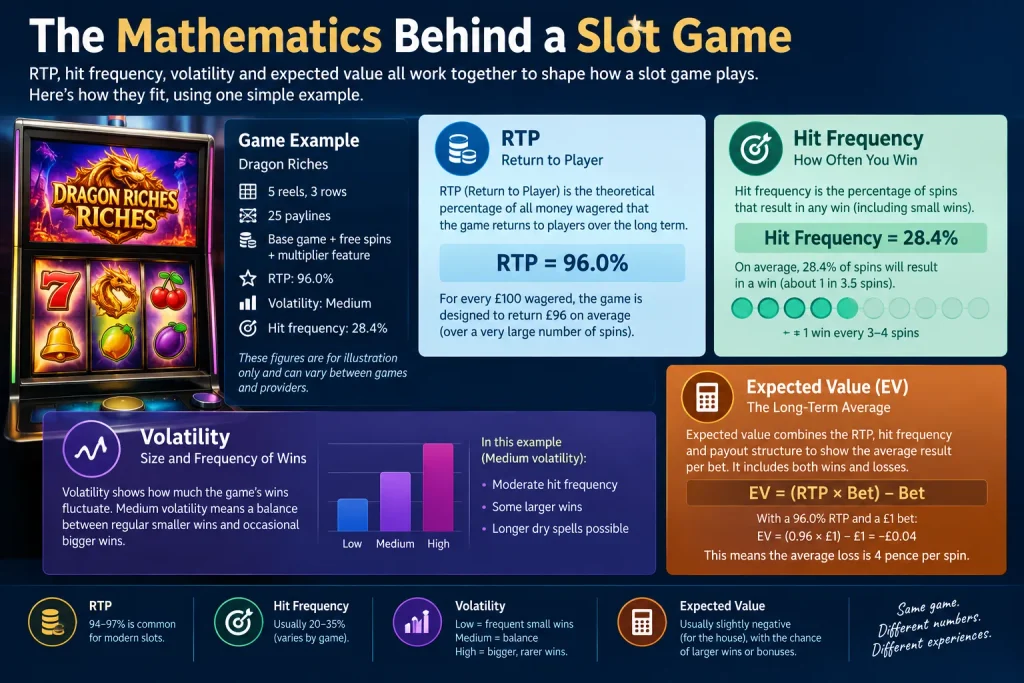
My question is: does the proposed game behave as intended?
This is where slot game mathematics becomes practical. I calculate theoretical RTP (return to player), examine slot game volatility, and model win frequency and value. RTP is a long-run expected percentage of wagers returned by a game; it can be calculated analytically or through simulation. GLI explains that complex games may require simulation when exhaustive evaluation is impractical.
If a game has a 96% theoretical RTP, I treat that as a long-run expectation, not a promise for an individual session.
9:00 a.m.: I turn the concept into a model
By mid-morning, I may have a brief for a five-reel adventure game with wilds, free spins, and multipliers. I translate that creative idea into mathematics.
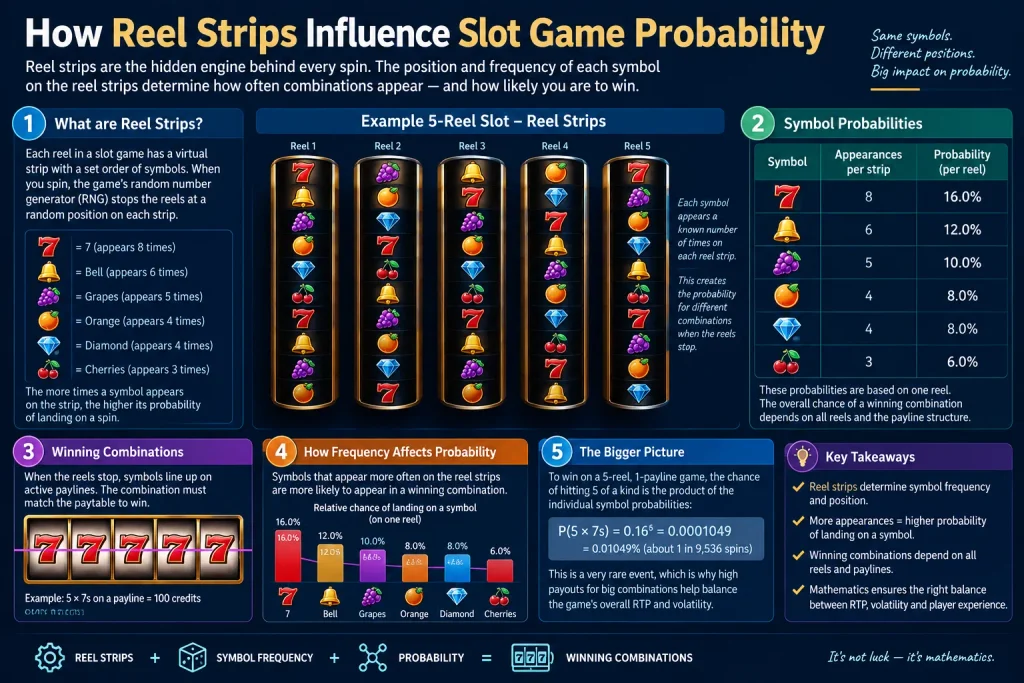
I determine symbol frequencies and how symbols interact with paylines, ways-to-win systems, and other mechanics. With traditional reel models, I may work with reel strips containing repeated symbols. Their composition affects symbol probabilities, while the paytable determines the value of winning combinations.
This is why slot game probability involves more than asking how often one symbol appears. I consider combinations, feature states, and conditional outcomes. A bonus round can have its own probability tree, while free spins can contain several states that change expected return.
I also model the contribution of the base game, feature games, and jackpots. GLI specifically considers these components when analysing theoretical RTP.
11:00 a.m.: I run simulations
Once the model works on paper, I run simulations and study the distribution of outcomes. This is where an iGaming mathematician discovers behaviour hidden by an average.
Two games can have similar RTP but very different win distributions. One may produce frequent small wins; another may produce fewer wins with more return coming from rare bonuses. I therefore analyse slot game volatility, hit frequency, maximum-win frequency and feature frequency.
When simulation results differ unexpectedly from theory, I investigate the cause. It may be a coding issue, incorrect parameter, modelling assumption or sampling variation. I do not change the model simply to make a simulation look convenient.
1:00 p.m.: I work with designers and programmers
After lunch, the job becomes collaborative. A designer may alter a bonus feature, while a programmer needs precise mathematical rules.
The random number generator (RNG) provides random inputs, and game logic maps those inputs to outcomes. The UK Gambling Commission defines mapping as selecting an outcome from an RNG result, such as mapping a random number to a reel-strip symbol.
I check that the mathematical model, programmed logic, and player-facing rules agree. A small interpretation difference in code can alter probabilities or payouts, so important changes trigger further testing.
2:30 p.m.: I test mathematics and edge cases
I test more than average payouts. I look at unusual combinations, repeated bonus triggers, maximum-win scenarios, and feature transitions.
For applicable regulated markets, technical standards can require evidence that random outcomes are appropriately random and that games operate according to their rules. UK remote-gambling standards, for example, require acceptable randomness and prohibit adaptive behaviour that changes outcome probabilities during play.
Independent testing can form part of release. The Gambling Commission testing strategy identifies third-party statistical analysis of RNGs and outcomes as a pre-release control for applicable products, while GLI describes independent analysis of theoretical RTP and volatility.
4:00 p.m.: I check what the player is told
A mathematically sound game still needs accurate communication. I check the paytable, help screens, feature descriptions, and displayed prizes.
The UK Gambling Commission’s RTS 3 says applicable game information must be easily available before gambling and accurate enough to explain rules and participation, alongside relevant information about payouts and likelihood of winning.
I also separate mathematics from marketing. A dramatic animation or near miss does not change the probability model. The published description has to match the actual game.
5:00 p.m.: I document the final model
I finish by recording model versions, assumptions, test results, and changes. The final product is a chain: mathematical specification, code, configuration, artwork, rules, and testing all need to match.
The Isle of Man Gambling Supervision Commission licenses and regulates online gambling activities on the island. An Isle of Man-based developer works within a regulated gambling environment, while games released elsewhere may also need to meet jurisdictional requirements.
My eight-stage slot game development workflow
I see the slot game development process as concept → mathematical specification → simulation → programming → quality assurance → compliance/testing → release configuration → monitoring.
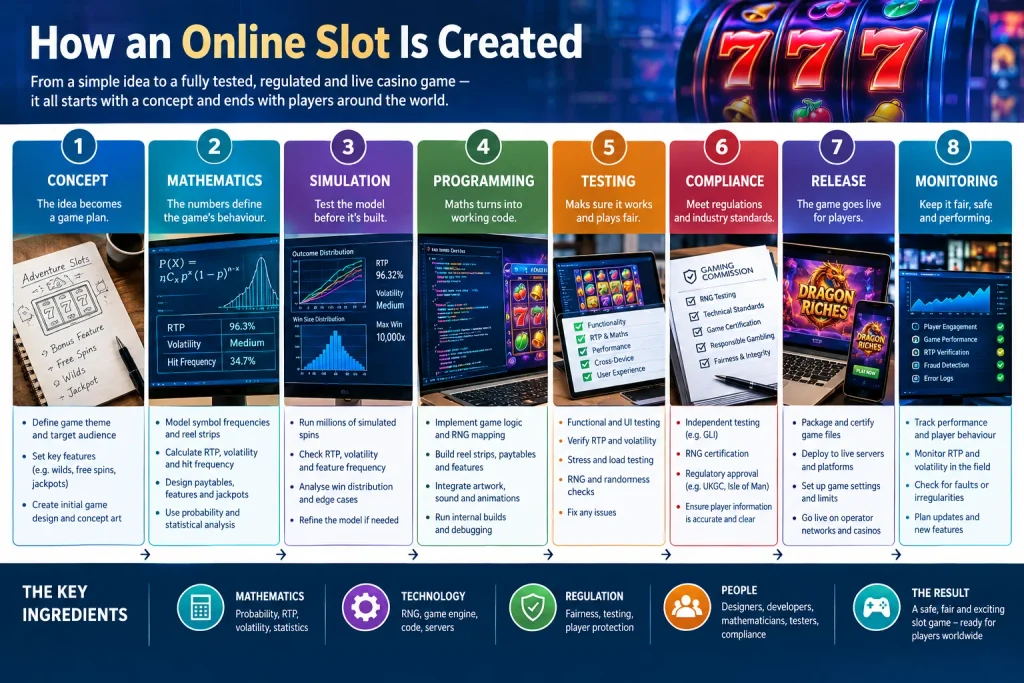
My role sits between creative intent and probability. Designers build the experience, artists create its visual identity, programmers build the software, testers challenge it, and I make sure the mathematics underneath remains coherent.
Conclusion
By the end of the day, I have rarely “finished” a slot game; I have moved its mathematics closer to something that can be built, tested, and released responsibly.
As a slot game mathematician, I translate creative ideas into measurable probabilities, payouts, RTP, and volatility, then challenge my assumptions with simulations and data. I work alongside designers, artists, programmers, testers, and compliance specialists because mathematics is only one part of the product. From Leipzig to the Isle of Man, my work is making the numbers internally consistent, reproducible, and understandable.
That is what my day looks like every day.
Frequently Asked Questions
What is a slot game mathematician?
I describe a slot game mathematician as the specialist who designs and validates the mathematical model underlying a slot. I work with probability, payout structures, RTP, volatility, feature mathematics, and simulations.
What does a slot mathematician do?
I convert game concepts into mathematical specifications, model symbol frequencies and feature outcomes, calculate theoretical returns, run simulations, and work with programmers and testers.
What maths is used to design slot games?
I use probability, combinatorics, statistical analysis, expected value, distributions, and simulation. The exact mathematics depends on the game mechanics.
How is slot RTP calculated?
I calculate expected return by considering the probability and payout of possible outcomes. For complex games, I may use simulation as well as analytical mathematics. GLI notes that RTP can be calculated theoretically or through simulation, depending on the game.
How is slot volatility calculated?
I analyse the distribution of outcomes rather than looking only at the average return. I examine win frequencies, win sizes, and the contribution of rare events to the overall result. Volatility is therefore best understood as a distribution characteristic rather than a single universal formula.
Can a slot game mathematician predict the next spin?
No. My model describes probabilities and long-run expectations; it does not tell me which specific outcome will occur next. Properly implemented random outcomes are intended to be unpredictable.
Does mathematics determine whether a slot pays?
Mathematics determines the designed probabilities and expected payout structure, while software implements those rules. Testing is then used to check that the implementation corresponds with the approved mathematical model.
Do slot game mathematicians work for casinos?
I work in a slot game development team. This can be for a development studio, software supplier, operator, testing organisation, or consultancy. My (fictional) role at Universal Games represents the supplier side of the industry.
What is an iGaming mathematician?
An “iGaming mathematician” is a broad job title for a mathematical specialist working on online gambling products. A slot specialist is one type of iGaming mathematician.
Can mathematics make a slot game predictable?
The mathematical model specifies probabilities, not individual future outcomes. An acceptable RNG is expected to be statistically appropriate and unpredictable, according to applicable technical standards.
Reference List:
Gambling Commission. (2021). Remote gambling and software technical standards.
Gambling Commission. (2024). Regulatory returns guidance: RTS 7 – Generation of random outcomes.
Gambling Commission. (2021). Testing strategy for compliance with remote gambling and software technical standards.
Gambling Supervision Commission. (n.d.). Isle of Man Gambling Supervision Commission.
Gaming Laboratories International. (n.d.). Casino & gaming RTP analysis: Return to player percentage.


Sign Up for Our Newsletters
Be the first to know when new content is created.Related Posts

The Cincinnati Kid Review – Steve McQueen’s Cool Poker Drama
The Cincinnati Kid remains one of the most compelling poker films ever made, blending tension, charisma, and Depression‑era grit. Steve McQueen’s performance anchors a story of ambition, skill, and psychological warfare at the card table. This review explores the film’s artistry, cultural influence, and its place in gambling cinema.

Andy Bloch Net Worth: MIT Blackjack Team and Poker Career
Andy Bloch is an American professional poker player, former MIT Blackjack Team member, engineer and Harvard Law School graduate whose career combines mathematics, casino gambling and poker. While his documented tournament earnings exceed $5.3 million, Andy Bloch net worth cannot be established from authoritative public records.

What Does a Responsible Gambling Manager Do?
Core Responsibilities 1. Regulatory Compliance 2. Developing and Implementing Responsible Gambling Policies 3. Player Monitoring and Intervention 4.…

Legendary Figures Who Made Millions Gambling
From high‑stakes gamblers to casino magnates, legendary figures who made millions gambling shaped gaming history with daring bets, sharp strategy, and bold entrepreneurship. Their stories reveal risk, luck, and innovation, tales of fortunes won and lost that illuminate how casinos, games, and personalities transformed gambling into a global industry and culture.
