


Dark
Light
If you have ever dreamed of winning a massive cash prize in the national lottery, then let me introduce you to the Renato Gianella Lottery System. Renato says he can predict your lottery numbers, and he does it all with colours! Renato Gianella is a Brazilian mathematician who claims that it is possible to predict the lottery results using complicated mathematics and probability theory. Sounds a bit mad, right? Well, it is actually!
Wherever there is a game of chance involving numbers, there is a mathematician who claims to have invented a winning lottery system that can beat it. In my experience, their claims are pretty much always false, but hey, you never really know, right!
In Pursuit of the Ultimate Winning Lottery System
Several years ago, my father, who was something of a mathematician himself (betting on horses), began carefully studying National Lottery results. He claimed that if you grouped lottery number sequences rather than choosing them individually, certain patterns emerged that could help you predict which numbers were more likely to be drawn.
OK, I know what you are thinking: that doesn’t sound like much of a winning lottery system! To be honest, I thought the same. However, the more I looked at it, the more my dear old Dad’s theory began to make sense.
National Lottery Numbers
Basically, it worked like this. In those days, the National Lottery only had 49 numbers. My father placed the 49 available numbers into four distinct groups…
- 1-9 (the single-digit numbers)
- 10-25
- 26-40
- 41-49
After methodically writing down every winning combination from every lottery draw for a whole year, he claimed that the most frequent winning 6-number combination followed a pattern of 1-2-2-1.
That translates to one number from the first group, two from the second, two from the third, and one number from the last group. Thus, my father claimed his winning lottery system was complete. How mad is that?
Not that mad at all, actually! When I checked his data, this pattern did indeed occur far more frequently than any other number pattern. Of course, this is much more of a statistical occurrence than an actual ‘system’. You would still need to choose the correct lottery numbers from each group to win the lottery. Nevertheless, it did keep his mind active in his later years.
Fast forward to 2014 (yes, it’s not a new thing!) and a mathematician from Brazil, Renato Gianella, writes a paper for the Biometric Brazilian Journal entitled…
The Law of Large Numbers
In this paper, Renato states that he believes it is possible to predict which lottery numbers are more likely to appear by using number patterns based upon the Law of Large Numbers.
The law of large numbers is a principle of probability according to which the frequencies of events with the same likelihood of occurrence even out, given enough trials or instances. As the number of experiments increases, the ratio of outcomes will converge on the theoretical or expected outcome ratio.
Renato Gianella goes on to claim that all the world’s lotteries have a distinct pattern that can be worked out by assigning colours to groups of lottery numbers (as my father observed 20 years previously). He named his system LotoRainbow.
An example of the LotoRainbow website created by Renato Gianella is shown below and is well worth checking out if you are a fan of such a winning lottery system or a mathematics student.
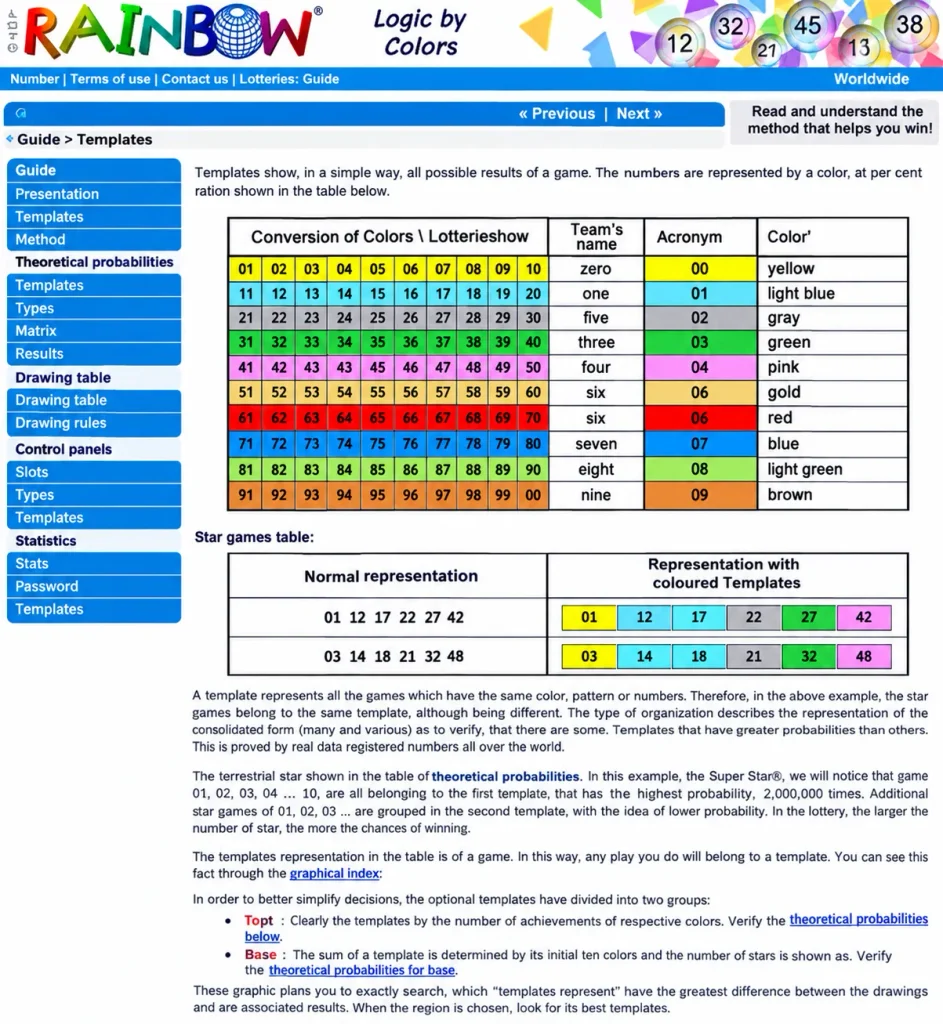
Being Brazilian, Renato Gianella based his equations on the Brazilian National Lottery. However, by extrapolating the lottery numbers, it’s possible to expand his theory to include European lotteries.
Essentially, Renato Gianella assigned colours to groups of numbers for clarity. It’s the grouping that is important here.
The Renato Gianella Lottery System – is it just a lot of nonsense?
Well, yes and no. Mathematicians like to prove that numbers have meaning, and in most cases they do. Unlike Renato Gianella, I am not a mathematician, but I do know that random sets of numbers form a pattern over time.
Of course, where this theory falls down is that it is not a guide to predicting the exact numbers in any given lottery. It can, however, be used as a guide when choosing which numbers you want to play. So, for example, if you have noticed that more often than not the numbers drawn in the lottery form a definite pattern, then it makes sense to choose numbers that fit that pattern.
Essentially, what he came up with is the Renato Gianella lottery system. As a rule, I am sceptical about winning lottery systems. That said, it is an interesting mathematical puzzle that, while unlikely to ensure long-term success in the lottery, could certainly make choosing the numbers far more entertaining and logical.
What do you think of Renato Gianella’s lottery system? Is it just a load of colourful nonsense, or is there something about that rainbow pattern that makes sense to you? Leave a comment below or try it out when you play Euromillions.
[The contents of this site, including blog articles and static pages, are designed to be fun and informative. Nothing in this blog is intended to show that taking part in any lottery (or trusting a ‘winning lottery system’) will significantly change your life, nor should this be inferred.]
Frequently Asked Questions
Who is Renato Gianella?
Renato Gianella is a Brazilian mathematician associated with research into lottery combinations, probability, and statistical patterns. His work includes the LotoRainbow approach and research presented under the title The Geometry of Chance: Lotto Numbers Follow a Predicted Pattern.
What is the Renato Gianella Lottery System?
The Renato Gianella Lottery System is a mathematical approach to analysing lottery combinations by organising possible outcomes into structured patterns or templates. The system uses statistical and probability concepts rather than simply selecting individual numbers based on their previous frequency.
What is LotoRainbow?
LotoRainbow is the name associated with Gianella’s colour-based lottery analysis approach. Numbers are organised into colour-coded groups, allowing combinations to be represented visually as different templates or patterns. Contemporary descriptions of the method explain that it uses historical lottery results and mathematical probability to analyse these structures.
How does the Renato Gianella Lottery System work?
The system organises lottery combinations into templates based on their numerical characteristics. Gianella’s research argues that when large numbers of lottery combinations are examined collectively, different structural patterns can occur at different frequencies. The approach therefore focuses on the probability of patterns or groups of combinations, rather than claiming that a particular individual number can simply be identified as the next winner.
What is the Law of Large Numbers in Gianella’s system?
The Law of Large Numbers is a fundamental concept in probability theory stating, broadly, that as the number of observations increases, observed averages tend to approach expected values. Gianella incorporates this concept into his analysis of large collections of lottery results and their recurring structural patterns.
What are lottery templates?
In the Gianella methodology, a template is a way of grouping combinations that share particular characteristics or patterns. The objective is to make a large sample space of possible lottery outcomes easier to analyse statistically.
Did Renato Gianella patent his lottery system?
Yes. U.S. Patent 7,565,263 B2 was granted to Renato Gianella in 2009 for a System of relevant statistics for games of prediction using templates and presented in the form of tables. The patent describes statistical templates and computer-generated tables for analysing prediction games.
Did Gianella prove that lottery numbers can be predicted?
Gianella’s research argued that lottery combinations could be analysed according to recurring structural patterns and that some groups could have different theoretical probabilities. However, this should not be interpreted as proof that a particular future winning combination can be predicted with certainty. Contemporary coverage describes the research as identifying potentially higher-probability groups rather than guaranteeing specific winning numbers.
Can the Renato Gianella Lottery System guarantee a jackpot?
No mathematical lottery system should be presented as guaranteeing a jackpot. Gianella’s method is an analytical framework for examining combinations and patterns; it does not eliminate the fundamental uncertainty associated with lottery draws.
Is the Renato Gianella Lottery System the same as choosing hot and cold numbers?
No. Hot-and-cold number strategies generally focus on how frequently individual numbers have appeared in previous draws. Gianella’s approach instead places greater emphasis on patterns, templates, and the statistical structure of combinations.
Is the Renato Gianella Lottery System still relevant?
It remains interesting from a historical and mathematical perspective because it represents an unusual attempt to apply combinatorial analysis and statistical templates to lottery data. His patent and published research provide documented evidence of the methodology.
What is the Geometry of Chance?
The Geometry of Chance: Lotto Numbers Follow a Predicted Pattern is a work attributed to Renato Gianella that examines lottery combinations using concepts including combinatorics, probability, patterns, and the Law of Large Numbers.
Is the Gianella system scientifically proven to beat the lottery?
It is better to describe the system as a mathematical/statistical lottery analysis methodology rather than a proven way of beating a genuinely random lottery. The existence of Gianella’s research and patent is independently documented, but those facts do not establish that the method can reliably overcome the odds of a properly conducted random lottery draw

Sign Up for Our Newsletters
Get notified of the best deals on our WordPress themes.Related Posts

Jose Antonio Gonzalez AKA ‘JAG’ – Former Owner of Mimosa Regency Casino, Philippines
Jose Antonio “JAG” Gonzalez was a pivotal figure in Philippine tourism and gaming development. As Tourism Secretary under President Corazon Aquino and later the visionary behind the Mimosa Leisure Estate and Mimosa Regency Casino, he helped shape Clark’s transformation into a premier leisure destination.

Hermes: Messenger of the Gods — Life, Myths, and His Connection to Luck & Chance
Hermes, the quick‑witted messenger of the gods, has long been associated with luck, cunning, and the unpredictable nature of chance. This article explores why Hermes became known as the Greek god of gamblers, his myths, symbols, and enduring influence on games of risk

Origins and Creation of Cassius Coolidge’s Dogs Playing Poker
Cassius Marcellus Coolidge’s Dogs Playing Poker is one of the most recognisable and parodied images in American art. Painted in the early 20th century, it transformed a humorous concept into a cultural icon. This essay explores its creation, history, artistic legacy, and enduring appeal among poker enthusiasts and pop culture.

The Archie Karas Story: How He Turned $50 into $40 Million
Archie Karas is a gambling legend whose story defies belief. Known for “The Run,” he turned $50 into $40 million in Las Vegas, defeating poker icons and casinos alike. His rise and fall remain unmatched in gambling history—a tale of brilliance, risk, obsession, and the ultimate price of chasing luck.