


Dark
Light
For many people, in 2026, when money is involved, almost anything goes. And, when it comes to big money, it doesn’t get much bigger than the national lottery. It goes without saying, therefore, that over time some people have been tempted to try to gain an advantage. One man who did just that was the French Enlightenment writer, historian, and philosopher, François-Marie Arouet, better known as Voltaire. This is the story of how Voltaire pulled off the Most Audacious Lottery Scam in History.
18th Century France And A Financial Crisis Is Brewing
The Voltaire national lottery scam began in 18th-century France: the country was going through a financial crisis brought about by the banking system (now, where have I heard that before?) This, in turn, triggered a period of austerity (that sounds familiar too). It also started a craze that gave ordinary people an opportunity to strike it rich by taking part in the national lottery.
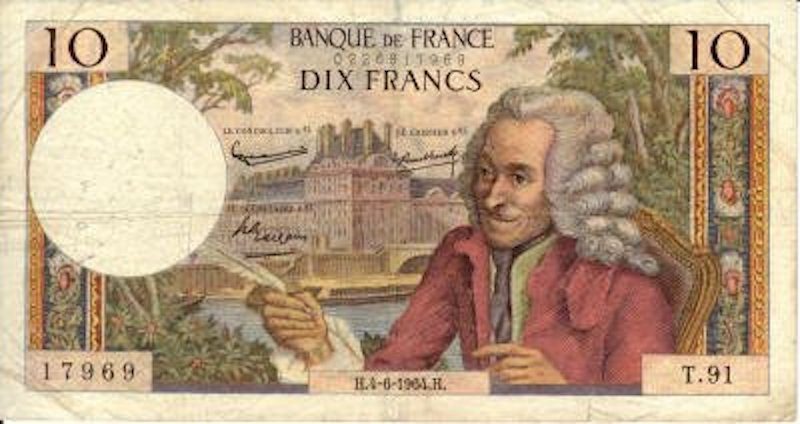
Due in part to the crisis France found itself in, the Government of the time sought to ease its financial burden by releasing a series of bonds to raise money. However, as a result of the economic turmoil, they were eventually forced to cut the interest rates on the bonds, leaving them worth much less than face value. This, in turn, made it difficult to sell new bond issues.
How not to Solve a Financial Crisis
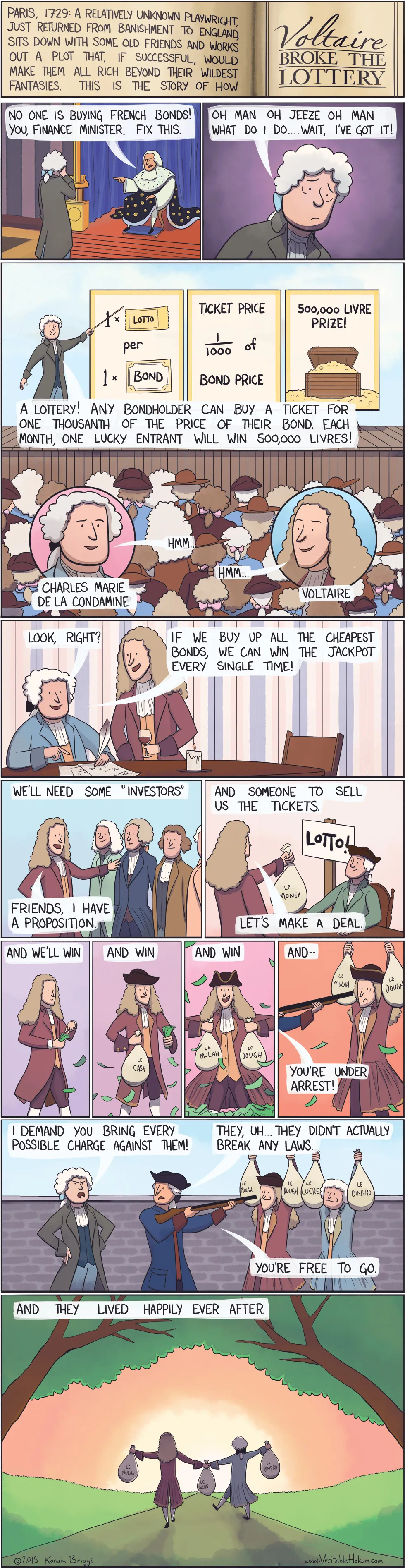
The Deputy Finance Minister of the day, a chap named Le Pelletier-Desforts, came up with an idea of how the government might raise the value of these bonds. A lottery!
Quite simply, it worked like this. If existing bond owners were allowed to purchase a lottery ticket worth 1/1000th of the value of the bond, the eventual winner would get the full face value of that bond (more than they could hope to get on the open market) plus a bonus of 500,000 Livres (the French currency at that time). The original bonds, of course, were issued at different price points. It was, therefore, possible to purchase bonds for 1,000 Livres and some for as much as 100,000 Livres.
Unfortunately for the French government (and ultimately Monsieur Le Pelletier-Desforts), there was one fatal flaw in their otherwise cunning plan…
The Voltaire National Lottery Scam
Thanks to a chance meeting over dinner, Voltaire and another wealthy gentleman, Charles Marie de la Condamine, reasoned that the lottery could be exploited. During this meeting, they set in motion an idea that would eventually lead to the most audacious lottery scam in history.
They figured that, for the Voltaire national lottery scam to succeed, they would buy all the tickets with bonds with a face value of 1000 Livres (1 Livre per ticket). This would give them a tremendous advantage over other bondholders. The reason is that far fewer high-value bonds were issued.
They also knew that they could not do this alone. At this time, government-issued bonds were available for purchase only from a select few agents. To get around this, they set about recruiting others to join France’s first-ever lottery syndicate.
With Voltaire’s help, de la Condamine and others in the French lottery syndicate reaped enormous sums of money month after month. Voltaire himself made a little over 500,000 Livres in the space of a year thanks to his incredible lottery scam.
It Only Takes One Mistake to Bring Down a Lottery Syndicate
Sadly, as with every other great lottery scam, one tiny mistake can bring the entire system down. Voltaire had one glaring weakness, you see: the French government.
All his adult life had been spent criticizing the French authorities. This led to imprisonment in the Bastille for nearly a year (during which time he wrote his first play, ‘Oedipus’), and to a period of exile from Paris.
When purchasing French lottery tickets, it was customary to write something on the back of the ticket. Usually, this was a good-luck slogan or a dedication to family or friends. Voltaire, however, used this opportunity to write anti-government rhetoric, and occasionally he would praise de la Condamine for his wisdom.
Because of his hubris, the authorities eventually became aware of the Voltaire lottery rig and discovered the names of those involved. Voltaire and de la Condamine were arrested and taken to court.
However, the court found that their lottery syndicate scam was not a scam at all. Neither man had actually broken any laws. It was really the structure of the lottery itself that was at fault. So eventually both men were released and entitled to keep the money earned from their lottery scam. The French lottery itself, though, was ended, ignominiously.
How Voltaire Won The Lottery
As for Monsieur Le Pelletier-Desforts? Indirectly, he was responsible for the biggest lottery scam in history. He also helped to fund one of the greatest mathematicians of the time, de la Condamine, and one of the greatest ever philosophers, Voltaire. In that sense, at least the lottery was a success.
Not All Lottery Syndicates Are Scams!
Was Voltaire a lottery scammer or did he take advantage of the odds? You decide. The truth is, he saw an opportunity, and he took it. You could too if you take part in an online lottery syndicate at Lotto Social.
By joining a fully managed online lottery syndicate at Lotto Social, you could improve your odds of winning a major jackpot by over 6000 times!
Join thousands of happy and successful lottery syndicate members at Lotto Social and get 10 Euromillions lines PLUS 5 FREE scratchcards for only £1.
Frequently Asked Questions
Who was Voltaire?
Voltaire was the pen name of François‑Marie Arouet (1694–1778), a French writer, philosopher, dramatist, historian, and one of the most influential figures of the Enlightenment. His work spanned tragedy, poetry, satire, philosophy, and historical analysis, making him one of the most prolific authors of the 18th century.
What are Voltaire’s most famous works?
Voltaire wrote across genres, but his best‑known works include:
- Candide (1759) – a satirical novella attacking philosophical optimism.
- Zadig (1747) – a philosophical tale exploring fate and morality.
- Micromégas (1752) – an early science‑fiction satire.
- La Henriade (1728) – an epic poem celebrating King Henri IV.
- Numerous tragedies such as Oedipe and Alzire, and historical works like The Age of Louis XIV. These works helped cement his reputation as a leading Enlightenment thinker.
What was Voltaire’s philosophy?
Voltaire championed reason, tolerance, freedom of thought, and opposition to tyranny. He was a fierce critic of religious dogma and institutional oppression, advocating instead for civil liberties and rational inquiry. His time in England (1726–1728) deepened his philosophical interests, exposing him to Newtonian science and British constitutionalism, which shaped his later writings.
Why was Voltaire imprisoned and exiled?
Voltaire was twice imprisoned in the Bastille for satirical remarks that offended powerful figures. In 1726, after a dispute with an aristocrat, he was briefly jailed and subsequently exiled to England, where he spent several formative years studying philosophy, politics, and science. His outspoken criticism of religious and political institutions frequently put him at odds with authorities throughout his life.
What was Voltaire’s role in the Enlightenment?
Voltaire is considered one of the central figures of the Enlightenment. His writings promoted intellectual freedom, scientific progress, and social reform, influencing European thought and political development. His legacy is so significant that the phrase “the age of Voltaire” is often used synonymously with the Enlightenment itself, reflecting his impact on modern ideas about liberty, tolerance, and rationality.
Did Voltaire win the lottery?
Yes. Voltaire won the lottery, in fact, voltaire won multiple lottery draws in the 1730s after exploiting a mathematical flaw in a French government bond‑lottery system. His repeated wins helped him accumulate a large personal fortune, which later funded his writing career and social status.
Did Voltaire cheat the lottery?
Voltaire did not “cheat” in the legal sense, but he strategically exploited a poorly designed lottery system. Working with mathematician Charles Marie de La Condamine, he purchased large quantities of low‑value bonds, which allowed him to buy lottery tickets extremely cheaply while retaining the same odds of winning as high‑value bondholders. Authorities investigated the scheme, but the royal council ultimately ruled that no laws had been broken, the French lottery was simply flawed.
The Works of Voltaire
François-Marie Arouet (21 November 1694 – 30 May 1778), or Voltaire, was a French Enlightenment writer, historian, and philosopher. He was famous for his wit, his attacks on the established Catholic Church, and his advocacy of freedom of religion, freedom of expression, and separation of church and state.
If you would like to learn more about Voltaire, his life, and works, including his most famous novel ‘Candide’, browse a selection of Voltaire’s books at Bookshop.org.

Sign Up for Our Newsletters
Get notified of the best deals on our WordPress themes.Related Posts

Charles De Ville Wells: The Man Who Broke the Bank at Monte Carlo
Charles De Ville Wells was a Victorian-era gambler, con artist, and media sensation whose legendary roulette win at Monte Carlo earned him global fame. Known as “The Man Who Broke the Bank,” Wells lived a life of daring schemes, public spectacle, and eventual disgrace. His story blends luck, fraud, and myth.

Macuilxochitl Aztec God of Gambling
Macuilxochitl, the Aztec God of Gambling, pleasure, music, dance, and games, remains one of the most fascinating deities in Aztec mythology. Revered as a patron of fun, fortune, and artistic expression, Macuilxochitl played a central role in ritual games, celebrations, and the cultural symbolism of luck in ancient Mesoamerica.

Top 10 Movie Stars Who Gamble In Real Life
Movie Stars Who Gamble have always fascinated fans, blending Hollywood glamour with high‑stakes casino excitement. While many celebrities enjoy poker, several famous actors prefer classic casino games like blackjack, roulette, baccarat, and slots. This guide explores ten movie stars who gamble in real life, their favourite games, and their biggest wins and losses.

Ne Zha Chinese God of Gambling
Nezha (Li‑Nezha) is widely recognised in modern casino culture as the Chinese God of Gambling, a fiery, rebellious deity associated with luck, risk and miraculous turnarounds. Although not traditionally a gambling god, Nezha’s mythic feats and fearless nature have made him a powerful symbol of fortune in contemporary gaming.